Boxed Warning Checker
Check current boxed warning status for prescription drugs and see historical updates
How to use: Enter a drug name or active ingredient to see its current boxed warning status and historical changes.
Search results are based on FDA's SrLC database (post-2016) and MedWatch archives (pre-2016).
When a drug gets a boxed warning, it’s not just a footnote-it’s a red flag. The FDA puts these bold, black-bordered alerts at the very top of prescription drug labels to scream: this could kill you. Since 1979, this system has been the agency’s strongest tool to warn doctors and patients about life-threatening risks. But here’s the thing: these warnings don’t stay the same. They change. They get updated. Sometimes they’re added, sometimes removed, and often they’re quietly revised without most people noticing. Tracking those changes isn’t optional-it’s essential for safety.
What Exactly Is a Boxed Warning?
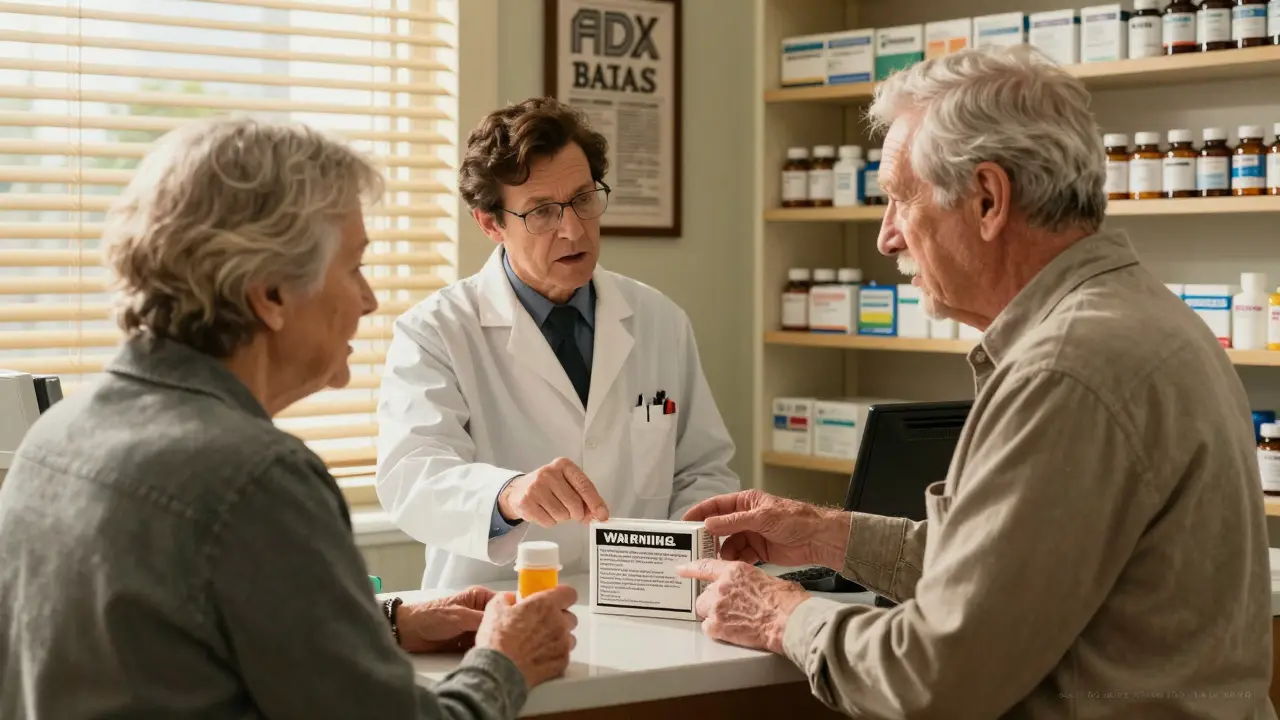
A boxed warning, also called a black box warning, is the FDA’s highest level of safety alert for prescription drugs. It’s not just a caution-it’s a mandatory, legally enforced statement that must appear in a specific format: bold uppercase header, black border, bullet points, and placed right at the start of the prescribing information, before even contraindications or general warnings.
It’s not used lightly. These warnings are reserved for risks that can cause serious injury or death-like sudden heart failure, suicidal behavior, liver damage, or life-threatening infections. Think of drugs like fluoroquinolone antibiotics (linked to tendon rupture), Chantix (associated with suicidal thoughts), or Avandia (connected to heart attacks). Each one carries a boxed warning because the data showed real, documented harm in real patients-not just theoretical risk.
According to FDA data, about 40% of all prescription drugs on the U.S. market today have at least one boxed warning. That number jumps to 87% for antipsychotics and 78% for anticoagulants. These aren’t rare outliers-they’re common in high-risk therapeutic areas.
How Boxed Warnings Are Created and Changed
Most boxed warnings don’t appear during clinical trials. They show up after the drug is on the market. That’s because some dangers only become clear when thousands-or millions-of people start using the drug over months or years. The FDA’s Drug Safety-related Labeling Changes (SrLC) database, launched in January 2016, tracks every single update to drug labels since then.
Between 2008 and 2015, the FDA issued 111 boxed warnings. Of those:
- 29% were brand-new warnings
- 32% were major updates to existing ones
- 40% were minor tweaks-like clarifying language or adding a new patient group
The most common triggers? Death (51%) and cardiovascular risks (27%). But drug addiction came up more than any single specific condition across all warnings. That’s why opioids, stimulants, and even some antidepressants carry these alerts.
Here’s the kicker: it takes an average of 11 years from when a drug is approved until the FDA adds a boxed warning. That’s up from 7 years in the 1990s. For some drugs, like the diabetes medication Avandia, it took over a decade before the heart risk was officially labeled. By then, millions had already been prescribed it.
Why Tracking Changes Matters
Imagine you’re a doctor prescribing a drug your patient has been on for five years. You don’t think to recheck the label-until suddenly, the warning changes. Maybe a new risk of liver damage was added. Maybe the warning was removed entirely, like with Chantix in 2016 after further review showed the psychiatric risk wasn’t as widespread as first thought.
A 2017 FDA survey found that 87% of prescribers check for boxed warnings when starting a new drug. But 63% admit they rarely check for updates to existing ones. That’s dangerous. A 2021 study showed that when boxed warnings were paired with Medication Guides (patient handouts), patient understanding of risks jumped from 42% to 78%. But only 35% of pharmacies consistently give those guides out.
And it’s not just doctors. Pharmacists, nurses, and even patients need to know when these labels change. One Reddit thread from 2023 described how a family clinic saw prescriptions for Chantix drop by 40% after the psychiatric warning was added-and then rebound after it was removed. That’s real behavior change driven by a label update.

How to Track Boxed Warning Updates Yourself
The FDA’s SrLC database is the official source for all labeling changes since January 2016. But it’s not user-friendly. Searching requires knowing the drug’s active ingredient, not just the brand name. You need to filter by section (BOXED WARNING), date range, and sometimes even the specific wording of the change.
A 2019 study from the University of Florida found it takes pharmacists 3 to 5 hours to become proficient with the system. That’s not practical for most busy clinics. So what do they do?
- Hospitals often assign 10-12 pharmacist-hours per month just to monitor labeling changes.
- 78% of hospital pharmacies use automated alert systems-but 41% say they get too many false alarms.
- Many still have to cross-check three sources: SrLC (post-2016), MedWatch archives (pre-2016), and Drugs@FDA for approval history.
And even then, 22% of recent labeling changes lack enough clinical context to know how to act on them. For example, a warning might say “risk of psychiatric adverse events” without saying which symptoms to watch for or how often to monitor.
Real-World Impact: When Warnings Change, Lives Change
Take fluoroquinolones-antibiotics like Cipro and Levaquin. In 2008, the FDA added a boxed warning about tendon rupture. On Sermo, a physician forum, 68% of 1,247 responders said they changed how they prescribed these drugs after the warning. Internists, who treat older patients with chronic conditions, were most affected.
Then there’s aducanumab (Aduhelm), the Alzheimer’s drug approved in 2021. In March 2023, the FDA added a boxed warning for amyloid-related imaging abnormalities (ARIA)-brain swelling and bleeding. Even though the drug’s effectiveness was already controversial, this warning made doctors even more hesitant to prescribe it.
On the flip side, Chantix’s psychiatric warning was removed in 2016 after more data showed the risk was lower than initially feared. Prescriptions rose again. That’s the power of an accurate, updated warning: it doesn’t just scare people-it can restore access to a helpful drug.

What’s Next? The Future of Boxed Warnings
The FDA admits the system is outdated. In 2023, they announced a plan to modernize the boxed warning format by 2026. Pilot tests are already underway to test clearer visuals, better organization, and even color coding to help prescribers spot critical risks faster.
They’re also working with the Observational Health Data Sciences and Informatics (OHDSI) consortium-a global network of researchers using real-world patient data-to cut the time between identifying a risk and issuing a warning from 11 years to under 5. That’s ambitious, but necessary.
Still, critics argue the system is too blunt. Dr. Jerry Avorn of Harvard says we need a tiered warning system-something between a boxed warning and a routine caution. Not every risk deserves a black border. Some drugs carry theoretical risks that don’t outweigh their benefits. The Avandia warning, for example, still makes many endocrinologists hesitate-even though newer studies suggest the risk was overstated.
Meanwhile, the market for drug safety monitoring tools has exploded-from $1.2 billion in 2015 to $2.8 billion in 2023. Companies are building AI tools that scan FDA updates, alert clinicians in real time, and even integrate warnings into electronic health records. But adoption is uneven. Only 38% of community pharmacies have formal monitoring systems. That means patients are still getting prescriptions based on outdated labels.
What You Should Do Now
If you’re a patient: Ask your pharmacist or doctor if your medication’s warning has changed since you started taking it. Don’t assume it’s the same.
If you’re a provider: Set up a monthly reminder to check the FDA’s SrLC database. Use automated alerts if your system offers them-but don’t trust them blindly. Cross-check with official sources.
If you’re a caregiver: Keep a printed copy of your loved one’s current drug labels. When a new warning comes out, it’s often not in the mail. You have to find it.
Boxed warnings aren’t perfect. They’re slow, sometimes confusing, and often come too late. But they’re still the most powerful tool we have to stop preventable deaths. The only way they work is if we pay attention-and keep tracking every change.
What is a boxed warning on a drug label?
A boxed warning, also called a black box warning, is the strongest safety alert the U.S. Food and Drug Administration (FDA) requires on prescription drug labels. It appears as a black-bordered box at the top of the prescribing information and highlights life-threatening risks like death, serious injury, or organ failure. The warning must use bold uppercase headers and bullet points to ensure it’s immediately noticeable to prescribers.
How often does the FDA update boxed warnings?
The FDA updates boxed warnings regularly-on average, 15-20 major changes per year since 2016. Between 2008 and 2015, the agency issued 111 boxed warnings, with nearly half being updates to existing ones. Updates can include adding new risks, removing outdated ones, clarifying patient populations at risk, or adjusting monitoring requirements. The FDA’s SrLC database tracks all changes since January 2016.
Can a boxed warning be removed from a drug label?
Yes, boxed warnings can be removed if new evidence shows the risk is less severe or less common than originally thought. For example, the boxed warning for Chantix (varenicline) regarding suicidal behavior was removed in 2016 after further studies found the risk was not as widespread as initial data suggested. Removal requires a formal FDA review and approval process.
Where can I find official updates to boxed warnings?
The official source for all boxed warning updates since January 2016 is the FDA’s Drug Safety-related Labeling Changes (SrLC) database. For changes before 2016, you’ll need to check MedWatch archives. Drug approval history and labeling details are also available on Drugs@FDA. Many healthcare institutions use automated alert systems, but it’s best to verify updates directly with FDA sources.
Why do some boxed warnings take so long to appear?
Most boxed warnings are added after a drug is on the market because serious side effects often only show up when used by large, diverse populations over time. Clinical trials involve thousands of patients, but real-world use can involve millions. It takes years to collect enough data to confirm a risk. The median time from drug approval to a boxed warning is now 11 years, up from 7 years in the 1990s.
Do boxed warnings affect how doctors prescribe medications?
Yes, significantly. A 2022 survey on Sermo found that 68% of physicians changed their prescribing habits after a fluoroquinolone tendon rupture warning was added. Similarly, when Chantix’s psychiatric warning was issued, prescriptions dropped by about 40% in some clinics. However, some doctors feel certain warnings are overly cautious and may prevent patients from accessing beneficial treatments, especially for chronic conditions with few alternatives.
Are boxed warnings used outside the U.S.?
Other countries use similar systems, but not identical. The European Medicines Agency uses a “black triangle” symbol to mark newly approved drugs under additional monitoring, but it doesn’t have a formal boxed warning equivalent. Canada, Australia, and Japan have their own risk communication tools, but the U.S. boxed warning remains the most visually prominent and legally enforceable format.


Beth Cooper
February 1, 2026 AT 08:06So let me get this straight - the FDA takes 11 years to warn us a drug might kill us, but they’ll slap a black box on anything that even smells like a lawsuit? I’ve seen warnings added because someone in a clinical trial sneezed too hard. This isn’t safety - it’s liability theater. And don’t get me started on how they removed Chantix’s warning only after the patent expired. Coincidence? I think not.
Blair Kelly
February 1, 2026 AT 22:32There is no such thing as a 'minor tweak' to a boxed warning. Every alteration - whether it's adding a comma or removing an entire clause - carries legal, clinical, and ethical weight. The FDA's language is not decorative; it is prescriptive. To call a revision 'minor' is to trivialize patient mortality. This article understates the gravity of label changes by an order of magnitude.
Rohit Kumar
February 3, 2026 AT 14:10In India, we don’t have boxed warnings. We have trust - or the lack of it. Doctors prescribe based on experience, not FDA bulletins. When a drug kills, it’s not because the warning was missing - it’s because the system failed before the label was written. Maybe the real issue isn’t the box, but the silence between when harm is seen and when it’s acknowledged.
Lily Steele
February 3, 2026 AT 21:24I just checked my mom’s blood thinner label last week - turns out the warning changed two years ago and no one told us. I’m so glad I asked. Seriously, if you’re on anything long-term, just ask your pharmacist: ‘Has this changed?’ It takes two minutes. Save yourself the panic later.
Jodi Olson
February 4, 2026 AT 21:45Boxed warnings are a symptom of a broken pharmacovigilance system. We rely on reactive surveillance rather than proactive modeling. The delay between market introduction and warning issuance reflects a fundamental failure to integrate real-world data into regulatory decision-making. We need continuous learning systems, not static documents.
calanha nevin
February 5, 2026 AT 11:10As a nurse who’s seen patients on Chantix for years, I can tell you - the removal of that warning didn’t just restore prescriptions. It restored hope. People were terrified to even say the drug’s name. When the label changed, they cried. Not because they were relieved to keep taking it - but because they realized they’d been scared for nothing. That’s the human cost of bad data.
Sidhanth SY
February 6, 2026 AT 17:22It’s funny how we treat drug warnings like scripture. But science doesn’t work that way. What’s true today might be false tomorrow. The fact that we still treat a 2008 tendon rupture warning as gospel for every fluoroquinolone - even when newer studies show only elderly diabetics are at risk - is a failure of critical thinking. Not the FDA’s. Ours.
April Allen
February 6, 2026 AT 21:29The FDA’s SrLC database is a data graveyard. The metadata is incomplete, the search algorithms are pre-2010, and the clinical context is often absent. Without standardized ontologies for adverse event codification - think SNOMED CT for labeling - we’re just shuffling paper in a digital world. This isn’t transparency. It’s performative bureaucracy.
Niamh Trihy
February 7, 2026 AT 04:02Back home in Ireland, we get the EMA’s black triangle for new drugs, but nothing like the FDA’s black box. We don’t need the drama - we need the data. If a warning is worth putting in bold, it should come with a clear risk-benefit ratio, not just a scare tactic. Patients aren’t children. We can handle nuance.
Yanaton Whittaker
February 9, 2026 AT 01:38THEY’RE LYING TO US. EVERY SINGLE TIME. They add warnings to scare people so they don’t sue. Remove them when the drug’s patent expires so Big Pharma can sell generics. This isn’t medicine - it’s a corporate profit filter. And you’re all just sitting here reading about it like it’s a documentary. WAKE UP.
Shubham Dixit
February 9, 2026 AT 20:07Let me tell you something about how this works in the real world - in the villages of Uttar Pradesh, where doctors don’t even have internet access, let alone a database. They prescribe based on what the rep told them last week, what the local chemist recommends, and what’s cheapest. The FDA’s black box? It’s a luxury. Safety isn’t about labels - it’s about infrastructure. And we don’t have any. So don’t lecture us about how we should track changes when we can’t even track our own supply chain.
KATHRYN JOHNSON
February 10, 2026 AT 08:27There is no justification for the absence of standardized patient-facing summaries. The FDA’s current format is designed for lawyers, not laypeople. The fact that only 35% of pharmacies distribute Medication Guides - and those are often printed in 6-point font - is a violation of basic patient rights. This is not negligence. It is malfeasance.
Gaurav Meena
February 11, 2026 AT 01:54Hey everyone - just wanted to say thank you for this thread. I’m a med student in Delhi and this opened my eyes. I used to think warnings were just red flags. Now I see they’re living documents. I’m starting a project to translate FDA updates into simple Hindi for rural clinics. If anyone wants to help, DM me. We can do this together.
Katie and Nathan Milburn
February 12, 2026 AT 20:47Interesting. I wonder if the delay in warnings correlates with how much money the drug makes. Just a thought.
Claire Wiltshire
February 13, 2026 AT 14:32For anyone trying to track updates: I use the FDA’s API with a custom script that alerts me when the BOXED WARNING section changes. It’s not perfect, but it cuts my monitoring time from 3 hours to 20 minutes. Happy to share the code if anyone’s interested.