
Cumulative Drug Toxicity Calculator
Calculate your cumulative drug exposure and compare it to known safety thresholds. This tool helps you understand how long-term medication use might be building up in your body.
Calculate Your Cumulative Exposure
mg
days/week
years
Most people assume that if a medication doesn’t hurt them right away, it’s safe to keep taking. But what if the harm isn’t immediate? What if it’s quietly building up inside you, dose after dose, year after year? That’s cumulative drug toxicity - a silent, slow-motion side effect that catches many off guard.
What Exactly Is Cumulative Drug Toxicity?
Cumulative drug toxicity happens when your body absorbs a drug faster than it can get rid of it. Over time, the drug builds up in your system - not in one big spike, but in tiny increments. Think of it like filling a bathtub with a slow leak. At first, nothing seems wrong. But after days or weeks, the water overflows. That’s what happens with certain medications. It’s not the same as an acute reaction - like an allergic rash after one pill. Cumulative toxicity creeps in. You might take the same dose for months, even years, feeling fine. Then, out of nowhere, you develop fatigue, numbness, liver damage, or lung scarring. By then, the damage is often done. Drugs with long half-lives are the biggest culprits. If a drug sticks around in your body for more than 24 hours, it’s more likely to pile up. Fat-soluble compounds like vitamin A, certain antibiotics, and heavy metals (lead, mercury) are especially prone to this. They don’t wash out easily. Instead, they hide in fat tissue or bone, slowly releasing back into your bloodstream.Who’s Most at Risk?
It’s not just older adults - though they’re the most affected. About 68% of adverse drug reactions in people over 65 are linked to cumulative toxicity, according to the Journal of the National Cancer Institute. Why? Because as we age, our kidneys and liver don’t filter drugs as well. That means even a normal dose can become toxic over time. People with chronic conditions are also at higher risk. If you’re on long-term medication for heart disease, arthritis, cancer, or mental health, you’re likely exposed to drugs that accumulate. Digoxin for heart failure, lithium for bipolar disorder, and amiodarone for irregular heartbeat are all known for this. One patient on Reddit shared how they developed lung scarring after taking amiodarone for five years - even though their blood levels were always "normal" at checkups. That’s because standard tests don’t measure total body burden, just blood concentration at a single point. Even kids and younger adults aren’t immune. A 2023 study found that teenagers on long-term antibiotics for acne showed early signs of liver stress after just 18 months. And with more people taking multiple prescriptions, the risk stacks up. The average American over 65 takes four prescription drugs a day. Multiply that by years of use, and you’ve got a chemical load no one ever warned you about.How Do You Know It’s Happening?
The problem with cumulative toxicity is that symptoms are vague - and they show up late. You might feel tired, dizzy, or notice your hands tingling. Maybe your skin turns yellow, or you start coughing without reason. These aren’t emergencies. So you brush them off as stress, aging, or "just getting older." But here’s what’s happening under the hood: your liver and kidneys are working overtime to clear the drugs. Eventually, they get overwhelmed. Drug levels rise past the safe threshold. Cells start dying. Organs get damaged. And because the damage is slow, it’s often irreversible by the time it’s diagnosed. Take anthracyclines - a common class of chemotherapy drugs. Doctors know that giving more than 450 mg/m² total over a patient’s lifetime can permanently damage the heart. That’s not a daily limit. It’s a lifetime cap. And yet, many patients never get told this. They just keep getting their infusions, assuming "if it worked before, it’s fine." The same goes for methotrexate, used for rheumatoid arthritis and psoriasis. One study found that when clinics started tracking total lifetime doses, adverse events dropped by 37%. Simple tracking made a huge difference.
What Medications Are Most Likely to Cause This?
Not all drugs do this. But here are the big ones:- Anthracyclines (like doxorubicin): Heart damage after cumulative doses over 450 mg/m²
- Amiodarone: Lung scarring, liver injury, thyroid problems - risk rises sharply after 600 grams total
- Digoxin: Nausea, confusion, irregular heartbeat - narrow safety window
- Lithium: Tremors, kidney damage, thyroid dysfunction - builds up if you’re dehydrated or on diuretics
- Aminoglycosides (like gentamicin): Hearing loss, kidney failure - especially risky in older adults
- Methotrexate: Liver fibrosis, bone marrow suppression - needs regular liver enzyme checks
- Vitamin A (high-dose supplements): Bone pain, liver damage, hair loss - fat-soluble, so it stores in your body
How Do Doctors Track This?
Some do. Many don’t. Therapeutic drug monitoring (TDM) is the gold standard. It means regularly testing blood levels to make sure you’re not accumulating too much. It’s standard for lithium and digoxin. But for drugs like amiodarone or methotrexate? Often not. Why? Because it’s not always covered by insurance. Or because doctors assume "if the patient feels okay, it’s fine." But here’s the catch: feeling okay doesn’t mean your organs are okay. A 2022 Medscape survey found that 82% of doctors say patients skip monitoring appointments. Why? Because they don’t understand the risk. They think, "I’ve been taking this for five years - why now?" Pharmacists are stepping in to fill the gap. In 45 healthcare systems, pharmacist-led monitoring programs cut hospital admissions for drug toxicity by 29%. They track doses, flag high-risk combinations, and alert doctors before damage occurs. Electronic health records (EHRs) are supposed to help. But only 38% of them can automatically calculate cumulative doses. That means most tracking is still done manually - on paper, in spreadsheets, or in someone’s head. It’s outdated. And dangerous.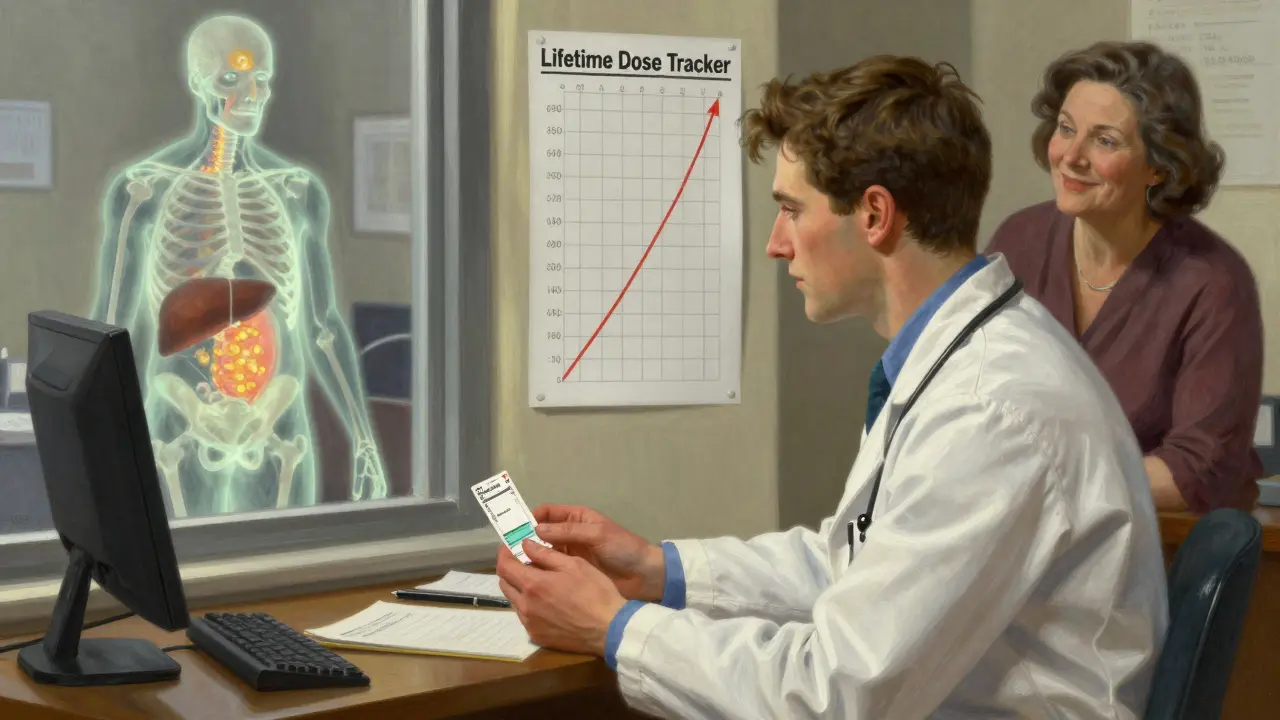
What Can You Do?
You don’t have to wait for a crisis. Here’s what you can do right now:- Ask your doctor: "Is this medication known to build up in the body? What’s my total lifetime dose so far?" If they don’t know, that’s a red flag.
- Keep a personal log: Write down every drug you take - name, dose, start date. Use a notes app or a notebook. Update it every time you get a new prescription.
- Request blood tests: Ask for liver enzymes, kidney function, and drug levels if you’re on a high-risk medication. Don’t wait for symptoms.
- Don’t skip follow-ups: If your doctor says "come back in 6 months," don’t wait until you feel bad. Go on time.
- Be wary of supplements: Fat-soluble vitamins (A, D, E, K) can accumulate too. High-dose vitamin A supplements have caused liver damage in people who took them daily for years.

Ian Cheung
January 11, 2026 AT 15:07This hit me right in the gut. I’ve been on lithium for 8 years and never once had my levels checked beyond the baseline. My doc just said 'you look fine' and moved on. Turns out my kidneys are at 65% capacity now. Not because I was reckless-but because nobody told me to track the total. That Bristol patient? That’s me. I’m alive but I’m not the same. Don’t wait like I did.
anthony martinez
January 12, 2026 AT 06:47So let me get this straight. The medical system is built on the assumption that if you’re not screaming in pain, everything’s fine. And somehow that’s still acceptable. The fact that we’re still relying on paper logs and guesswork in 2025 is a crime. Not a mistake. A crime.
Mario Bros
January 12, 2026 AT 18:47Yo. This is the kind of post that saves lives. Seriously. If you’re on any of those meds, stop scrolling and check your pills right now. Write it down. Ask your pharmacist. They’ll know more than your doctor sometimes. You got this. 💪
Jake Nunez
January 14, 2026 AT 09:56In my country, this isn’t even a conversation. People take meds like candy because the system doesn’t teach you how to question. I moved here from Mexico and was shocked that doctors here actually expect you to know your own drug history. That’s both empowering and terrifying.
Christine Milne
January 15, 2026 AT 23:13It is deeply concerning that the United States has not yet mandated cumulative toxicity assessments for non-oncological pharmaceuticals, particularly when the European Medicines Agency has implemented such a protocol with unequivocal efficacy. One must question the regulatory inertia of the Food and Drug Administration, which continues to prioritize pharmaceutical industry interests over patient longevity.
Bradford Beardall
January 17, 2026 AT 17:21Wait-so if AI can predict toxicity risk with 82% accuracy, why aren’t we using it everywhere? Is it cost? Lack of training? Or just institutional laziness? I’ve got a cousin on amiodarone. I’m sending her this right now. This needs to be mainstream knowledge, not a Reddit deep dive.
McCarthy Halverson
January 19, 2026 AT 09:51Track your doses. Ask for blood tests. Don’t wait. That’s it.
Michael Marchio
January 20, 2026 AT 15:08You know what’s really sad? People read this and think it’s about individual responsibility. But it’s not. It’s about a broken system that treats patients like disposable data points. Doctors are overworked, underpaid, and pressured to move through appointments like assembly lines. They don’t have time to calculate lifetime amiodarone doses. And yet we blame the patient for not knowing? That’s the real toxicity here-the cultural belief that if you’re not screaming, you’re fine. It’s not just drugs that accumulate. It’s neglect.
Jake Kelly
January 20, 2026 AT 15:52Thanks for sharing this. I’m going to print out the list and take it to my next appointment. Better safe than sorry.