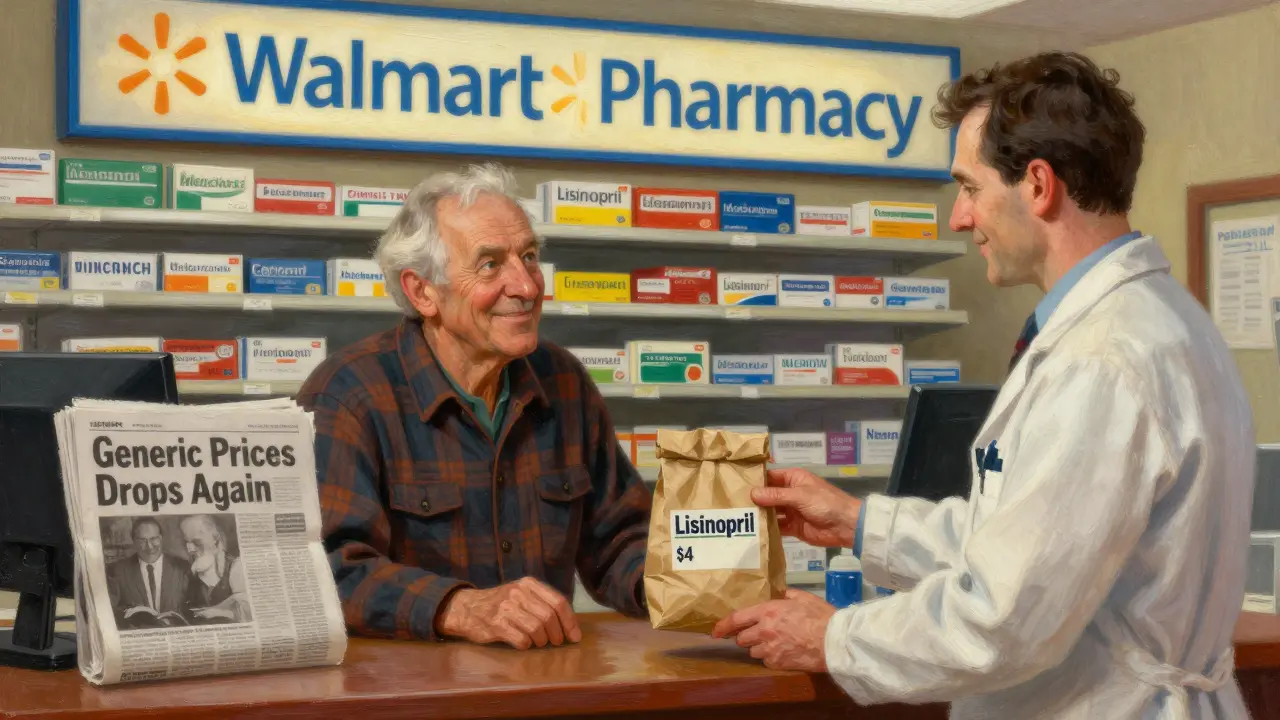
When you walk into a pharmacy in the U.S. and pick up a month’s supply of generic lisinopril, you might pay $4. Do the same thing in Germany, and you’ll likely pay €15-nearly four times as much. Yet when it comes to brand-name drugs like Jardiance or Stelara, the U.S. pays far more than Europe. This isn’t a mistake. It’s the result of two completely different systems, and the reason comes down to one thing: competition.
How the U.S. Got Cheap Generics
The U.S. doesn’t have a single entity setting drug prices. Instead, it has a chaotic, noisy marketplace. There are hundreds of insurers, dozens of Pharmacy Benefit Managers (PBMs), and thousands of pharmacies. When a drug loses its patent, dozens of companies rush in to make copies. Teva, Mylan, Sandoz, and others start producing the same pill, and they compete on price. The result? Prices drop fast. A 2022 report from the U.S. Department of Health and Human Services found that Americans pay, on average, 33% less for generic drugs than people in 33 other OECD countries. Why? Because the U.S. generic market is brutally competitive. PBMs negotiate bulk discounts. Large pharmacy chains like CVS and Walmart buy in massive volumes. And because patients are often switched automatically to generics at the pharmacy (in 49 states), demand stays high. That’s a recipe for low prices. But there’s a catch. This system works because manufacturers are willing to sell at razor-thin margins-sometimes below cost. When profits vanish, some companies quit. That’s when shortages happen. In 2023, there were over 200 drug shortages in the U.S., mostly generics. One reason? A company stopped making a cheap generic because another company bought up all the manufacturing capacity and raised prices. It’s a cycle: too low → exit → monopoly → price spike.Why Europe Pays More for Generics
In Europe, governments don’t let the market decide. They negotiate. Each country has a central agency that sets prices based on what they think is fair. Germany uses reference pricing-what other countries pay. France sets prices based on how much a drug improves health. The UK’s NICE looks at cost per quality-adjusted life year. The goal isn’t to drive prices to the bottom. It’s to keep them stable. That means fewer companies compete. In the U.S., 90% of prescriptions are for generics. In Europe, it’s only 41%. Why? Because when a generic enters the market, European regulators often cap the price before competition can fully take hold. There’s less incentive for a new manufacturer to enter if they can’t make a decent profit. So fewer players, less competition, higher prices. You’ll also find that European pharmacies don’t automatically substitute generics. In France, your doctor has to approve the switch. In Germany, pharmacists can swap-but only if the patient agrees. That means patients often keep the brand-name version even after a generic is available. Less switching = less pressure to lower prices.Why Brand-Name Drugs Cost So Much More in the U.S.
Here’s the twist: the U.S. is the world’s biggest payer for brand-name drugs. A 2023 ASPE report showed Americans pay 4.2 times more for brand-name drugs than other OECD countries. That’s not because U.S. companies are greedy. It’s because the system forces them to. In Europe, governments negotiate hard. If a drug costs $10,000 a year and doesn’t offer enough benefit, it won’t be covered. In the U.S., insurers pay list prices-then get rebates. But patients don’t see those rebates. They pay based on the original price. So drugmakers set high list prices knowing they’ll give discounts later. It’s a game of hide-and-seek. The result? The U.S. funds most of global drug innovation. A 2024 analysis from the Milbank Quarterly found that roughly two-thirds of all pharmaceutical R&D spending comes from U.S. sales. Companies rely on high U.S. prices to pay for research. When they can’t make enough money here, they cut development. That’s why new drugs often launch first in the U.S. before hitting Europe.
The Hidden Cost: Rebates, Not Retail
Here’s where things get confusing. The $28.50 average price for a U.S. generic prescription? That’s the net price after rebates and discounts. The list price might be $50. But PBMs negotiate 35-40% off. That money doesn’t go to the patient. It goes to the insurer or the PBM. The patient still sees the full price at the counter. In Europe, there are no rebates. The price you see is the price paid. So even though the sticker price is higher, it’s more transparent. But that also means European governments can’t use rebates to squeeze savings out of drugmakers. They have to negotiate harder upfront. This is why comparing U.S. and European prices is tricky. You can’t just look at the shelf price. You have to ask: Who’s paying? And how much are they really paying after discounts?What’s Changing? Medicare Negotiations and Global Pressure
The Inflation Reduction Act changed the game. Starting in 2023, Medicare began negotiating prices for 10 high-cost brand-name drugs. For Jardiance, Medicare got $204 per month. The average price in 11 other countries? $52. That’s still 3.9 times higher. But it’s down from $380 in 2022. This is just the beginning. By 2027, 60 drugs could be subject to negotiation. That’s putting pressure on drugmakers. If Medicare cuts prices, companies might raise prices elsewhere to make up the difference. Alexander Natz of EUCOPE warned that if the U.S. forces drugmakers to match the lowest global price (a policy called “most favored nation”), companies could raise prices in Europe to stay profitable. That could hurt access in countries that already struggle to afford new medicines. Meanwhile, the U.S. generic market keeps humming. Even as brand-name prices come under fire, generics remain cheap. Why? Because the system is built for it. More competitors. More volume. More pressure. It’s not perfect-shortages still happen-but it works.
What This Means for Patients
If you’re an American on Medicare or private insurance, you’re getting a deal on generics. You pay $0-$10 a month for drugs like metformin, atorvastatin, or levothyroxine. That’s not luck. It’s the result of a messy, competitive market. If you’re in Europe, you pay more for generics, but you pay less for brand-name drugs. And if you need a new cancer drug or a breakthrough treatment, you’re more likely to get it sooner in the U.S.-even if it costs more. The real takeaway? There’s no single “right” way to price drugs. The U.S. system prioritizes access to cheap generics and innovation. Europe prioritizes affordability and stability. Neither is perfect. But each delivers what it’s designed to.What’s Next?
The U.S. may keep its low generic prices for years. The structure is too entrenched to change. But as Medicare negotiation expands, brand-name prices could drop. That might mean less money for R&D-or companies raising prices abroad. Europe may eventually loosen its price controls to keep access to new drugs. The global system is at a turning point. One thing’s clear: the next time you pay $4 for a generic pill, remember-it’s not magic. It’s competition. And it’s not happening anywhere else in the world quite like this.Why are generic drugs cheaper in the U.S. than in Europe?
Generic drugs are cheaper in the U.S. because of intense competition. Hundreds of manufacturers produce the same drug after patent expiry, and large pharmacy chains and PBMs buy in bulk, driving prices down. European countries limit competition by setting fixed prices and requiring government approval before generics can enter the market, resulting in fewer suppliers and higher prices.
Do Americans pay more for brand-name drugs than Europeans?
Yes, Americans pay significantly more for brand-name drugs. The U.S. pays roughly 4 times more on average than other OECD countries. This is because U.S. drugmakers set high list prices, then offer rebates to insurers and PBMs-money patients don’t see. European governments negotiate prices directly and often refuse to cover drugs they deem too expensive.
Why don’t European countries just let generics compete like the U.S. does?
European countries prioritize price stability and predictability over competition. They fear that allowing too many generic manufacturers could lead to price wars that make it hard for companies to stay in business. Instead, they cap prices early, limit the number of approved generics, and require physician approval for substitutions-slowing down competition to protect supply.
Is the U.S. subsidizing drug innovation for the rest of the world?
Yes. The U.S. accounts for 40% of global pharmaceutical sales but only 4% of the world’s population. Experts estimate that two-thirds of global drug R&D funding comes from high U.S. prices. Countries like Germany and France pay far less for the same drugs, meaning they benefit from innovations funded largely by American consumers.
Will Medicare drug negotiations lower U.S. drug prices overall?
Medicare negotiations are already lowering prices for the 10 drugs selected so far-some by over 50%. But this only affects a small number of expensive brand-name drugs. It won’t change generic prices, which are already low. The bigger impact may be on drugmakers, who could raise prices in Europe to offset U.S. losses, potentially affecting access abroad.
Why do U.S. generic drug shortages happen?
Shortages happen because the U.S. generic market is so competitive that some manufacturers make little to no profit. When prices drop too low, companies exit the market. If one company then gains control of the manufacturing, they can raise prices sharply. This happened with several antibiotics and blood pressure drugs in 2022-2024, causing nationwide shortages.
Can I get cheaper drugs by traveling to Europe?
For brand-name drugs, yes-you’ll likely pay less. But for generics, no. In fact, many Americans who’ve bought generic medications in Europe report paying 3-4 times more than they do at home. For example, generic lisinopril costs $4 in the U.S. but €15 in Germany. So unless you’re buying expensive brand-name drugs, it’s not worth the trip.

Jonathan Noe
February 15, 2026 AT 10:21Let’s be real-the U.S. generic system works because it’s a bloodsport. Companies fight to the death over pennies per pill, and the consumer wins. Europe’s cozy price caps? That’s not fairness, it’s stagnation. You get stability, sure, but at the cost of innovation and access. When a company can’t make a dime on a generic, they walk away. Then boom-shortage. And suddenly, the ‘fair’ system looks pretty broken.
Jack Havard
February 16, 2026 AT 14:16This whole post is propaganda dressed up as economics. The U.S. doesn’t have low prices-it has hidden subsidies, opaque rebates, and a PBM cartel that pockets the difference. You think $4 is cheap? Wait until your insurance drops you and you’re handed the list price at the counter.
Kristin Jarecki
February 16, 2026 AT 16:41It’s important to recognize that both systems reflect deeply held cultural values. The United States prioritizes market-driven outcomes and individual choice, even when they lead to volatility. Europe, by contrast, prioritizes collective welfare and systemic predictability. Neither is morally superior-both are compromises. The U.S. system delivers affordability for generics but risks instability. Europe delivers reliability but limits access through reduced competition. The challenge is not to choose one over the other, but to understand the trade-offs each society has willingly accepted.
Brad Ralph
February 16, 2026 AT 21:36So we pay $4 for lisinopril… and $1,200 for insulin. Guess which one’s generic? 😏
christian jon
February 17, 2026 AT 18:42Oh, so it’s ‘competition’ that’s responsible? Yeah, right. You think this is capitalism? It’s corporate cannibalism! The PBMs? The pharmacy chains? They’re not heroes-they’re middlemen who siphon off billions while patients get slapped with $50 co-pays for drugs that cost $2 to make. And don’t even get me started on how the FDA lets 12 companies make the same damn pill, but only 3 have the right equipment-so when one factory has a power outage, half the country goes without blood pressure meds! This isn’t a market-it’s a rigged game of musical chairs with your life on the line!
Suzette Smith
February 19, 2026 AT 05:41Interesting take. I’ve always thought Europe’s system was just… slower. But maybe it’s not about being better or worse-it’s about what you value. I’d rather pay a little more and not worry about running out of my meds. Then again, I’ve never had to choose between rent and my diabetes pills, so maybe I’m just lucky.
Autumn Frankart
February 19, 2026 AT 14:49Of course the U.S. has cheap generics. That’s because Big Pharma lets them sell cheap so they can keep the brand-name profits high. It’s a trap. You think you’re saving money? You’re just being conditioned to accept a system that lets corporations control your health. Meanwhile, Europe? They’re not ‘anti-competition’-they’re anti-exploitation. And guess who’s funding the R&D? The same companies that got rich off you. This isn’t freedom. It’s financial slavery with a side of pharmacy coupons.
Pat Mun
February 20, 2026 AT 16:57I’ve been working in pharmacy for 18 years, and I’ve seen this play out. The U.S. system is a rollercoaster-sometimes you get off at the bottom, sometimes you get thrown into the loop. I’ve had patients cry because they couldn’t afford their generic metformin after a shortage. Then, two months later, it’s back at $4. But the trauma sticks. Meanwhile, in Canada or Germany, patients don’t have that same fear. They know their price. They know their supply. And that peace of mind? It’s worth more than a few bucks saved per month. We need to stop romanticizing chaos. Stability isn’t weakness-it’s care.
andres az
February 22, 2026 AT 14:32The PBM vertical integration creates an asymmetric information architecture that enables rent-seeking behavior in the pharmaceutical supply chain. The list price/net price disconnect is a structural artifact of third-party intermediary capture, wherein rebate retention mechanisms disincentivize transparency and amplify consumer-facing cost burdens. The European model, by contrast, employs centralized price-setting protocols that mitigate adverse selection and reduce transactional friction. The U.S. system is not a market-it’s a regulatory arbitrage engine.
Steve DESTIVELLE
February 22, 2026 AT 17:34Life is a paradox. We think we want freedom, but we crave safety. The U.S. gives us freedom to pay less for pills, but not freedom from fear. Europe gives us safety from surprise, but not freedom from cost. So who is truly free? The man who pays $4 and waits for his next shortage? Or the man who pays $15 and never wonders? Maybe the answer is not in the price, but in the silence after the purchase. We are all just waiting for the next crisis to remind us that no system is perfect. Only human.
Stephon Devereux
February 23, 2026 AT 21:15One thing no one talks about: the U.S. system works because it’s subsidized by the suffering of manufacturers. When you have 80 companies fighting over a $0.02 profit margin on a pill, someone’s got to pay the price. And it’s not the big players-it’s the small labs, the contract manufacturers, the workers on the line. They get squeezed out. Then, when the monopoly forms, the price spikes. It’s not capitalism-it’s a cycle of exploitation and consolidation. Europe’s model isn’t perfect, but it at least tries to protect the people who make the drugs, not just the ones who buy them. Maybe we need a hybrid: competitive pricing, but with safety nets for manufacturers. Otherwise, we’re just trading one crisis for another.