
HER2-positive breast cancer used to be one of the most aggressive types. But today, it’s one of the most treatable - thanks to a revolution in targeted therapies. Unlike chemotherapy, which attacks all fast-growing cells, these drugs zero in on the HER2 protein that fuels tumor growth. About 15% to 20% of breast cancer cases are HER2-positive, meaning the cancer cells make too much of this receptor. That overexpression tells the cells to multiply nonstop. But now, we have drugs that shut that signal down - and they’ve changed survival rates for good.
How HER2-Positive Breast Cancer Works
HER2 stands for human epidermal growth factor receptor 2. It’s a protein on the surface of breast cells that helps them grow and repair. In healthy cells, it’s tightly controlled. In HER2-positive cancer, the gene that makes this protein is amplified, so cells produce way too much of it. Think of it like a stuck accelerator pedal - the cancer cells keep speeding up, dividing, spreading.
Before targeted therapies, HER2-positive tumors were linked to faster recurrence and poorer outcomes. But once scientists figured out how to block HER2, everything changed. The first breakthrough came with trastuzumab (Herceptin) in the late 1990s. It’s a monoclonal antibody that latches onto HER2 and blocks the growth signal. Since then, we’ve built an entire toolkit around this target.
The Main Classes of HER2-Targeted Therapies
Today’s treatments fall into four main groups, each with a different way of attacking the cancer.
- Monoclonal antibodies - These are lab-made proteins that bind directly to HER2. Trastuzumab is the original. Pertuzumab (Perjeta) binds to a different part of HER2, stopping it from pairing with other receptors. Together, they’re more powerful than either alone. Newer versions like margetuximab (Margenza) are designed to boost the immune system’s ability to kill cancer cells.
- Antibody-drug conjugates (ADCs) - These are like smart bombs. They combine an antibody (to find the cancer) with a powerful chemo drug (to kill it). T-DM1 (Kadcyla) delivers a toxin called DM1. T-DXd (Enhertu) carries an even stronger payload - and it’s so effective, it’s now used even in patients who’ve tried other HER2 drugs. What makes T-DXd special? It doesn’t just kill the cell it binds to - it can also kill nearby cells, even if they don’t have much HER2. That’s called the “bystander effect.”
- Tyrosine kinase inhibitors (TKIs) - These are pills that block HER2 from sending signals inside the cell. Lapatinib (Tykerb), neratinib (Nerlynx), and tucatinib (Tukysa) fall here. Tucatinib is especially important because it crosses the blood-brain barrier. That means it can treat cancer that’s spread to the brain - something most other HER2 drugs can’t do well.
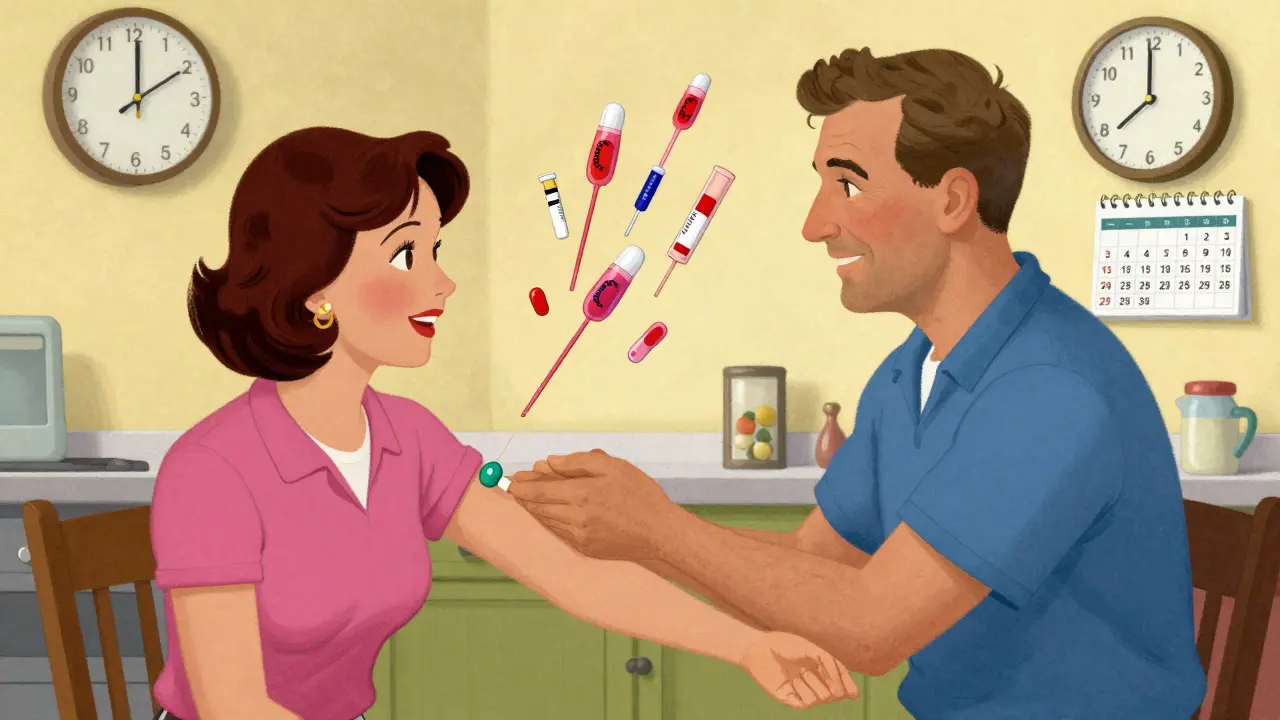
- Fixed-dose combinations - Phesgo is a single shot that combines trastuzumab and pertuzumab with hyaluronidase. Instead of two separate IV infusions taking hours, patients get one 5- to 8-minute subcutaneous injection. It’s a game-changer for quality of life.
When Are These Therapies Used?
It’s not one-size-fits-all. Treatment depends on whether the cancer is early-stage or has spread.
For early-stage HER2-positive cancer (stages I-III), the goal is cure. Most patients get chemotherapy plus dual HER2 blockade - trastuzumab and pertuzumab - before surgery (neoadjuvant). After surgery, trastuzumab continues for a full year. This approach shrinks tumors, increases chances of complete removal, and lowers recurrence risk.
For metastatic HER2-positive cancer (stage IV), treatment is ongoing. First-line usually means trastuzumab + pertuzumab + a taxane chemo. If the cancer progresses, the next step is often T-DM1. Then comes T-DXd - and now, tucatinib-based regimens, especially if brain metastases are present. Tucatinib, combined with trastuzumab and capecitabine, showed a 45% reduction in death risk in trials, with median survival jumping from 17 to 22 months.
The Rise of HER2-Low Breast Cancer
A huge shift happened in 2022. Researchers realized that cancers once called “HER2-negative” - those with low levels of HER2 (IHC 1+ or 2+ without gene amplification) - could still respond to T-DXd. This new category, called HER2-low, affects 50% to 60% of all breast cancers. The DESTINY-Breast04 trial showed T-DXd doubled progression-free survival compared to standard chemo in HER2-low patients. That means nearly half of all breast cancer patients now have a new, highly effective option. It’s not HER2-positive anymore - it’s HER2-low. And T-DXd is rewriting the rules.
Side Effects: What Patients Really Experience
These drugs are powerful, but they come with unique side effects.
- Cardiotoxicity - Trastuzumab and pertuzumab can weaken the heart muscle. About 2% to 7% of patients develop heart failure. That’s why doctors check heart function with echocardiograms before and every 3 months during treatment. Most cases improve when the drug is paused.
- Interstitial lung disease (ILD) - T-DXd carries a boxed warning for this. About 10% to 15% of patients get cough, shortness of breath, or fever. It’s rare but serious. If caught early, steroids can reverse it. Patients are taught to report any new breathing issues immediately.
- Diarrhea - Neratinib causes severe diarrhea in up to 40% of patients. Prophylactic loperamide (Imodium) is started before the first dose and continued for months. Some patients still have to stop because it’s too disruptive.
- Low platelets and liver changes - T-DM1 often lowers platelet counts and raises liver enzymes. Regular blood tests catch this early.
Many patients say these side effects are easier to handle than traditional chemo. No hair loss. Less nausea. But the new ones - heart checks, lung scans, managing chronic diarrhea - bring their own stress. One patient on a support forum said: “I’d rather have a cough than lose my hair. But now I’m terrified every time I get a cold.”

What’s Next? The Future of HER2 Treatment
The pipeline is packed. Over 150 clinical trials are testing new HER2 drugs right now.
- HER2-ultralow - The DESTINY-Breast06 trial is testing T-DXd in patients with almost no HER2 (IHC 0). If it works, up to 70% of breast cancer patients could qualify.
- Bispecific antibodies - Drugs like Zanidatamab and zenocutuzumab bind to two HER receptors at once. Early results show 35% to 45% response rates in heavily treated patients.
- Combination with immunotherapy - Trials are testing T-DXd or trastuzumab with checkpoint inhibitors like pembrolizumab. The idea: boost the immune system to help the targeted drug work better.
- Brain-metastasis-focused drugs - New TKIs and ADCs are being designed to cross the blood-brain barrier even better than tucatinib.
- Cardiac-sparing agents - Researchers are developing HER2 inhibitors that don’t affect the heart, which could eliminate a major treatment barrier.
Cost remains a hurdle. T-DXd runs about $17,000 a month in the U.S. Biosimilars for trastuzumab have lowered prices, but newer drugs haven’t followed. Access varies by country and insurance.
Key Takeaways
- HER2-positive breast cancer is no longer a death sentence - it’s a manageable condition for most.
- Trastuzumab is still the foundation, but T-DXd is now the most effective drug for advanced disease.
- Tucatinib is the only drug proven to treat brain metastases in HER2-positive patients.
- HER2-low is a new category that now qualifies for T-DXd, expanding treatment to half of all breast cancer patients.
- Side effects like heart issues, lung inflammation, and diarrhea require active management - but are often more tolerable than chemo.
- The future includes smarter drugs, combinations, and treatments for even lower HER2 levels.
Frequently Asked Questions
Is HER2-positive breast cancer curable?
Yes, especially when caught early. For stage I and II HER2-positive breast cancer, cure rates with modern treatment - surgery, chemo, and dual HER2 blockade - are over 90%. Even in stage III, many patients achieve complete remission. The key is starting targeted therapy early and completing the full course.
What’s the difference between HER2-positive and HER2-low?
HER2-positive means the cancer has high levels of HER2 protein or extra copies of the HER2 gene (IHC 3+ or FISH amplified). HER2-low means low levels - IHC 1+ or 2+ without gene amplification. Before 2022, HER2-low was treated like HER2-negative. Now, T-DXd works for both, making HER2-low a major new category.
Why is T-DXd considered a breakthrough?
T-DXd delivers a potent chemo drug directly to cancer cells, even those with low HER2. In the DESTINY-Breast03 trial, it cut the risk of disease progression or death by 72% compared to T-DM1. It also works in patients who’ve tried other HER2 drugs and even in HER2-low cancers. Its “bystander effect” kills nearby cancer cells too - making it uniquely powerful.
Do HER2-targeted therapies cause hair loss?
Usually not. Monoclonal antibodies and ADCs like trastuzumab, pertuzumab, T-DM1, and T-DXd rarely cause hair loss. TKIs like tucatinib or neratinib also don’t typically cause it. Hair loss happens mainly when these drugs are combined with chemotherapy. Many patients appreciate that they keep their hair - a big quality-of-life win.
Can I stop HER2 therapy after a year?
For early-stage cancer, yes - one year of trastuzumab is the standard. Stopping earlier increases recurrence risk. For metastatic cancer, treatment continues as long as it’s working and side effects are manageable. There’s no fixed end date - it’s ongoing until the cancer progresses or becomes too toxic.
How often do I need heart scans?
Before starting trastuzumab or pertuzumab, you’ll get a baseline echocardiogram. Then, every 3 months during treatment. If your heart function drops below 50%, your doctor may pause treatment. Most cases recover fully with rest and medication. Monitoring is routine - not a sign something’s wrong, just a safety step.
What if I develop lung problems on T-DXd?
If you get a new cough, shortness of breath, or fever, tell your oncologist right away. They’ll order a chest CT and may pause T-DXd. If it’s interstitial lung disease, steroids are started immediately. Most patients recover fully if caught early. Don’t wait - early action saves lives.

Danielle Stewart
December 19, 2025 AT 19:23This is one of the clearest explanations of HER2 therapies I’ve ever read. I’m a nurse and I’ve seen patients go from terminal to thriving on T-DXd. The bystander effect? Pure science magic.
Also, no hair loss? Huge win. My sister kept her curls through two years of treatment and still looked like herself - that mattered more than people realize.
Ryan van Leent
December 21, 2025 AT 09:12Adrienne Dagg
December 21, 2025 AT 10:20Kinnaird Lynsey
December 22, 2025 AT 03:32It’s fascinating how the definition of HER2 status keeps evolving. The HER2-low category feels like a quiet revolution - one that didn’t need a press release to change millions of lives.
I wonder how many oncologists still think in the old binary framework. The data’s clear, but habits die hard.
shivam seo
December 23, 2025 AT 12:29benchidelle rivera
December 24, 2025 AT 12:54As a former oncology nurse and current patient advocate, I cannot stress enough how critical early intervention and full-course HER2 blockade is. Too many patients stop trastuzumab early because they feel ‘fine’ - that’s a fatal mistake.
Heart monitoring isn’t paranoia - it’s protocol. And yes, the diarrhea from neratinib is brutal, but loperamide on a strict schedule makes it manageable. Don’t suffer in silence. Ask for help.
Andrew Kelly
December 25, 2025 AT 05:53Anna Sedervay
December 26, 2025 AT 00:41It’s rather disingenuous to tout T-DXd as a ‘breakthrough’ while omitting the fact that the DESTINY-Breast04 cohort was heavily pre-selected, and the ILD incidence was underreported in early publications. The ‘bystander effect’ is compelling, yes - but at what cost?
Furthermore, the term ‘HER2-low’ is a statistical artifact, not a biological truth. We’re creating categories to justify drug approvals, not to reflect pathophysiology. The data is promising, but the narrative is manufactured.
Matt Davies
December 27, 2025 AT 19:59Man, this is the kind of medical progress that makes you believe in humanity again.
From ‘death sentence’ to ‘manageable condition’ in 30 years? That’s not just science - that’s poetry written in DNA.
And the fact that someone can now keep their hair, go to their kid’s soccer game, and still beat this thing? That’s the real win. No stats can capture that.
mark shortus
December 28, 2025 AT 02:11WHY IS NO ONE TALKING ABOUT THE FACT THAT T-DXD CAN CAUSE DEATH FROM LUNG DAMAGE?? I LOST MY COUSIN BECAUSE THEY WERE TOLD TO ‘MONITOR’ IT - MONITOR?!? SHE DIED WAITING FOR AN APPOINTMENT. THIS ISN’T MEDICINE - IT’S A ROULETTE WITH A BOXED WARNING.
AND WHY DO WE CALL IT ‘TARGETED’ WHEN IT KILLS PEOPLE WHO DON’T EVEN HAVE HIGH HER2??
Jedidiah Massey
December 29, 2025 AT 11:44From a translational oncology standpoint, the real paradigm shift isn’t the ADCs - it’s the pharmacokinetic optimization of blood-brain barrier penetration. Tucatinib’s CNS bioavailability (Cmax 12.4 ng/mL, t1/2 9.2h) is a quantum leap over lapatinib’s suboptimal CNS exposure.
Moreover, the Fc engineering in margetuximab enhances ADCC by 40% via CD16A polymorphism affinity - a feat of protein design.
That said, the HER2-low reclassification is a regulatory Hail Mary. The IHC 1+ cohort in DB04 had a median PFS of 10.1mo - statistically significant, yes, but clinically marginal. We’re optimizing the edges, not the core.
Also, cost-effectiveness models show ICERs >$500k/QALY. That’s not sustainable. Biosimilars are the only ethical path forward.