
Going to the pharmacy every month for your blood pressure, diabetes, or cholesterol meds is exhausting. You’re not alone. Millions of people on long-term medications do it-until they don’t. Missed doses, forgotten refills, and last-minute pharmacy runs lead to worse health outcomes. But there’s a simple fix most people don’t ask for: a 90-day supply of your maintenance meds.
Why 90-Day Supplies Work Better
A 90-day supply means you get three months of medication in one go. Instead of 12 trips a year, you make just four. That’s not just convenient-it’s life-changing for people managing chronic conditions like hypertension, type 2 diabetes, or depression. Studies show people who use 90-day supplies are 27% more likely to take their meds as prescribed. That’s not a small bump. That’s a major shift in health outcomes. Why? Because it removes the friction. No more running out on a weekend. No more forgetting to call the doctor for a refill. No more paying multiple copays when you could pay one. You also save money. On average, people save $2.35 per prescription every month. That adds up to over $28 a year per drug. For someone on three meds? That’s $85 saved annually-just by switching to a 90-day supply. Some pharmacies like Walmart offer generics for just $10 for 90 days. That’s cheaper than a coffee run.Which Medications Qualify
Not every drug can be filled for 90 days. These programs only work for maintenance medications-drugs you take daily for long-term conditions. Common ones include:- High blood pressure (lisinopril, amlodipine)
- Diabetes (metformin, glimepiride)
- Cholesterol (atorvastatin, rosuvastatin)
- Thyroid (levothyroxine)
- Depression and anxiety (sertraline, escitalopram)
How to Get Started
Step one: Check your insurance plan. Most major insurers-Aetna, Cigna, Express Scripts, CVS Caremark-offer 90-day programs. Medicare Part D plans are required to include them. Medicare Advantage plans sometimes even offer 100-day supplies. Log into your insurer’s website or call the number on your card. Ask: “Do you offer a 90-day supply program for maintenance medications?” If they say yes, ask if it’s through mail-order or a network pharmacy. Step two: Confirm your meds are eligible. Look at your prescription list. If you’ve been refilling the same drug every 30 days for over a year, it’s almost certainly eligible. If you’re unsure, ask your pharmacist-they can check your history and tell you right away. Step three: Ask your doctor for a 90-day prescription. This is where most people get stuck. Doctors often default to 30-day scripts because it’s what they’ve always done. But you can change that. Say this: “I’d like to switch to a 90-day supply of my [medication name] to reduce trips to the pharmacy and stay more consistent with my treatment. Can you write a prescription for 90 days?” Many doctors will say yes. If they hesitate, explain you’ve read about the adherence benefits. Mention the 27% improvement in medication-taking rates. Most doctors know the data and will agree. If your doctor’s office uses electronic prescribing, they can send the 90-day script directly to your mail-order pharmacy. If they prefer paper, bring the script to your pharmacy and ask them to process it for mail delivery.
Choosing Your Delivery Method
There are two main ways to get your 90-day supply: mail-order or retail network pharmacy. Mail-order (CVS Caremark, Express Scripts, Aetna): You sign up online, your doctor sends the script, and your meds arrive by mail in 7-10 business days. This is the most common method. It’s free to ship, and you get refill reminders. Some even include free syringes or safety checks for drug interactions. Network retail pharmacy (Cigna 90 Now, Walmart): You pick a pharmacy in your insurer’s network and get your 90-day supply in person. Walmart offers the lowest prices on generics: $10 for 90 days on many common drugs. But you must use their pharmacy-not just any Walmart. Cigna 90 Now only works at select pharmacies, not all. If you travel often or don’t trust mail delivery, retail might be better. If you want the easiest, most hands-off option, go mail-order.What to Watch Out For
Not everything is smooth. Here are the common roadblocks:- State restrictions: Some states block 90-day programs for certain plans. California, Texas, Minnesota, New Hampshire, and Washington have had limitations in the past. Check your plan’s fine print.
- Specialty drugs: Injectables or high-cost meds often require three 30-day fills before you can switch. Don’t get discouraged-ask after your third refill.
- Tiered pricing: Your copay depends on whether your drug is generic, preferred brand, or non-preferred brand. Generics are cheapest. Preferred brands cost more but still less than 30-day fills. Non-preferred brands can be expensive-ask if there’s a generic alternative.
- Pharmacy network limits: If you’re on Cigna 90 Now, you can’t just walk into any CVS. You must use one in their network. Use their online pharmacy locator before you go.
How to Make It Stick
Once you’ve got your 90-day script, set up automatic refills. Most mail-order services let you do this online. You’ll get a reminder 10 days before you run out, and they’ll send the next batch automatically. Keep your meds in a visible spot. Use a pill organizer labeled for weeks 1, 2, and 3. If you’re worried about forgetting, set a phone alert for the same time every day. If you miss a dose, don’t panic. Just take it when you remember. Don’t double up. And if you’re ever unsure, call your pharmacy. Most offer 24/7 pharmacist support.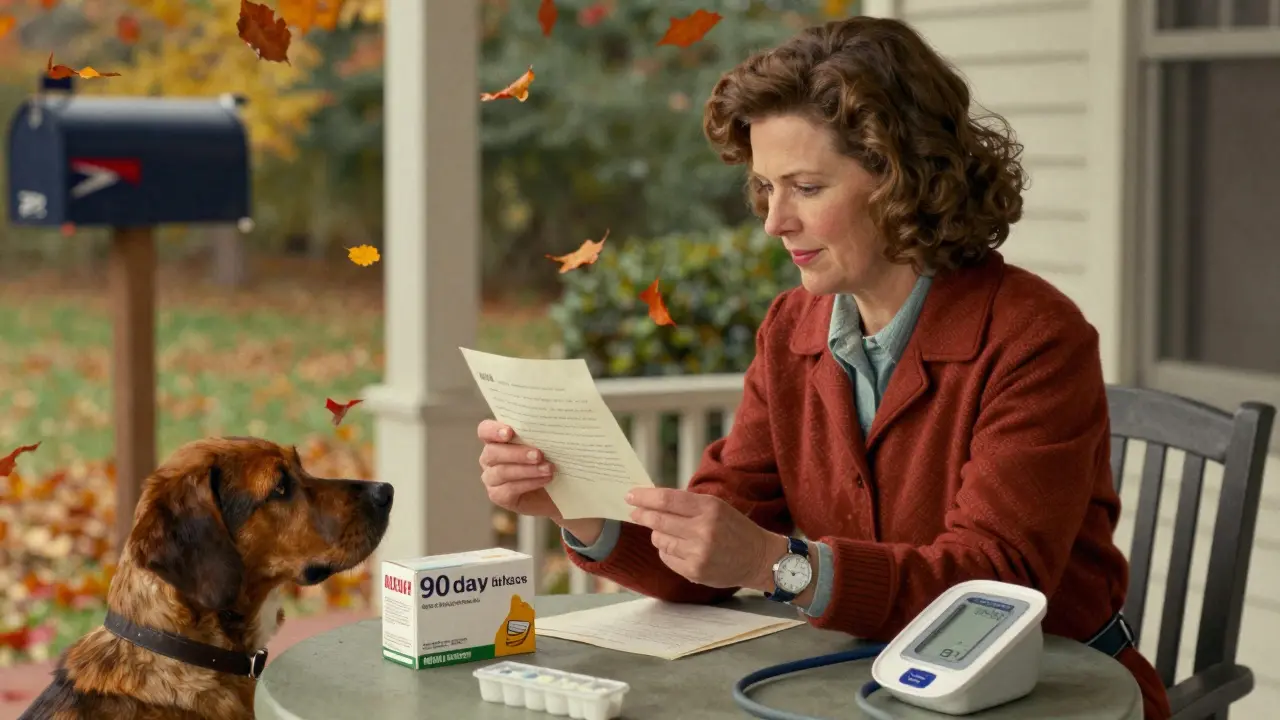
What If Your Insurance Doesn’t Offer It?
If you’re on a small plan or private insurance that doesn’t offer 90-day supplies, ask anyway. Sometimes, they’ll make an exception if you explain your situation. You can also switch to a different plan during open enrollment. Many Medicare Advantage plans and employer-sponsored plans now include 90-day options as standard. If you’re paying full price at the pharmacy, it’s worth exploring. Walmart’s $10 generic program is available to anyone, insured or not. If you’re on a tight budget, this is your best bet.Real-Life Impact
Sarah, 62, from Bristol, used to go to the pharmacy every 28 days for her metformin and lisinopril. She’d forget. She’d miss doses. Her blood pressure wasn’t under control. After switching to a 90-day mail-order script through her Aetna plan, she went from missing 2-3 doses a month to taking them every day. Her A1C dropped from 7.8 to 6.4 in six months. She saved $90 a year. And she got back two hours of her month-time she now spends walking her dog. You don’t need to be perfect. You just need to be consistent. And a 90-day supply makes consistency easier.Final Tip: Ask Early
Don’t wait until you’re out of pills. Talk to your doctor before your next refill. Bring this up during your annual checkup. It’s a simple change with big rewards. You’re not asking for a favor. You’re asking for a proven tool to help you stay healthy. And you deserve that.Can I get a 90-day supply of any prescription?
No. Only maintenance medications for chronic conditions qualify-like those for high blood pressure, diabetes, cholesterol, thyroid issues, or depression. Antibiotics, painkillers, or short-term drugs don’t qualify. Some specialty medications require three 30-day fills before you can switch to 90-day supplies.
Will my insurance cover a 90-day supply?
Most major insurers-including Aetna, Cigna, CVS Caremark, Express Scripts, and Medicare Part D-offer 90-day coverage. Check your plan’s website or call the number on your card. If you’re unsure, ask: “Do you have a 90-day supply program for maintenance meds?”
How do I get my doctor to write a 90-day script?
Simply ask: “Can you write a 90-day prescription for my [medication name]? I want to reduce pharmacy trips and stay more consistent with my treatment.” Many doctors already know the benefits and will agree. If they hesitate, mention that studies show a 27% increase in medication adherence with 90-day supplies.
Is mail-order safe and reliable?
Yes. Major mail-order pharmacies like CVS Caremark and Express Scripts are licensed, regulated, and use temperature-controlled packaging for sensitive medications. They offer refill reminders, drug interaction checks, and 24/7 pharmacist support. Delivery usually takes 7-10 business days and is free.
Can I use Walmart’s $10 90-day program if I have insurance?
Yes. Walmart’s $10 for 90-day generic program is available to anyone, insured or not. But if your insurance offers a better copay (like $5 for generics), use that instead. Compare prices at your pharmacy’s counter before choosing.
Are there states where 90-day supplies aren’t allowed?
Some states have restrictions on certain plans. As of 2025, California, Texas, Minnesota, New Hampshire, and Washington have had limitations in the past. Always check your plan’s terms or call your insurer to confirm availability in your state.
How much money can I save with a 90-day supply?
On average, people save $2.35 per prescription each month-about $28 a year per drug. For someone on three medications, that’s over $80 saved annually. Walmart’s generic program offers 90-day supplies for just $10, which can be cheaper than a 30-day copay.


Himanshu Singh
January 23, 2026 AT 15:33Bro this is life-changing. I’ve been on metformin for 5 years and never thought to ask for 90-day. Now I’m saving $30/month and actually remembering to take it. No more midnight pharmacy runs. 🙌
venkatesh karumanchi
January 25, 2026 AT 04:01Imagine if the system just… gave you this without you having to beg? 😭 I mean, we’re not asking for magic-just basic dignity. You take meds for life, you deserve a life that doesn’t revolve around pharmacy queues. 💯
Sharon Biggins
January 26, 2026 AT 23:39i just switched last month and my bp is way better. i used to forget every other week. now i just grab my pill box and go. also saved like $100. thank you for sharing this!! 🙏
John McGuirk
January 28, 2026 AT 10:13So let me get this straight… you’re telling me the pharma companies and insurers are hiding this because they profit off you running out? Of course they are. They want you sick. They want you coming back. This is a scam. Always has been. You think they care about your health? Nah. They care about your copay.
Michael Camilleri
January 30, 2026 AT 09:08People who don’t ask for 90-day supplies are just lazy. If you can’t be bothered to call your doctor or read your insurance info then you deserve to miss doses. I’ve been doing this since 2018. I’m not special. I just didn’t accept mediocrity. Stop making excuses
Kat Peterson
January 31, 2026 AT 15:53OMG I JUST REALIZED I’VE BEEN PAYING $45 A MONTH FOR LISINOPRIL??? 😱 I’m crying. Like actual tears. I just called my doctor and they said YES. I’m switching to mail order. My dog is so proud of me 🐶💖
Husain Atther
February 1, 2026 AT 20:51This is a very practical and well-structured guide. Many people overlook the psychological benefit of reducing daily decision fatigue when managing chronic illness. A 90-day supply reduces cognitive load and increases long-term adherence. Well done.
Helen Leite
February 1, 2026 AT 23:22Wait… so you’re saying the government and big pharma are keeping this quiet so we keep buying pills every month?? 😳 I just looked up my plan and they DO offer it… but I bet they hide it on purpose. I’m calling them right now. #PharmaConspiracy 🕵️♀️💊
Elizabeth Cannon
February 1, 2026 AT 23:34you guys are gonna love this: i switched to walmart’s $10 90-day and my whole family is on it now. my mom’s cholesterol med, my dad’s thyroid, even my sister’s antidepressant. we all save money and dont stress about refills. if you’re on a budget, this is your new best friend. just ask. no shame.