
Every school day, thousands of children rely on medication to manage asthma, diabetes, ADHD, seizures, and other chronic conditions. But who makes sure those pills, inhalers, and injections happen at the right time, in the right way? The answer isn’t just a nurse on staff-it’s a carefully coordinated system. Without clear protocols, trained staff, and solid documentation, medication errors can happen. And in a school setting, even a small mistake can have serious consequences.
Why Coordination Matters More Than You Think
It’s easy to assume that if a child takes medicine at home, they’ll do the same at school. But schools aren’t clinics. They’re busy, unpredictable environments. A child might be in the middle of a math test when they need their inhaler. Or a substitute teacher might not know how to handle an epinephrine auto-injector. That’s why coordination isn’t optional-it’s a safety requirement.
According to the National Association of School Nurses (NASN), medication errors occur in about 1.2% of all school-based administrations. That might sound low, but when you’re talking about hundreds of thousands of doses given daily across the U.S., even 1% means hundreds of preventable mistakes every year. The good news? Most of these errors are avoidable with the right system in place.
The Five Rights: Your Foundation for Safety
At the heart of every successful medication program is the Five Rights: right student, right medication, right dose, right route, right time. This isn’t just a checklist-it’s a mindset. Every time a medication is given, each of these five elements must be confirmed.
For example, a student with type 1 diabetes needs insulin before lunch. The nurse checks:
- Right student: Matches the student’s name and ID with the prescription label.
- Right medication: Verifies it’s insulin, not another drug.
- Right dose: Confirms it’s 8 units, not 10 or 5.
- Right route: Ensures it’s injected subcutaneously, not swallowed or inhaled.
- Right time: Gives it within 30 minutes of the prescribed schedule, as required by the American Academy of Pediatrics (AAP) 2024 guidelines.
Skipping even one of these steps increases risk. A 2022 Harvard study found that 63% of medication errors happened because staff skipped the student or medication verification step. That’s why the Five Rights must be drilled into every person involved-not just nurses.
Who Can Give the Medication? Delegation Rules Vary
School nurses can’t be everywhere. That’s why delegation is necessary-but only under strict rules. In 37 states, trained unlicensed personnel (UAP) can give medications under nurse supervision. But not all states allow it the same way.
Virginia requires nurses to personally review the first dose of any new medication before delegation. This practice has cut adverse events by 22%. Texas, on the other hand, treats medication administration as an administrative task, not a nursing function. That creates legal gray zones. A 2022 legal analysis found districts using this model had 14% higher liability risk.
Training for UAPs isn’t one-size-fits-all. Simple medications like oral antihistamines might only need 4 hours of training. Complex ones-like insulin pumps or seizure rescue meds-require up to 16 hours. Nurses must assess both the student’s condition and the staff member’s competence before handing off any task.

Documentation: The Paper Trail That Protects Everyone
Every time a medication is given, it must be documented. Immediately. No exceptions.
98% of school districts use electronic health records (EHRs) now, but 42 states still allow paper logs. EHRs reduce errors by making it harder to skip steps and easier to track trends. Fairfax County Public Schools, for example, cut documentation time by 45% and improved accuracy by 31% after switching to an electronic system.
What gets recorded? The student’s name, medication name, dose, time given, route, who gave it, and the student’s response. Did they vomit? Did they seem drowsy? Did their breathing improve after an inhaler? These details aren’t just paperwork-they’re critical for spotting patterns and preventing future issues.
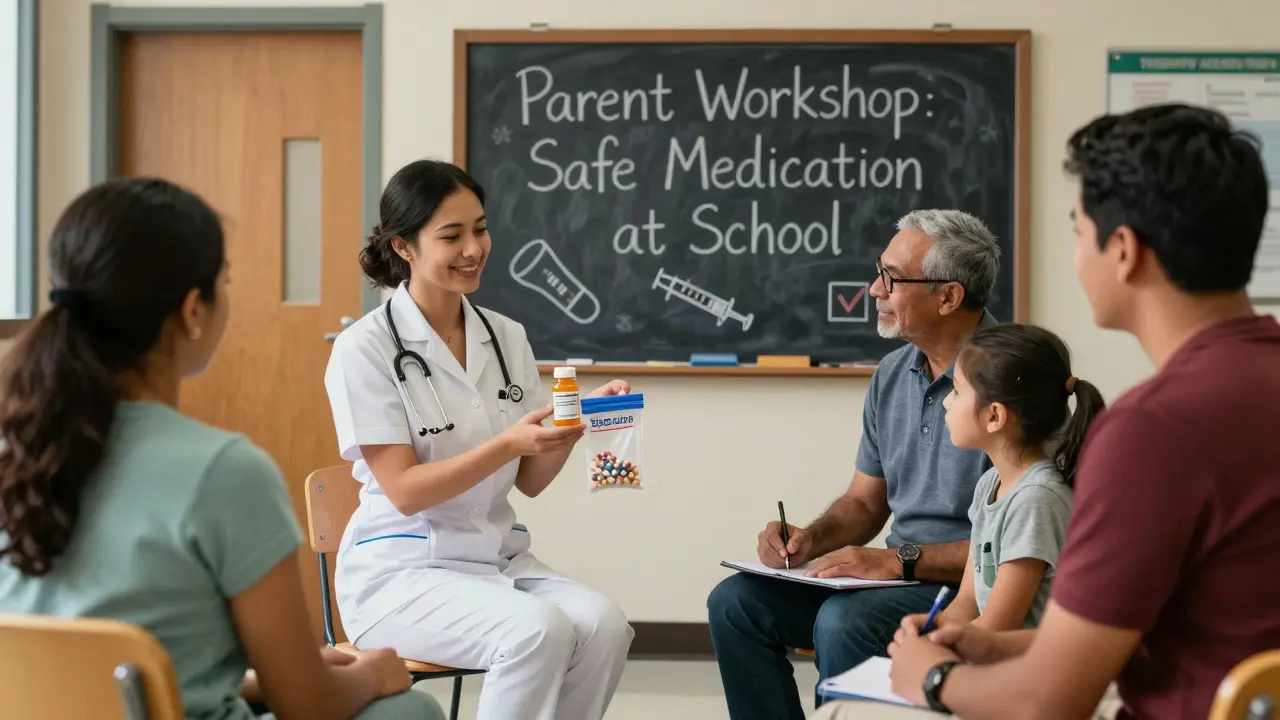
Parents often don’t realize how important documentation is. A 2023 NASN survey found that 38% of districts had trouble getting parents to bring medications in original, pharmacy-labeled containers. Federal law (21 CFR § 1306.22) requires this. Unlabeled pills in Ziploc bags? That’s not just unsafe-it’s illegal. Districts that held mandatory parent education sessions saw compliance jump by 52%.
Individualized Healthcare Plans (IHPs): The Blueprint for Success
Not all students are the same. A child with asthma might need a quick puff before gym class. A child with diabetes needs a blood sugar check and insulin dose before every meal. A child with epilepsy might need a rescue medication during a seizure. These needs can’t be handled with a one-size-fits-all policy.
That’s where Individualized Healthcare Plans (IHPs) come in. These are written plans, developed with input from parents, doctors, and school staff, that outline exactly what medication the student needs, when, how, and who will give it. IHPs are legally required under Section 504 of the Rehabilitation Act and IDEA for students with qualifying conditions.
Studies show schools using IHPs have 28% better medication adherence than those relying on generic logs. Why? Because IHPs account for real-life situations: field trips, lunchroom delays, after-school events. They also make it easier to train substitutes and cover for absent nurses.
Emergency Protocols: When Seconds Count
Not all medications are routine. Some are life-saving.
Epinephrine for anaphylaxis must be given within 5 minutes of symptom onset, according to CDC guidelines. That’s why 87% of U.S. schools now keep stock epinephrine on hand. But having it isn’t enough. Staff must know where it is, how to use it, and when to use it.
Training drills matter. One school in Oregon saved a student’s life after a teacher recognized hives and wheezing during lunch and administered epinephrine before the nurse arrived. That teacher had trained just three months earlier. That’s the power of regular practice.
For students with known allergies, the IHP must include clear triggers, symptoms, and emergency contacts. And the school nurse must ensure that all staff who interact with the student-cafeteria workers, bus drivers, PE teachers-know what to do.
The Real Challenges: Time, Staffing, and State Confusion
Here’s the hard truth: most school nurses are overwhelmed.
The national average is 1 nurse for every 1,102 students. The recommended ratio for schools with complex medical needs is 1:750. That means nurses are juggling injuries, mental health crises, immunizations, and medication administration-all at once.
76% of nurses report not having enough time for proper documentation. Rural nurses feel it even more-82% say they’re stretched too thin. And state laws? They’re a patchwork. One nurse in Texas told a Reddit forum she’s had principals override her medication decisions three times this year. That’s not just frustrating-it’s dangerous.
And yet, districts that use NASN’s Evidence-Based Guideline (2022) and its Implementation Toolkit see real results. Schools using the toolkit’s “Just Culture” approach to error reporting reduced staff anxiety by 70% and cut repeat errors by 37%. Why? Because instead of blaming individuals, they fix the system.
What Works: Real Solutions from Real Schools
Successful districts don’t rely on luck. They build systems.
- Use electronic systems: They cut documentation time and reduce errors.
- Train everyone: Teachers, aides, bus drivers-they all need to know the basics.
- Hold parent workshops: Make sure they bring medications in original containers.
- Review errors monthly: Not to punish, but to improve.
- Start with IHPs: Every student on daily medication needs one.
One district in Maryland started requiring parents to attend a 30-minute orientation before their child could receive medication at school. Compliance with labeling rules went from 62% to 97% in six months.
What’s Next: Technology and Standardization
The future is here. As of Q1 2024, 63% of districts are piloting smartphone-based medication verification systems. These apps let staff scan a barcode on the medication bottle and confirm the Five Rights in seconds. Some even send alerts if a dose is missed.
And there’s momentum for change. In January 2024, NASN and the AAP launched the School Medication Administration Standardization Initiative. The goal? To create model legislation that states can adopt. Twelve states have already signed on. By 2026, they hope to see 45 states using the same rules.
With childhood chronic conditions expected to grow 22% by 2030, better coordination isn’t just nice-it’s essential. The system we have now works for some. But it’s time to make it work for all.
Can a teacher give my child their medication?
Yes, but only if they’ve been properly trained and the school nurse has delegated the task under state law. In 37 states, trained unlicensed personnel (like teachers or aides) can give medications under nurse supervision. The nurse must assess both the student’s needs and the staff’s competence before delegation. Simple medications like oral pills may require only 4 hours of training; complex ones like insulin or seizure meds need up to 16 hours.
What if my child’s medication isn’t in the original bottle?
Schools cannot legally administer medication that isn’t in the original, pharmacy-labeled container. Federal law (21 CFR § 1306.22) requires this to prevent mix-ups and ensure accurate dosing. If you bring medication in a Ziploc bag or unlabeled container, the school will refuse to give it. Many districts hold parent education sessions to fix this issue-those that do see compliance rates jump by over 50%.
Do schools have to have a nurse on-site every day?
No, federal law doesn’t require a full-time nurse in every school. But if a student has a medical condition requiring daily medication, the school must have a plan to ensure safe administration. This often means using trained staff, telehealth support, or shared nursing services across multiple schools. However, the recommended ratio is 1 nurse per 750 students with complex needs. The national average is 1:1,102, which leaves many schools under-resourced.
What’s an Individualized Healthcare Plan (IHP)?
An IHP is a written plan developed by the school nurse in collaboration with parents, doctors, and school staff. It outlines exactly what medication a student needs, when, how, who will give it, and what to do in emergencies. IHPs are legally required under Section 504 and IDEA for students with chronic conditions. Schools using IHPs see 28% better medication adherence than those relying on generic logs.
Are schools required to stock epinephrine?
No federal law requires it, but 87% of U.S. schools now keep stock epinephrine on hand due to state laws and safety best practices. The CDC recommends having it available for students with known allergies and for unexpected reactions. Schools must train staff to recognize anaphylaxis symptoms and use the auto-injector within 5 minutes. This has saved lives when a child has a first-time reaction and no one knew they were allergic.

Sonja Stoces
February 11, 2026 AT 18:26Kristin Jarecki
February 13, 2026 AT 06:22Jonathan Noe
February 15, 2026 AT 02:57Jim Johnson
February 15, 2026 AT 04:23christian jon
February 15, 2026 AT 11:02Autumn Frankart
February 15, 2026 AT 14:10Skilken Awe
February 15, 2026 AT 15:27Steve DESTIVELLE
February 17, 2026 AT 12:17