
When someone is told they carry the gene for Huntington’s disease, their life doesn’t just change-it reorients. There’s no cure. No magic pill. Just a slow, inevitable march of symptoms that steal movement, memory, and control. But here’s the truth most people don’t talk about: Huntington’s disease isn’t just about what happens to the brain. It’s about what happens to families, to budgets, to futures. And the difference between a life of chaos and one of dignity often comes down to one thing-care planning done early.
How Genetics Decides Your Fate
Huntington’s disease isn’t caught like a cold. It’s inherited. If one parent has it, each child has exactly a 50% chance of getting the mutated gene. No exceptions. No luck. Just biology. This isn’t a rare fluke-it’s a precise, cruel math equation written into DNA. The problem lies in a tiny glitch on chromosome 4. A sequence of three letters-CAG-is repeated too many times in the HTT gene. Normal people have 10 to 26 repeats. If you have 40 or more, you will develop Huntington’s disease. Between 36 and 39? You might, or you might not. It’s a gray zone. And if you have 50 or more? Symptoms often show up before age 20. That’s the juvenile form, sometimes called the Westphal variant. What makes this even more painful is how it passes down. When the gene comes from the father, the repeats tend to grow longer. This is called genetic anticipation. A father with 42 repeats might have a child with 55. That child could develop symptoms in their teens. That’s why 85 to 90% of juvenile cases come from the father’s side. Mothers rarely pass on the big jumps. And here’s the kicker: you can get tested before symptoms show. But 72% of people at risk delay testing until they start noticing problems. Why? Fear. Guilt. The weight of knowing too soon. Genetic counseling isn’t optional-it’s essential. Those who go through it report feeling less alone, more prepared. Without it, the shock of diagnosis can be paralyzing.Chorea: When Your Body Betrays You
Chorea is the signature symptom of Huntington’s. It’s not just twitching. It’s not fidgeting. It’s involuntary movements that roll through your body like waves-arms flailing, shoulders shrugging, legs jerking, face contorting. They’re unpredictable. They’re embarrassing. And they disappear when you sleep. Doctors measure chorea using the Unified Huntington’s Disease Rating Scale (UHDRS). A score of 0 means no movement. A score of 4 means constant, wild motion that makes sitting, eating, even holding a cup impossible. Early on, it’s mild-maybe just a slight hand tremor or an odd step. By mid-stage, it’s everywhere. Later, it fades. Not because it’s better. Because the brain is too damaged to make the movements. What replaces it? Stiffness, slowness, frozen limbs. A different kind of prison. The damage happens deep inside the brain. The striatum, a region that helps control movement, slowly dies off. Specifically, the neurons that use GABA-the brain’s main calming chemical-vanish. That’s why the body loses its brakes. The signals to move get scrambled. And the more CAG repeats you have, the faster this destruction happens. The only FDA-approved drug for chorea is tetrabenazine (Xenazine). It cuts movement by about 25-30%. Sounds good? Until you hear the side effects: depression in 22% of users, drowsiness in 18%. Some people can’t take it. Others stop because they feel too numb. A newer option, deutetrabenazine (Austedo), works similarly but with fewer side effects. It now makes up 65% of the chorea drug market. In 2023, the FDA approved valbenazine (Ingrezza) as a second option, with similar results. But none of these stop the disease. They just mute one symptom.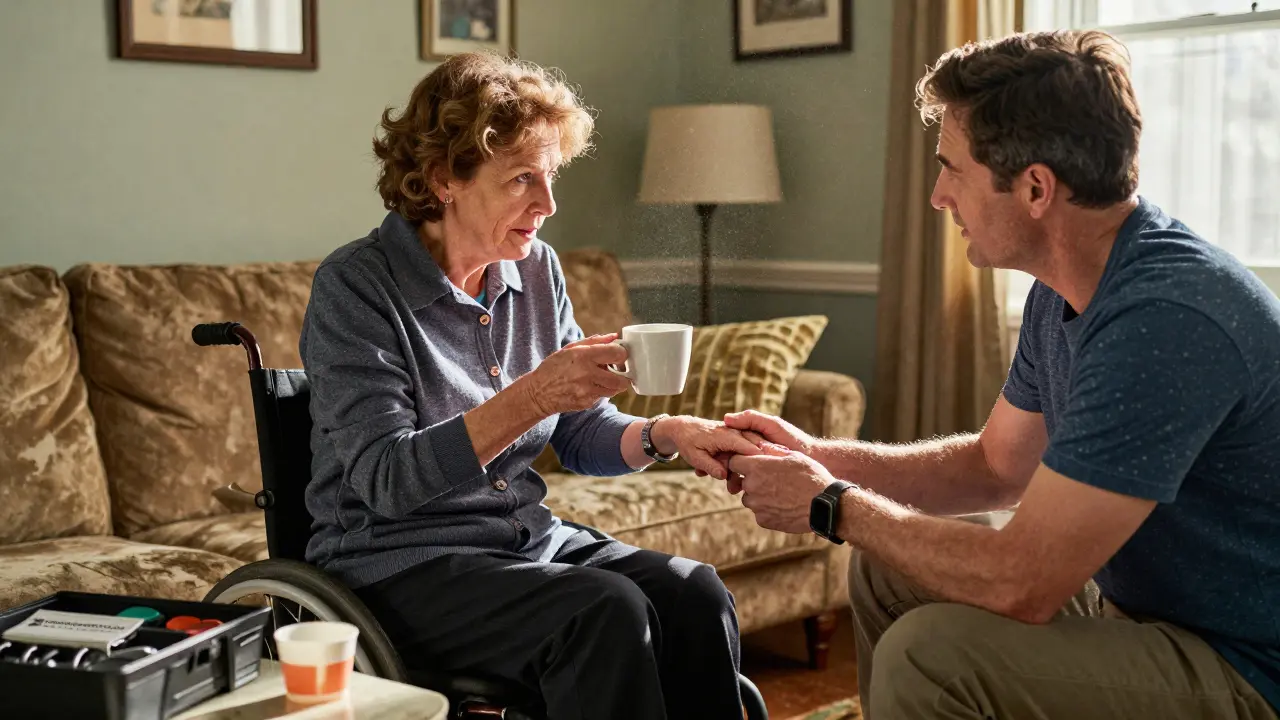
Why Care Planning Isn’t Optional
Most people think treatment means medicine. For Huntington’s, treatment means planning. Because by the time chorea is bad, you’re already losing your independence. By the time speech falters, you’re already struggling to eat. By the time you can’t walk, you need round-the-clock help. The HDSA (Huntington’s Disease Society of America) says the most important thing you can do is start care planning within six months of diagnosis. And yet, only 37% of people in general neurology clinics do it. At specialized HD centers? 82% do. The difference? Years of life. Less hospitalization. Less suffering. Here’s what that planning looks like:- Early stage (0-5 years): Legal documents-living wills, healthcare proxies, power of attorney. 78% of patients complete these within two years when they get help. Without them, families face agonizing decisions during crises.
- Mid-stage (5-15 years): Therapy becomes critical. Occupational therapy helps with dressing, eating, using tools. Speech therapy prevents choking and keeps communication alive. 65% need occupational help by 10 years. 45% need speech help. Aquatic therapy? Studies show it improves balance 35% more than land-based exercises. But 68% of families can’t afford it.
- Late stage (15+ years): Full-time care. 89% of patients need residential facilities by 20 years. Annual costs? Around $125,000 in the U.S. Most insurance doesn’t cover long-term care. Families pay out of pocket. One survey found 42% of U.S. households spend over $5,000 a year on uncovered therapies.
The Hidden Cost: Emotional and Financial Strain
The numbers don’t tell the whole story. A caregiver on the HDSA forum wrote: “The hardest part isn’t the chorea or even knowing I’ll decline-it’s watching my family try to plan for my deterioration while I’m still here.” That’s the emotional weight no study measures. Care coordination is the biggest burden. Families juggle neurologists, therapists, social workers, psychiatrists. One survey found caregivers spend 15+ hours a week just managing appointments. In rural areas, it takes over two years to get a full care team together. In cities? Just over a year. And the disparities are brutal. Only 62% of U.S. HD patients have access to a specialty center. In Europe, it’s 28%. That gap isn’t just inconvenient-it’s deadly. Patients in specialty care live 2.3 years longer on average. They have 32% fewer hospital visits for pneumonia and 58% fewer suicides. Even with new drugs in trials-like Wave Life Sciences’ gene-targeting therapy that cut mutant protein by 38% in early tests-care planning remains essential. Because even if a cure comes tomorrow, there are 40,000 Americans living with HD today. They need help now.
What Needs to Change
Right now, care for Huntington’s is patchy. Some clinics have full teams-neurologists, therapists, social workers, genetic counselors-all talking to each other. Others? One doctor, one appointment, one prescription, and you’re on your own. Specialty centers hold quarterly team meetings. Only 53% of them actually do. Why? Reimbursement. Insurance doesn’t pay enough for coordination. So the best care is rare. And expensive. The HDSA’s goal? Get 85% of U.S. patients into specialty care by 2025. That means more clinics. More trained staff. More funding. Right now, only 65% of movement disorder specialists are certified to use the UHDRS. That’s the tool that measures disease progression. If doctors aren’t trained to use it, they can’t track it. And if they can’t track it, they can’t plan. There’s hope. The FDA now requires new HD drugs to show at least a 3.5-point improvement on the UHDRS to get approved. That’s forcing better research. And more trials. But until care is treated like a system-not an afterthought-we’re leaving people behind.What You Can Do
If you or someone you love has HD:- Get genetic counseling before testing-even if you’re just thinking about it.
- Start legal and care planning within six months of diagnosis. Don’t wait.
- Find a Huntington’s Disease Center of Excellence. Use the HDSA directory.
- Push for aquatic therapy if mobility is declining. It works better.
- Connect with others. Reddit’s r/huntington community has over 12,000 members. You’re not alone.
If you’re a caregiver: your job is exhausting. But you’re not just managing symptoms-you’re preserving dignity. Document everything. Track changes. Ask for help. There are support groups. Financial aid programs. And you deserve to be supported, too.
Huntington’s disease doesn’t give you time. But good care planning? It gives you control. Even in the face of inevitable decline, it lets you choose how you live-right up until the end.

Sanjana Rajan
March 20, 2026 AT 05:35Also, why are we still using terms like 'juvenile form'? Sounds like a Disney movie. It’s not cute. It’s horrifying.
Kyle Young
March 21, 2026 AT 10:31This isn’t merely a neurological disorder. It’s an existential crisis written in DNA. The tragedy isn’t just the loss of function. It’s the loss of narrative continuity. Who are we, if we cannot be the authors of our own actions?
Alexander Pitt
March 21, 2026 AT 21:13Manish Singh
March 22, 2026 AT 22:22Nilesh Khedekar
March 23, 2026 AT 07:30Robin Hall
March 24, 2026 AT 00:54jared baker
March 25, 2026 AT 01:07Michelle Jackson
March 25, 2026 AT 16:08Suchi G.
March 27, 2026 AT 03:25