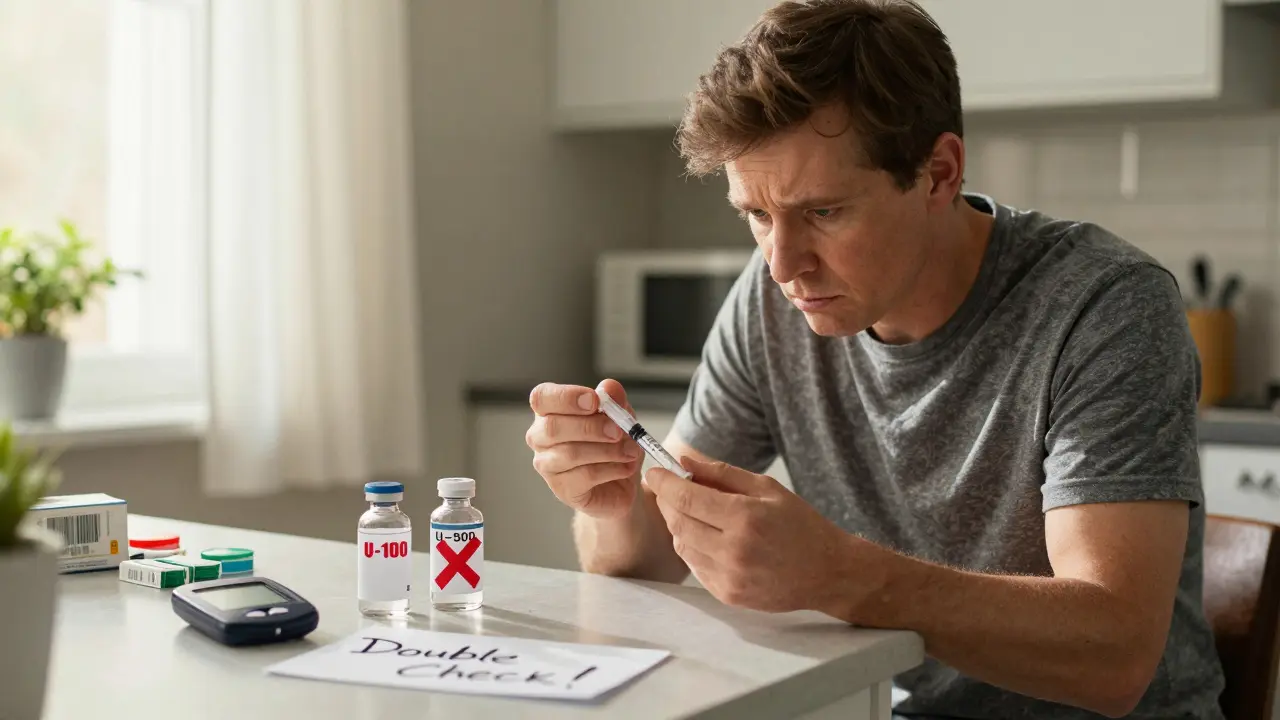
Getting insulin wrong can be deadly. One extra unit. One wrong syringe. One misread number. It doesn’t take much for blood sugar to crash - and when it does, it can happen fast. You might feel shaky, sweaty, confused. Or worse, you might pass out. This isn’t theoretical. In the U.S. alone, over 7 million people use insulin daily. Many of them have made a dosing mistake at least once. And most of those mistakes happen because of simple, preventable errors - not because they didn’t try hard enough.
Understanding Insulin Concentration: U-100 vs. U-500
Not all insulin is the same. The most common type you’ll see is U-100, which means 100 units of insulin per milliliter. That’s what’s in most pens and vials. But there’s also U-500, five times stronger. It’s used by people who need a lot of insulin - often over 200 units a day. Mixing them up is dangerous. Using a U-100 syringe to draw U-500 insulin? You’ll get five times the dose you intended. That’s not a typo. That’s a trip to the ER.Even the labels can trick you. Some vials say "100 units/mL". Others say "U-100". Same thing. But if you see "U-500", stop. Double-check. Don’t assume. If you’re not sure what kind you’re holding, ask your pharmacist. Or better yet, write it on the vial in big letters with a marker. Visual cues save lives.
The Syringe Mistake Everyone Makes
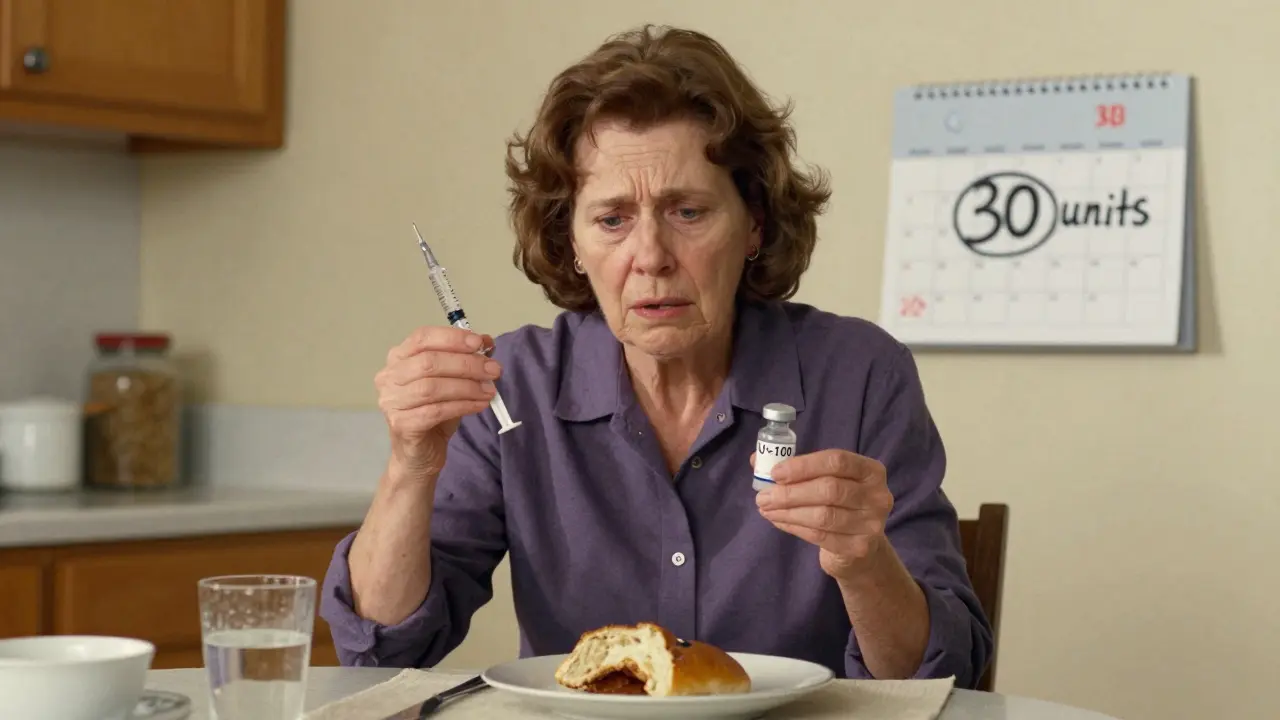
Insulin syringes are marked in units, not milliliters. That’s intentional. It’s meant to make dosing easier. But here’s the problem: people use the wrong syringe. A U-100 syringe holds 100 units max. If you need 80 units, you fill to the 80 mark. Simple. But if you’re using a tuberculin syringe - the kind meant for tiny doses like vaccines - you’ll misread the lines. Tuberculin syringes are marked in 0.1 mL increments. One unit of U-100 insulin is 0.01 mL. So 10 units = 0.1 mL. That’s not obvious unless you’ve been trained.Real story: A woman in Bristol took 30 units of insulin instead of 3 because she used a tuberculin syringe. She thought the line at "0.3" meant 3 units. It meant 30. She woke up in the hospital. Her blood sugar was 28 mg/dL. She survived. But she won’t forget it. Always use the syringe that matches your insulin. U-100 insulin? Use a U-100 syringe. No exceptions.
How to Calculate Your Dose - Without Guessing
There are three big numbers you need to know: your insulin-to-carb ratio, your correction factor, and your total daily dose.- Insulin-to-carb ratio: How many grams of carbs one unit of insulin covers. Most people start with 1:15 (1 unit for every 15 grams of carbs). But it can be 1:10 or even 1:30. Your doctor figures this out based on your weight, activity, and how your body responds.
- Correction factor: How much one unit of insulin lowers your blood sugar. The standard formula is 1800 ÷ total daily insulin dose. So if you take 30 units a day, 1800 ÷ 30 = 60. That means one unit drops your sugar by about 60 mg/dL. If you’re at 240 and want to get to 120, that’s a 120-point drop. 120 ÷ 60 = 2 units.
- Total daily dose: Your whole insulin need in a day. A rough starting point is your weight in kilograms × 0.55. So if you weigh 70 kg, that’s about 38.5 units a day. That’s split between basal (background) and bolus (meal) insulin.
Don’t do this in your head. Write it down. Or use a simple app. One mistake here can mean a crash - or a spike that lasts for days.
Basal Insulin: The Silent Killer
Basal insulin - like Lantus, Basaglar, or Tresiba - works all day, all night. It’s not supposed to change much. But when you switch from one to another, you’re not just changing brands. You’re changing how your body responds.Switching from NPH to Lantus? You need to cut your dose by 20%. Why? Because Lantus is more predictable. NPH has peaks. Lantus doesn’t. If you don’t reduce it, you’ll go low - often in the middle of the night. A 60-unit NPH dose becomes 48 units of Lantus. That’s not a suggestion. That’s standard protocol.
And Tresiba? It lasts longer. If you’re switching from Tresiba to Basaglar, you can’t just swap units. Tresiba is once daily. Basaglar is often given twice a day. So 100 units of Tresiba becomes 40 units of Basaglar every 12 hours. That’s 80 units total - not 100. You’re reducing the dose. Again, not optional. Mess this up, and you’re either high all day or crashing at night.
Hypoglycemia: The Silent Emergency
Hypoglycemia isn’t just "feeling shaky." It’s a medical event. Blood sugar below 70 mg/dL is low. Below 54 mg/dL is dangerous. Below 40? That’s a risk of seizure or coma. And it doesn’t always come with warning signs. Some people - especially those who’ve had diabetes for years - lose their ability to feel low. That’s called hypoglycemia unawareness. It’s terrifying.Here’s what you need to do:
- Always carry fast-acting sugar: glucose tabs, juice, or candy. Not chocolate - it’s too slow.
- Check your blood sugar before you drive, before you sleep, and before you exercise.
- Tell someone close to you how to give you glucagon. Keep it in your fridge or your bag. Glucagon kits aren’t just for diabetics - they’re for the people who love them.
- If you’re low and alone? Eat something. Then call someone. Don’t wait to feel better.
And if you’re a caregiver? Learn the signs. Slurred speech. Confusion. Sweating. Irritability. These aren’t personality changes. They’re signs of low blood sugar. Act fast.
Titration: Small Changes, Big Results
Adjusting insulin isn’t about trial and error. It’s about patterns. Your doctor won’t change your dose based on one bad reading. They look at trends.Here’s what works:
- If your fasting sugar is ≥180 mg/dL for 3 days in a row → add 8 units to your basal insulin.
- If it’s 160-179 → add 6 units.
- If it’s 140-159 → add 4 units.
- If it’s below 60 → cut 4 units or more.
These numbers aren’t guesses. They’re based on studies. But they’re not one-size-fits-all. If you’re very sensitive, you might need 2-unit changes. If you’re resistant, you might need 4. Track your numbers. Use a logbook. Or a phone app. Don’t rely on memory.

The Conversion Factor That’s Wrong Everywhere
This one’s technical, but it matters. Insulin is measured in units - not grams. But some lab reports and online calculators still use the wrong conversion to turn units into mass. The correct factor is 5.18 (meaning 1 unit = 5.18 picomoles). But most tools use 6.0. That’s a 15% error. It sounds small. But if you’re doing research, or if your doctor uses those numbers to adjust your dose? You could be getting too much insulin.It’s not your fault. The error is in the systems. But you can protect yourself: if you see a lab result or a calculation that talks about insulin in "pmol/L" or "micrograms," ask how they got there. Don’t assume it’s right. If your doctor says, "We calculated your dose based on this number," ask: "What conversion factor did you use?" If they don’t know - get a second opinion.
What to Do If You Made a Mistake
You took 12 units instead of 2. You used the wrong syringe. You forgot to count carbs. It happens. Here’s what to do:- Check your blood sugar now.
- Check it again in 15 minutes.
- If it’s below 70, eat 15 grams of fast-acting sugar.
- Recheck in 15. If it’s still low, eat another 15 grams.
- Call your doctor or go to urgent care if you’re confused, dizzy, or can’t raise your sugar.
- Don’t hide it. Tell your care team. They need to know so they can adjust your plan.
Shame doesn’t save you. Awareness does. Every mistake you report helps make insulin safer for everyone.
Final Rule: When in Doubt, Don’t Inject
If you’re tired. If you’re stressed. If your vision is blurry. If your pump is acting weird. If you’re not 100% sure - don’t inject. Wait. Call your pharmacist. Call your doctor. Call a friend. Read the label again. Double-check the syringe. Count the units out loud.Insulin isn’t like painkillers. You can’t take a little more if the first one didn’t work. One wrong unit can send you into a coma. And you won’t have time to fix it.
There’s no shame in asking for help. There’s only danger in pretending you know when you’re not sure.
Can I use the same syringe for U-100 and U-500 insulin?
No. Never. U-500 insulin is five times stronger than U-100. Using a U-100 syringe with U-500 means you’ll draw five times the dose you intend. Always use a U-500 syringe - they’re specially marked and only sold for that purpose. If you’re prescribed U-500, ask your pharmacist to show you how to use it.
Why do I need to reduce my dose when switching from NPH to Lantus?
NPH insulin has peaks - it works harder in the first few hours after injection. Lantus works steadily without peaks. If you switch without lowering your dose, you’ll get too much insulin overall. That leads to low blood sugar, especially overnight. The standard reduction is 20%. So 60 units of NPH becomes 48 units of Lantus. Always confirm this with your doctor before switching.
How do I know if my correction factor is right?
Test it. Take a correction dose when your blood sugar is high - say, 250 mg/dL. Wait 2 hours. If it’s around 150, your factor is working. If it’s still over 200, you need more insulin per unit. If it’s below 100, you’re taking too much. The formula is 1800 ÷ total daily insulin, but your body might need more or less. Track your results for a week and bring them to your provider.
Can I use a glucose meter from another country?
Yes - but check the units. Some meters show mmol/L (common in Europe and Canada), others show mg/dL (used in the U.S.). 5.5 mmol/L equals 100 mg/dL. If you’re used to 100 and see 5.5, you might think you’re low when you’re not. Always know which unit your meter uses. Most modern meters let you switch. Check the settings.
What should I do if I forget to take my basal insulin?
If you miss it by less than 2 hours, take it now. If it’s been more than 2 hours, don’t double up. Just take your next dose at the regular time. Doubling up can cause a dangerous drop later. If you miss doses often, talk to your doctor. You might need a different type of insulin, or a reminder system. Don’t try to catch up on your own.
Is it safe to reuse insulin syringes?
Some people do - but it’s not recommended. Reusing needles increases pain, risk of infection, and can dull the tip, making injections less accurate. If you’re on a tight budget, talk to your pharmacy. Many offer free or low-cost syringes through patient assistance programs. Your health isn’t worth the risk of a reused needle.


Beth Templeton
January 6, 2026 AT 22:49U-500 and U-100 in the same house? That’s not a diabetes management issue, that’s a horror movie waiting to happen.
Kiran Plaha
January 8, 2026 AT 08:38I used a tuberculin syringe once thinking it was the same. Turned out I took 30 units instead of 3. Woke up in the ER. Never again. Always double-check the syringe.
Vinayak Naik
January 9, 2026 AT 07:20Man, insulin is like a ninja-silent, deadly, and if you mess with it even a little, it’ll ghost you in the middle of the night. U-500 ain’t no joke, it’s like bringing a flamethrower to a candle fight. And don’t even get me started on NPH to Lantus switches-cut that dose like you’re chopping onions, not guessing your way to coma.
I’ve seen folks try to wing it with ‘I think my body needs more’ and end up in the hospital with a glucose monitor screaming like a smoke alarm. Your body ain’t a spreadsheet, it’s a live wire. Track, don’t guess.
And yeah, the 1800 rule? Works like magic if you’re not a walking insulin volcano. But if your sugar drops like a rock after 2 units? Maybe your factor’s not 60, maybe it’s 30. Test it. Don’t trust the textbook.
Also, glucose tabs, not chocolate. Chocolate’s for when you’re celebrating not dying. And glucagon? Keep it where your partner can find it while crying and yelling your name. Don’t make them hunt for it like a lost sock.
And if you’re reusing needles? Bro, you’re not saving money, you’re buying pain, infection, and a side of sepsis. Talk to your pharmacy. There’s programs. I got mine free through a nonprofit. You ain’t poor if you’re alive.
Basal insulin isn’t a suggestion. It’s the quiet engine in your body. Mess with it without knowing the specs? You’re not being brave, you’re being dumb.
And that conversion factor thing? 5.18 vs 6.0? Sounds tiny, but if your doc’s using the wrong number, you’re getting extra insulin like it’s free candy. Ask them. If they stare blankly? Get a new doc.
When in doubt? Don’t inject. Wait. Call someone. Read the label again. Say it out loud. ‘U-100. Syringe marked in units. Not mL.’ Say it like a mantra. Your life’s not a gamble.
And yeah, I’ve messed up. I told my care team. They didn’t judge. They adjusted. That’s how you survive this.
Isaac Jules
January 10, 2026 AT 03:05LOL at people who think ‘I just need to adjust’ after a mistake. You don’t get to ‘adjust’ after you nearly kill yourself. You get to be the guy who almost died because he thought insulin was like Advil.
And that ‘use the same syringe’ myth? That’s not ignorance, that’s negligence. If you’re using a tuberculin syringe for insulin, you deserve to crash.
Also, why are we still using ‘1800 divided by total daily dose’? That formula was written in 1998. Your body isn’t a 1998 calculator.
And if you’re reusing needles? You’re not saving money. You’re paying for a trip to the ER with a side of sepsis.
Dana Termini
January 10, 2026 AT 10:11Thank you for writing this. I’ve been scared to ask my doctor about switching from NPH to Lantus because I didn’t know how much to reduce. This made it clear. I’m going in tomorrow with this printed out.
Also, I never knew about the conversion factor thing. I’ll ask my endo next time. I don’t trust numbers I don’t understand.
Stuart Shield
January 11, 2026 AT 04:02Insulin’s like a silent orchestra conductor-mess with one note and the whole symphony collapses. I’ve been on it for 17 years and still check the label three times. Always. Even when I’m half-asleep. Even when the pump’s beeping. Even when my wife’s yelling at me to hurry up.
U-500? That’s not insulin, that’s a loaded gun with no safety. And the syringe thing? I keep my U-100 and U-500 syringes in different colored pill organizers. Visual cues saved my life.
And yes, glucagon. I keep two in the fridge. One for me, one for my kid. If I go down, he knows where to find it. He’s 12. He’s trained. He’s my hero.
Don’t be the person who ‘didn’t think it was that bad.’ It’s always that bad.
Pavan Vora
January 12, 2026 AT 01:01As someone from India, I’ve seen so many people using insulin pens bought online without knowing U-100 vs U-500... it’s terrifying. We need more awareness here. Pharmacies don’t always explain. Many think ‘it’s insulin, it’s all the same.’ No. No. No. This post is a lifeline.
And yes, glucose tabs-never chocolate. I learned that the hard way. My uncle passed out at a wedding because he ate a chocolate bar. Took 45 minutes to revive him. Don’t be like my uncle.
Also, I use a notebook. I write down every dose, every meal, every reading. Memory is a liar. Paper doesn’t lie.
Kelly Beck
January 13, 2026 AT 08:29You are doing such important work with this post. I’ve been on insulin for 12 years and I still get nervous every time I draw up a dose. It’s okay to be scared. It’s okay to double-check. It’s okay to ask for help.
I keep a sticky note on my insulin pen: ‘U-100. Syringe. Units. Not mL.’ I read it every single time. Even if I’ve done it 1000 times.
And glucagon? I taught my whole family how to use it. My dog even knows the sound of the injector. He barks when I’m low. (Okay, maybe not the dog, but you get it.)
You’re not weak for needing help. You’re brave for staying alive.
Amy Le
January 14, 2026 AT 13:00U.S. healthcare is a joke. You need to know 12 different conversion factors just to not die. Meanwhile, in Canada, they just give you the right syringe and say ‘don’t be an idiot.’
And why is this even a thing? Why aren’t U-500 syringes the default? Why are we still using 1970s labeling?
Also, ‘1800 divided by total dose’? That’s not science. That’s a guess written on a napkin by a tired endo in 1999.
And why is glucose tab availability worse than tampons in some states? This isn’t healthcare. It’s a survival game.
Leonard Shit
January 15, 2026 AT 05:45Yeah, I messed up once. Took 12 units instead of 2. Didn’t tell anyone. Thought I’d ‘figure it out.’ Ended up in the ER at 3 a.m. with my mom crying. I was too embarrassed to say anything.
Turns out, the docs didn’t care. They just said, ‘Next time, tell us.’
So now I do. Every time. Even if I feel dumb. Because shame doesn’t save you. Awareness does.
Also, I use a phone app now. It beeps when I’m about to inject. And it logs everything. I don’t trust my brain anymore.
Brian Anaz
January 15, 2026 AT 23:38Why are we still having this conversation? This isn’t rocket science. It’s basic safety. If you can’t read a label or use a syringe, you shouldn’t be injecting insulin.
And yes, U-500 is five times stronger. That’s not a suggestion. It’s math. Stop pretending it’s not.
Also, ‘reusing needles’? That’s not frugal. That’s reckless. You’re not saving money. You’re risking infection, nerve damage, and worse.
And if your doctor doesn’t know the conversion factor? Fire them.
Venkataramanan Viswanathan
January 16, 2026 AT 10:15As an Indian diabetic living in the U.S., I can confirm: the language barrier is deadly. Many of my relatives back home buy insulin from street vendors. No labels. No instructions. Just ‘take one.’
I’ve translated this entire post into Hindi and shared it in five WhatsApp groups. If one life is saved, it’s worth it.
And yes-glucose tabs. Not candy. Not juice. Tabs. Fast. Precise. Reliable.
Indra Triawan
January 17, 2026 AT 15:27I used to think insulin was just a number. Now I know it’s a ghost. It waits. It watches. It doesn’t care if you’re tired, stressed, or confused. It just takes.
I’m not angry. I’m just… tired. Tired of being scared every time I pick up a syringe.
But I still do it. Because I want to live.
Tom Swinton
January 19, 2026 AT 03:18Let me tell you something-this isn’t just about insulin. It’s about dignity. It’s about not being treated like a statistic. It’s about being seen as someone who deserves to live without fear.
I’ve had nurses assume I was ‘non-compliant’ because I had a low. I wasn’t non-compliant. I was human. I made a mistake. And I told them. And they didn’t help. They judged.
But I kept going. I learned. I wrote down everything. I got a glucose monitor that talks to my phone. I taught my kids how to use glucagon. I carry two sets of tabs in my purse, my car, my work bag.
And I still check the label three times. Always. Even when I’m in a rush. Even when I’m crying. Even when I’m exhausted.
You are not alone. You are not broken. You are not failing. You are surviving. And that’s enough.
Keep going. You’re doing better than you think.
Katie Schoen
January 19, 2026 AT 18:26U-500 syringes are like the unicorn of diabetes supplies-everyone talks about them, but no one can find them. My pharmacy had to order mine from a warehouse in Ohio. Took two weeks.
Meanwhile, my insurance said ‘we don’t cover specialty syringes.’
So I paid $120 out of pocket. Because I’d rather pay $120 than wake up in the ICU.
And yes-I wrote ‘U-500’ on the vial in red marker. And I put a red sticker on the syringe box.
Because if I’m going to survive this, I need all the visual help I can get.
Brian Anaz
January 19, 2026 AT 19:49Wait, you said ‘don’t inject if you’re unsure’? Then why do we have to be perfect? Why isn’t there a fail-safe? Like, a backup dose counter? Or a syringe that auto-detects insulin type?
Why is this still on the patient? Why isn’t the system protecting us?
It’s not our fault. It’s the system’s failure.