Medication-Induced Glaucoma Risk Checker
This tool helps you assess your risk of medication-induced acute angle-closure glaucoma based on the medications you're taking and your personal risk factors. It's not a substitute for medical advice, but can help you have informed conversations with your doctor.
Medication Risk Assessment
Personal Risk Factors
Your Risk Assessment
Select medications and risk factors to see your assessment
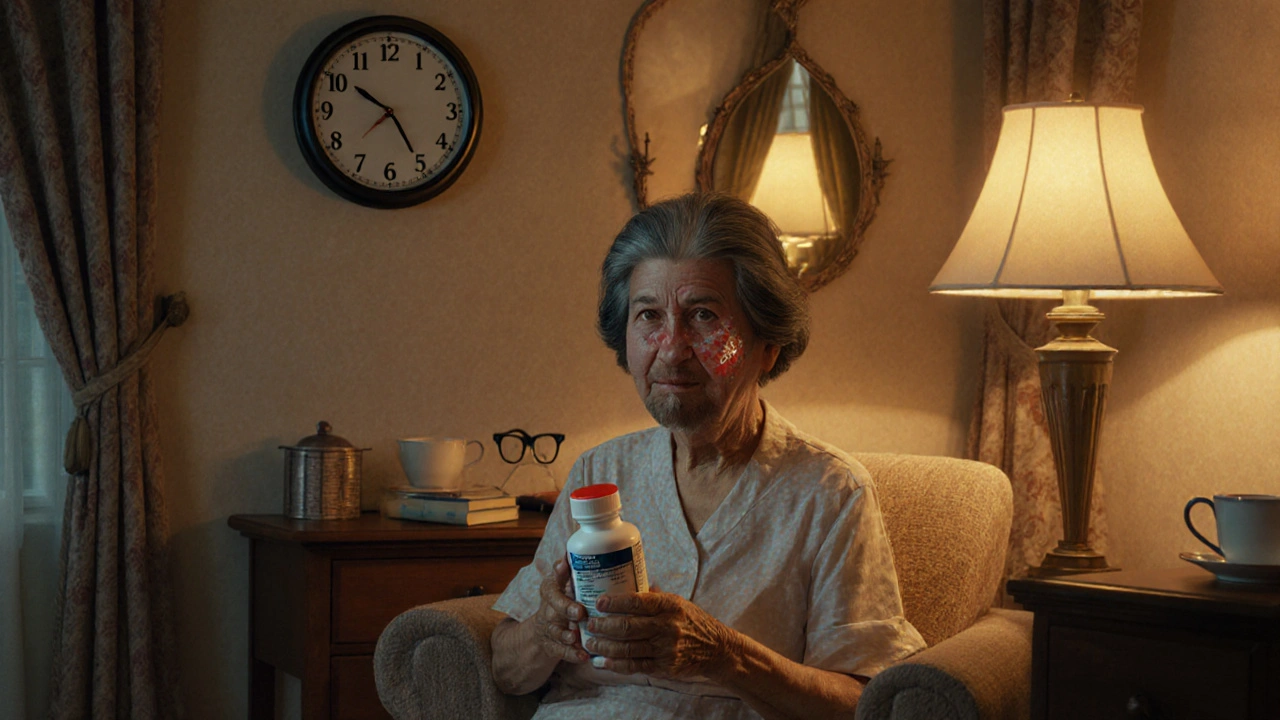
Imagine waking up with severe eye pain, blurred vision, and halos around lights-then realizing your headache isn’t a migraine. It’s your eye pressure skyrocketing, and you’re losing vision fast. This isn’t rare. Every year, hundreds of people develop acute angle-closure glaucoma because of a medication they took for a cold, allergies, or depression. And most had no idea they were at risk.
What Is Acute Angle-Closure Glaucoma?
Acute angle-closure glaucoma (AACG) happens when the drainage system inside your eye suddenly gets blocked. Normally, fluid called aqueous humor flows out through a tiny mesh at the front of your eye. But if the iris swells or pushes forward, it can shut that drain completely. Pressure builds up in minutes-not days or years. When it hits 40-80 mm Hg (normal is 10-21), your optic nerve starts dying. Permanent vision loss can happen in under 24 hours.
Unlike the slow, silent damage of open-angle glaucoma, AACG hits like a sledgehammer. Symptoms include:
- Severe eye pain or headache
- Blurred or foggy vision
- Seeing colored halos around lights
- Red, swollen eye
- Nausea or vomiting
- A fixed, mid-dilated pupil (not reacting to light)
This isn’t just a bad eye infection. It’s a true emergency. If you have these symptoms and haven’t been checked by an eye doctor, go to an emergency room immediately. Waiting even a few hours can cost you sight.
How Do Medications Trigger This?
Most people with AACG have narrow iridocorneal angles-meaning the space between the iris and cornea is too tight. It’s like having a door that barely opens. Normally, it’s fine. But certain drugs can make the iris swell or the pupil dilate so much that it slams shut against the lens, blocking fluid flow.
The biggest culprits? These five classes of medications:
- Adrenergic agents (like phenylephrine in nasal sprays and eye drops)-cause 35% of cases
- Anticholinergics (like tropicamide in dilating drops, diphenhydramine in allergy meds)-responsible for 28%
- Sulfonamide drugs (like acetazolamide, topiramate, sulfa antibiotics)-cause 15%
- SSRIs and tricyclic antidepressants (like paroxetine, amitriptyline)-12%
- Antihistamines and decongestants (like pseudoephedrine)-10%
Some drugs work in multiple ways. Tropicamide doesn’t just dilate the pupil-it can also cause the iris to thicken. Sulfa drugs can make the ciliary body swell, pushing the iris forward. Even a single dose of a nasal spray or an allergy pill can trigger this in someone with narrow angles.
Who’s at Risk?
You don’t need to have glaucoma to be at risk. Many people with narrow angles never know it-until a drug triggers an attack.
High-risk groups include:
- People over 40
- Women (twice as likely as men)
- People of East Asian descent (8.5% have narrow angles vs. 3.8% in White populations)
- Farsighted individuals (hyperopia)
- Those with shallow anterior chambers (less than 2.5 mm deep)
- People with a family history of angle-closure glaucoma
Studies show only 25% of people who suffer a medication-induced attack had ever been told they had narrow angles. The rest? They took a common drug-maybe even over-the-counter-and woke up blind in one eye.
Why Do Doctors Miss This?
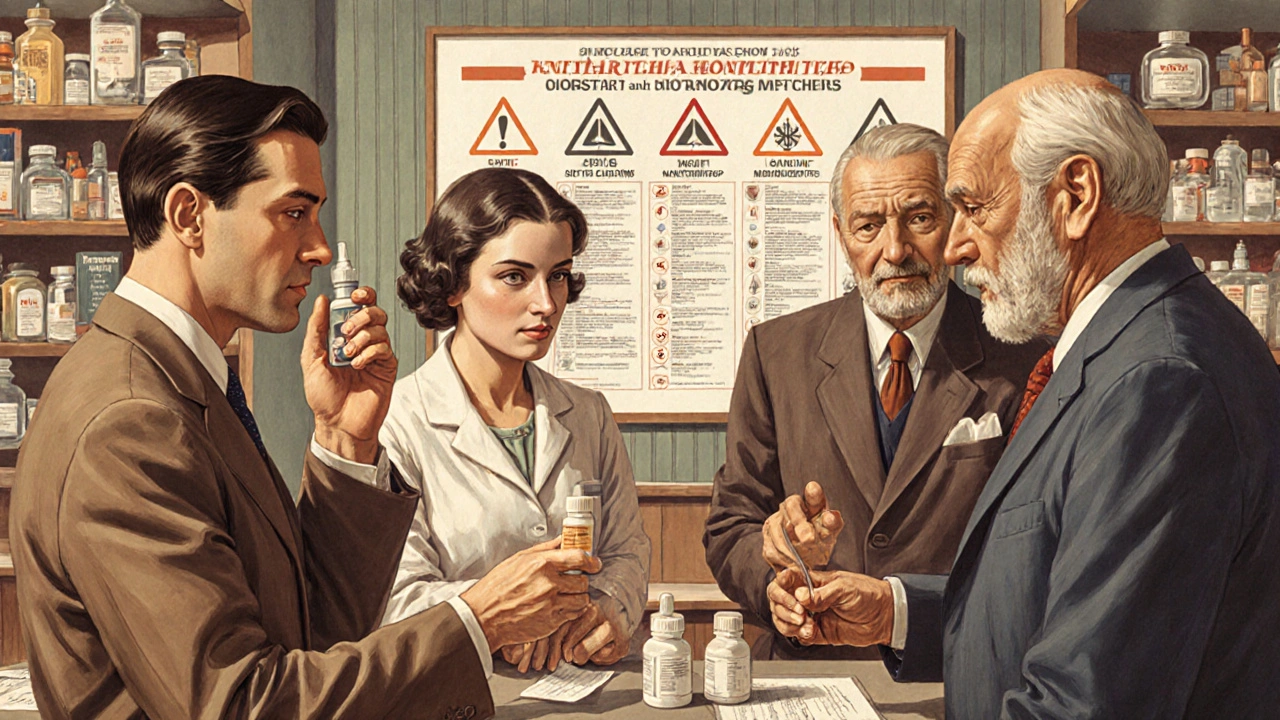
Emergency rooms get 4,327 cases of suspected AACG each year in the U.S. alone. Only 38% are correctly diagnosed the first time. Why?
Because the symptoms look like other things:
- Severe migraine
- Food poisoning
- Stress reaction
- Conjunctivitis
One patient on Reddit described being sent home with painkillers after telling the ER she had “the worst headache of my life.” Two days later, she lost 20% of her peripheral vision. Another patient had her pupils dilated during a routine eye exam-no angle check was done-and woke up with 60 mm Hg pressure. Permanent damage followed.
Doctors aren’t always trained to think about eye pressure when someone walks in with nausea and a headache. But they should be.
What Should You Do Before Taking These Medications?
Prevention is simple-if you know what to ask for.
If you’re over 40, or you’re farsighted, or you’re of East Asian descent, ask your doctor or pharmacist this before taking any new medication:
- “Could this cause my eye pressure to spike?”
- “Have I ever had my eye angles checked?”
- “Is there a safer alternative?”
There’s a 5-7 minute test called gonioscopy that can show if your angles are narrow. It’s painless. It doesn’t hurt. It’s done with a special lens and a quick glance. If your angles are narrow (Shaffer grade ≤2), you should avoid these drugs entirely-or use them only under close supervision.
Safe alternatives exist:
- Instead of diphenhydramine (Benadryl), use loratadine (Claritin)
- Instead of pseudoephedrine, use phenylephrine-free decongestants
- Instead of amitriptyline, try an SSRI like sertraline (if approved by your doctor)
- For asthma, use formoterol instead of epinephrine-based inhalers
What Happens If It’s Not Treated?
If you don’t lower the pressure fast, your optic nerve dies. Once it’s gone, it doesn’t come back. Even with treatment, up to 44% of patients have permanent vision loss. That’s not a risk you take lightly.
Emergency treatment includes:
- Pilocarpine eye drops (2%) every 15 minutes for an hour
- IV mannitol to pull fluid out of the eye
- Oral acetazolamide (if not contraindicated)
- Laser iridotomy within 24 hours to create a new drainage hole
But none of this matters if you don’t get help in time. The clock starts ticking the moment your pressure rises above 40 mm Hg. After 24 hours, the chance of saving your vision drops by 50%.
Why Is This Still Happening?
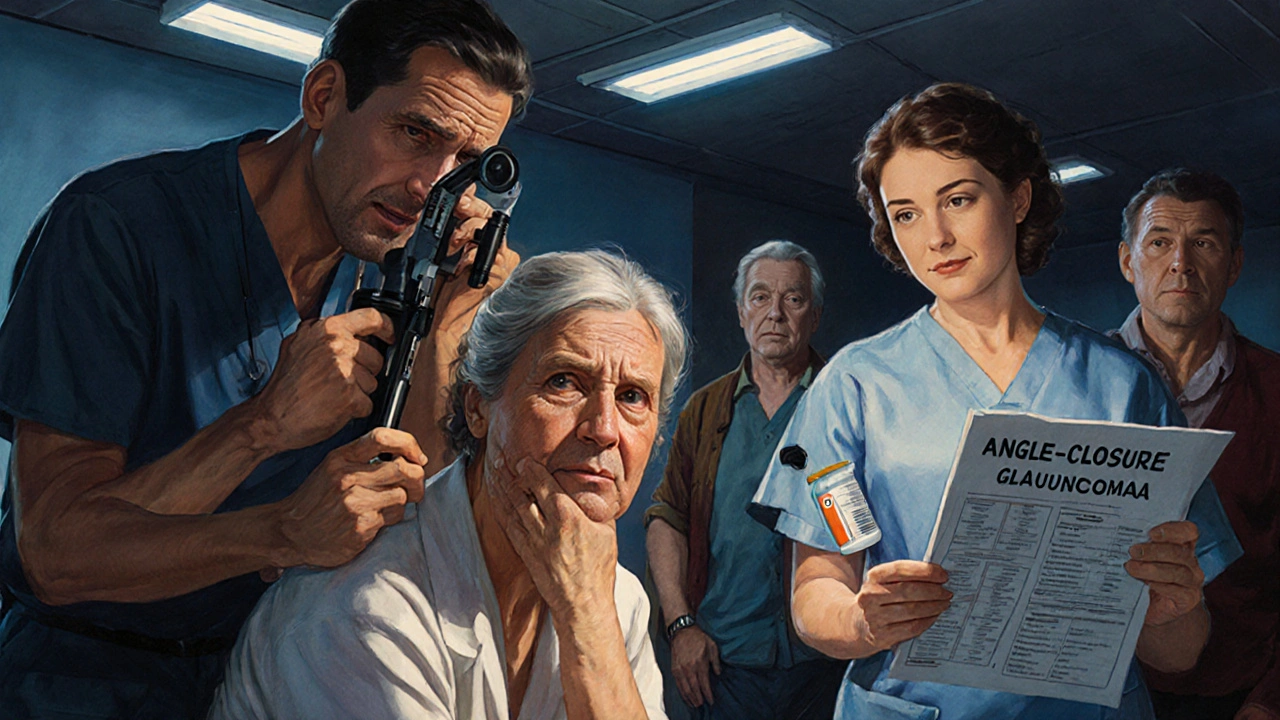
In 2022, the FDA required black box warnings on topiramate and sulfa drugs. In 2023, Epic’s electronic health system started flagging high-risk prescriptions. Yet a 2023 survey found only 42% of primary care doctors routinely check for narrow angles before prescribing these drugs. And 68% of patients say they were never warned.
It’s not that doctors are careless. It’s that this isn’t part of standard training. A cold pill or a migraine med doesn’t seem dangerous. But for someone with narrow angles, it’s a landmine.
What’s worse? Many patients don’t even know they’re at risk. No one told them. No one checked. And now, they’re paying the price.
What Can You Do Right Now?
You don’t need to wait for symptoms. If you’re over 40, or you’re farsighted, or you’re Asian, get your angles checked. Ask your optometrist or ophthalmologist for a gonioscopy. It’s not part of a routine eye exam-you have to ask for it.
Keep a list of all your medications. Share it with every doctor. If you’ve ever had eye pain after taking a new drug, tell your eye doctor-even if it happened years ago.
And if you ever wake up with sudden eye pain, blurred vision, or halos around lights-don’t wait. Don’t call your GP. Don’t wait for your appointment. Go to the ER. Say: “I think I have acute angle-closure glaucoma. My eye pressure might be too high.”
That one sentence could save your sight.
What If I’ve Already Taken One of These Drugs?
If you’ve taken any of these medications and you’re in a high-risk group, don’t panic-but don’t ignore it either.
- If you feel fine: Schedule a gonioscopy as soon as possible.
- If you’ve had eye pain, blurred vision, or headaches after taking the drug: Get checked now. Even if it was weeks ago.
- If you’ve lost peripheral vision: You need a full visual field test and optic nerve imaging. Damage may be permanent, but further loss can be stopped.
There’s no harm in getting checked. There’s huge risk in waiting.

Chris Taylor
November 29, 2025 AT 01:11I had no idea a simple allergy pill could do this. My mom took Benadryl last year for her sinus stuff and woke up with a headache so bad she thought she was having a stroke. Turns out she’s farsighted and had narrow angles-never checked. She’s lucky she didn’t lose vision. Now she gets her angles checked every year. If you’re over 40, just ask. It takes five minutes.
Thanks for posting this. People need to know.
Melissa Michaels
November 29, 2025 AT 14:42While the information presented here is medically accurate and critically important, the tone of the original post risks inducing panic among readers who may not fully understand their personal risk profile. Not every farsighted individual over 40 needs to fear every OTC medication. The key is awareness and targeted screening-not blanket avoidance. Gonioscopy should be standard for high-risk groups, but it’s not a substitute for clinical judgment. Patients should consult their eye care provider before making changes to medication regimens.
Also, the term 'landmine' is emotionally charged and may discourage trust in physicians. A more collaborative framing would improve public health outcomes.
Nathan Brown
November 30, 2025 AT 22:18It’s wild how we live in a world where a cough drop can blind you and no one tells you until it’s too late.
We’ve optimized for convenience, not caution. We take pills like they’re candy because the system says they’re safe. But safety isn’t universal-it’s conditional. Your body’s architecture matters. Your ancestry matters. Your eye shape matters. And yet, we’re taught to trust labels, not biology.
I’m Indian. My dad had angle-closure glaucoma after a cold med. He never knew his angles were narrow. No one asked. No one checked. He lost 30% of his vision before they figured it out.
We don’t need more warnings on labels. We need a culture that asks: ‘What could this do to *me*?’ Not just ‘Is it approved?’
And yeah, if you’re Asian, farsighted, or over 40-you’re not being paranoid. You’re being smart. Go get that gonioscopy. It’s not weird. It’s survival.
Matthew Stanford
December 1, 2025 AT 23:25Big thanks to the OP for sharing this. So many people don’t realize how simple prevention can be. Just ask your eye doctor for a gonioscopy. Five minutes. No pain. Could save your sight.
And if you’re on meds like topiramate or amitriptyline? Talk to your pharmacist. They’re trained to catch these interactions. Most don’t even know they’re supposed to.
Let’s make this common knowledge. Not just a Reddit post. Real change starts with one person asking the right question.
Olivia Currie
December 3, 2025 AT 12:30OMG I JUST TOOK DIPHENHYDRAMINE LAST WEEK AND I’M ASIAN AND FARSIGHTED I’M GOING TO BE BLIND I’M GOING TO BE BLIND I’M GOING TO BE BLIND
WAIT WAIT WAIT-hold on. I feel fine. But like… what if? What if I’m already losing vision and I just don’t know? I’m booking an appointment RIGHT NOW. I’m calling my mom. I’m telling my whole family. This is terrifying. But also… thank you. Thank you for saving me before I lost it.
Curtis Ryan
December 5, 2025 AT 06:41wait so benadryl can make you go blind?? i took that last month for my allergies and my eyes felt weird but i thought it was just dryness
oh god oh god oh god i need to go to the er right now
wait no i dont feel pain or halos but i still think i should get checked just in case
also why dont they put warnings on the bottle like they do for alcohol?? this is insane
Rajiv Vyas
December 7, 2025 AT 04:25lol this is all a pharma scam. They want you to pay for 'gonioscopy' so they can sell you laser surgery later. You think they care if you go blind? No. They make billions off glaucoma meds. The real cause? Fluoride in the water. It shrinks your anterior chamber. I’ve read 37 studies. The FDA knows. They just don’t tell you.
Also, your 'narrow angles' are just a myth created by optometrists to sell exams. I’ve never had one. I take everything. My eyes are fine. You’re being manipulated.
farhiya jama
December 9, 2025 AT 02:15ugh why is everyone so dramatic. I’ve taken Benadryl since I was 16 and I’m fine. You’re all just scared of medicine now. It’s not a conspiracy, it’s just bad luck. If you’re gonna panic over every OTC drug, maybe don’t take anything. Just live in a bubble. I’m not going to the eye doctor because I ‘might’ have narrow angles. That’s not healthcare, that’s anxiety marketing.
Astro Service
December 10, 2025 AT 06:58Why are we letting Asians and farsighted people get special rules? This is discrimination. In America, everyone should be treated the same. If you take a cold pill and your eye hurts, that’s your problem. Don’t blame the medicine. Blame your genetics. We don’t need more tests. We need more toughness. My grandpa took everything and never had a problem. You people are too soft.