
Most people think sunscreen is simple: slap it on, go outside, and hope for the best. But if you’re using a sunscreen that doesn’t protect properly, or you’re not applying enough, you’re not just risking a sunburn-you’re increasing your chance of skin cancer and accelerating skin aging. The truth is, not all OTC sunscreens are created equal. Even if it says SPF 50 on the bottle, it might not be doing what you think.
What SPF Actually Means (And Why Higher Isn’t Always Better)
SPF stands for Sun Protection Factor. It measures how well a sunscreen blocks UVB rays-the kind that cause sunburn and contribute to skin cancer. SPF 30 blocks about 97% of UVB rays. SPF 50 blocks 98%. SPF 100 blocks 99%. That’s it. The difference between SPF 50 and SPF 100 is just 1% more protection. Yet, many brands charge double the price for SPF 100, making it feel like a premium upgrade when it’s barely better.The FDA has been pushing for clearer labeling because misleading claims hurt consumers. Right now, any sunscreen labeled SPF 15 or higher must pass strict testing to prove it works. But here’s the catch: SPF only measures UVB. It tells you nothing about UVA rays, which penetrate deeper, cause wrinkles, and also lead to skin cancer. That’s where broad spectrum comes in.
Broad Spectrum Isn’t Just a Marketing Word
A sunscreen labeled “broad spectrum” means it protects against both UVA and UVB rays. The FDA requires these products to pass a critical wavelength test-meaning they must block UV rays up to at least 370 nanometers. If it doesn’t meet that, it can’t legally say “broad spectrum,” even if the label screams it.But here’s where things get messy. In Consumer Reports’ 2025 testing of 107 sunscreens, many mineral-based sunscreens failed the broad spectrum test. One product labeled SPF 30 actually blocked only the equivalent of SPF 4. Another, marketed as “kids-safe,” delivered only SPF 13. That’s not just disappointing-it’s dangerous. Mineral sunscreens (zinc oxide and titanium dioxide) are often preferred for sensitive skin, but they don’t automatically mean better protection. Many formulas are too thin, don’t spread evenly, or lack enough active ingredients to cover the full UVA spectrum.
Chemical sunscreens, on the other hand, often perform better in lab tests. Ingredients like avobenzone, octocrylene, and ecamsule are proven to absorb UVA rays effectively. La Roche-Posay Anthelios Melt-in Milk SPF 60 scored 92 out of 100 in protection. In contrast, top mineral sunscreens averaged around 55 out of 100. That’s a huge gap.
Mineral vs. Chemical: What Works for Your Skin
Mineral sunscreens sit on top of the skin and physically block UV rays. They start working immediately after application. That’s why dermatologists often recommend them for people with rosacea, eczema, or melasma. Zinc oxide, in particular, has anti-inflammatory properties. EltaMD UV Clear SPF 46, with 9% zinc oxide and niacinamide, is a top pick for sensitive skin.But here’s the downside: mineral sunscreens often leave a white cast, especially on deeper skin tones. That’s why many people with Fitzpatrick skin types IV-VI stop using them. Some brands have improved this-Caravee Hydrating Sheer Sunscreen SPF 30, for example, blends well without pilling. But others, like Vichy Capital Soleil Tinted Mineral SPF 60, oxidize on the skin, turning orange within hours.
Chemical sunscreens absorb UV rays and convert them into heat. They’re usually lighter, easier to spread, and invisible on the skin. Supergoop! Unseen Sunscreen SPF 40, for instance, disappears completely on medium to dark skin tones. But they need about 15-20 minutes to activate after application. And some ingredients, like oxybenzone and octinoxate, are linked to coral reef damage. That’s why Hawaii and Key West banned them in 2021.
There’s no one-size-fits-all. If you’re prone to breakouts or have sensitive skin, go mineral. If you want invisible, high-performance protection and don’t care about reefs, chemical is more reliable. And if you’re confused? Look for zinc oxide as the primary ingredient-it’s the most stable, least irritating mineral filter.
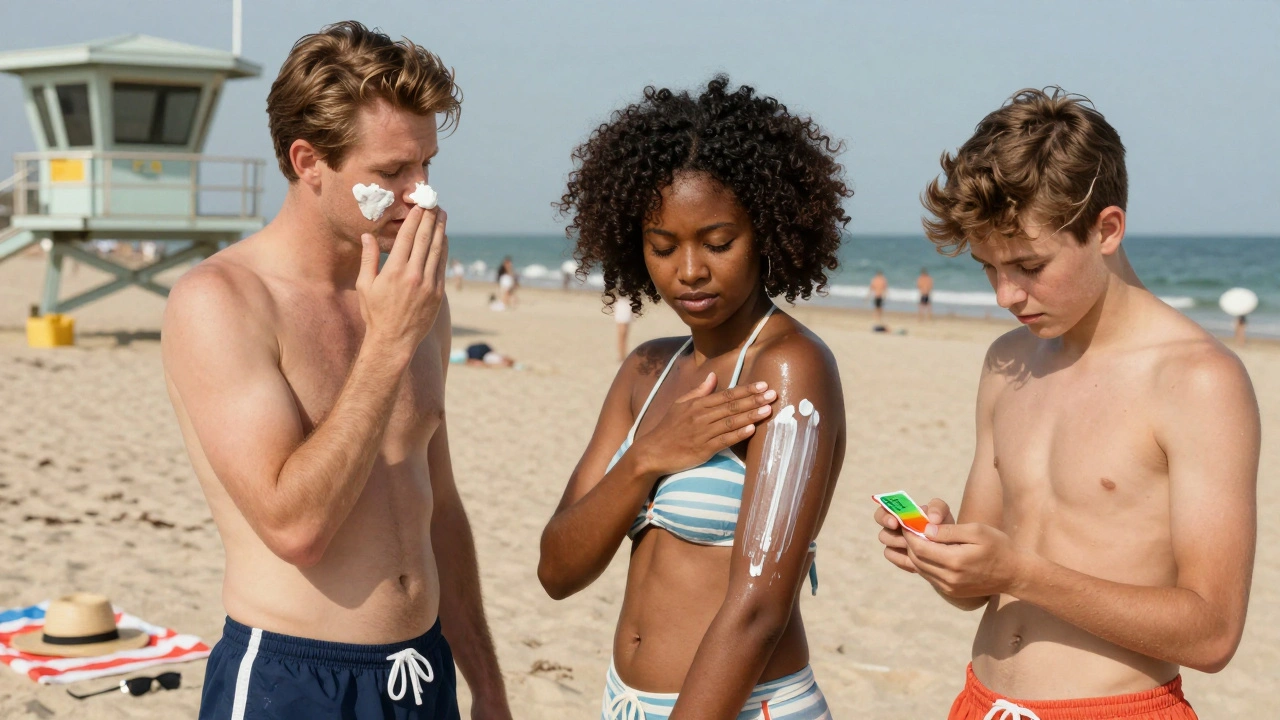
How Much Should You Really Use?
Most people apply only 25-50% of the recommended amount. That slashes protection dramatically. SPF 30 applied thinly might only give you SPF 10. The FDA says you need 2 milligrams of sunscreen per square centimeter of skin. For your face, that’s about a quarter teaspoon-roughly five pea-sized dots. Spread them across your forehead, cheeks, nose, chin, and neck. Don’t forget your ears, the back of your neck, and your lips (use a lip balm with SPF 30+).For your whole body, you need about one ounce-enough to fill a shot glass. Most people use half that. If you’re using a spray, you need to spray for 3-5 seconds per body part and rub it in. Sprays are convenient, but they’re easy to underapply. A 2024 study found that 68% of spray users didn’t cover enough skin.
Reapplication: The Most Ignored Rule
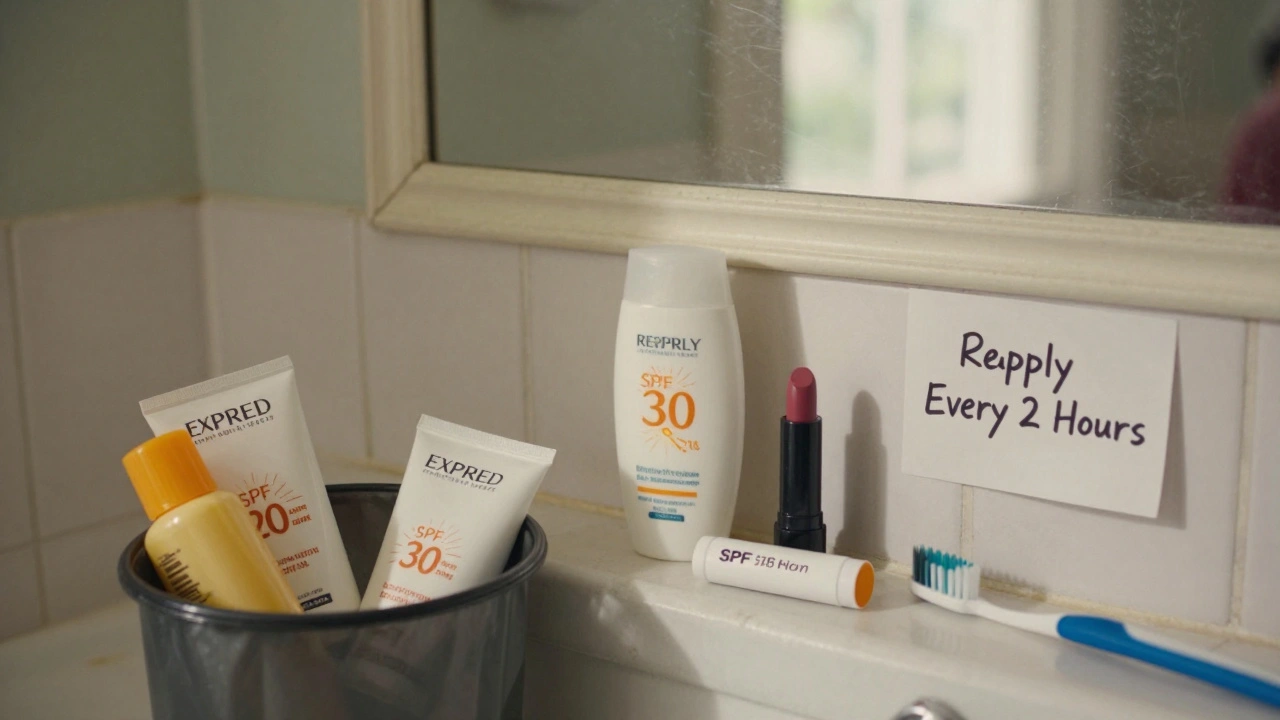
No sunscreen lasts all day. Even “water-resistant” formulas wear off. Water resistance means the product stays effective for either 40 or 80 minutes while swimming or sweating. After that, you need to reapply. And don’t forget: towel drying removes up to 80% of sunscreen, even if it’s labeled water-resistant.Experts agree: reapply every two hours, no exceptions. But here’s the reality: only 14% of people at the beach do it. On Reddit’s r/SkincareAddiction, 72% of users admitted they skip reapplication during long days outdoors. That’s why sunburns happen even when people “used sunscreen.”
There are tricks to make reapplication easier. Use a mineral sunscreen powder for touch-ups over makeup. Keep a travel-sized bottle in your bag, car, or work desk. Some brands now offer UV-sensing stickers that change color when protection fades. And apps like Sunscreenr use your phone’s camera to show uncovered spots on your skin.
What’s Changing in 2025?
The FDA is finalizing new rules expected by December 2025. By then, all OTC sunscreens must meet stricter UVA protection standards, aligning more closely with European guidelines. The agency is also considering banning 12 chemical filters, including PABA and trolamine salicylate, due to safety concerns. Oxybenzone may still be allowed, but at lower concentrations.Meanwhile, innovation is coming. Shade Smart, a wearable UV sensor launching in Q2 2025, will sync with your phone and buzz when it’s time to reapply. And mineral sunscreen sales are expected to hit 35% of the market by 2027 as environmental awareness grows. But until efficacy catches up, chemical filters still lead in protection.
What to Look For on the Label
- SPF 30 or higher - Anything lower doesn’t offer meaningful protection.
- Broad Spectrum - Non-negotiable. No exceptions.
- Water-resistant (40 or 80 minutes) - Especially if you sweat or swim.
- Active ingredients - Zinc oxide (5-25%), titanium dioxide (2-15%), avobenzone (3% max), octinoxate (7.5% max).
- Expiration date - Sunscreen loses effectiveness after two years. If there’s no date, toss it after 12 months.
Don’t be fooled by fancy packaging or celebrity endorsements. JLo Beauty That Big Screen SPF 30 costs $55-but it’s not five times better than CVS Health SPF 50 spray at $2.99. The median price is $14.75 per ounce. Pay for ingredients, not branding.
Final Takeaway
The best sunscreen is the one you’ll use every day, in the right amount, and reapply when needed. You don’t need the most expensive one. You don’t need the trendiest one. You need one that’s broad spectrum, SPF 30+, and feels good on your skin so you’ll actually wear it. And if you’re still unsure? Ask a dermatologist. They know which products actually work-not just which ones sell the most.Is SPF 100 really better than SPF 50?
No. SPF 50 blocks 98% of UVB rays. SPF 100 blocks 99%. The difference is minimal, and both require reapplication every two hours. Higher SPF can give a false sense of security, leading people to stay in the sun longer without reapplying.
Can I rely on makeup with SPF instead of sunscreen?
No. Most makeup with SPF is applied too thinly to offer real protection. You’d need to use several layers-far more than most people do-to reach the labeled SPF. Always apply a dedicated sunscreen underneath.
Do I need sunscreen on cloudy days?
Yes. Up to 80% of UV rays penetrate cloud cover. Daily sunscreen use reduces melanoma risk by 50%, according to the American Academy of Dermatology. It’s not just for beach days.
Are mineral sunscreens safer for the environment?
Zinc oxide and titanium dioxide are considered reef-safe, unlike oxybenzone and octinoxate, which damage coral DNA. But not all mineral sunscreens are equal-some contain nanoparticles or additives that may still harm marine life. Look for non-nano zinc oxide for the safest option.
Why does my sunscreen pill under makeup?
Pilling happens when sunscreen doesn’t fully absorb before applying makeup. Wait 15-20 minutes after applying sunscreen before putting on foundation. Use lightweight, water-based products. Some sunscreens, like those with silicone-based formulas, are less likely to pill.
How do I know if my sunscreen has expired?
Check the expiration date printed on the bottle. If there’s no date, discard it after 12 months. Signs of spoilage include separation, unusual smell, or change in texture. Expired sunscreen won’t protect you.

मनोज कुमार
December 3, 2025 AT 10:47SPF 50 vs 100 is a scam. 98% vs 99%? Wake up. You’re paying for marketing not protection. Mineral sunscreens? Most are useless. Lab data shows it. Stop believing the hype.
Paul Keller
December 3, 2025 AT 19:29It’s frustrating how consumers are manipulated into thinking higher SPF means better safety. The FDA’s labeling rules are a step forward, but the market still thrives on psychological pricing. SPF 100 isn’t safer-it’s just more expensive. People don’t realize that applying half the amount negates the entire benefit. Even SPF 100 becomes SPF 25 if you’re lazy. The real issue isn’t the product-it’s the behavior. Reapplication every two hours isn’t optional. It’s biological necessity. And yet, 86% of people don’t do it. We treat sunscreen like a one-time ritual instead of daily maintenance. It’s like brushing your teeth once a week and wondering why you have cavities.
Chemical filters work. They’re not perfect, but they’re proven. Avobenzone, octocrylene, ecamsule-they’re not magic, but they’re science. Meanwhile, mineral sunscreens get praised for being ‘natural’ even when they’re under-dosed and ineffective. Zinc oxide isn’t a miracle. It’s a physical blocker. If the formula doesn’t contain enough of it, or it’s not dispersed properly, it’s just white paste with false confidence. And don’t get me started on sprays. People think spraying for two seconds counts as application. It doesn’t. You need to coat, then rub. Otherwise, you’re just spraying money away.
Reef safety is a valid concern, but let’s not confuse environmental virtue signaling with actual protection. Oxybenzone is banned in Hawaii, but the real threat to coral is climate change, not sunscreen. Still, if you’re swimming in sensitive ecosystems, choose non-nano zinc. But for everyday use? Prioritize efficacy over guilt. Your skin doesn’t care if your sunscreen is eco-friendly. It only cares if it blocks UV.
And makeup with SPF? That’s a joke. You’d need to apply three layers of foundation to hit SPF 30. No one does that. You’re getting maybe SPF 5, if you’re lucky. Always layer. Sunscreen first. Always. This isn’t skincare-it’s survival.
Zed theMartian
December 4, 2025 AT 21:23SPF 100 is the new Tesla Cybertruck-overengineered, overpriced, and bought by people who think performance is measured in numbers, not results. You don’t need SPF 100. You need discipline. You need to remember you’re not a Viking charging into battle-you’re a human being with melanin that’s slowly turning into cancer cells. And yet, we treat sunscreen like a religious icon we worship once a year. I’ve seen people in Miami with SPF 100 on their face but bare shoulders, back, and neck. They think they’re protected. They’re not. They’re just a walking billboard for false security.
And don’t even get me started on ‘mineral’ being synonymous with ‘safe.’ That’s like calling a plastic fork ‘organic’ because it’s not metal. Zinc oxide doesn’t magically become effective because it’s a mineral. It needs to be in the right concentration, properly formulated, and applied thickly. Most ‘mineral’ sunscreens on the shelf are diluted with fillers and titanium dioxide that does jack squat for UVA. And then they charge $40 for it. Meanwhile, La Roche-Posay delivers 92/100 protection for $20. Why? Because they don’t market it as ‘healing crystals for your skin.’ They just make it work.
The real villain isn’t oxybenzone. It’s complacency. People think sunscreen is a checkbox. It’s not. It’s a daily ritual. Like flossing. Like sleeping. Like not eating expired yogurt. If you skip it, you’re gambling with your future skin. And your future self is going to hate you.
dave nevogt
December 5, 2025 AT 06:32It’s interesting how we’ve turned something so fundamentally biological-protection from ultraviolet radiation-into a complex consumer choice wrapped in marketing, fear, and identity. We’re not just choosing sunscreen. We’re choosing who we want to be: the eco-conscious, the science-driven, the minimalist, the luxury buyer. But the skin doesn’t care about your values. It only responds to photons. And every photon that hits unprotected skin is a tiny wound that accumulates over decades. That’s why daily use matters more than SPF number. A person using SPF 30 every day, correctly applied, will have far less damage than someone using SPF 100 once a week because they ‘only go out on weekends.’
The mineral vs chemical debate feels like a religious war. But the truth is, both have roles. Mineral is great for sensitive skin, but only if it’s well-formulated. Chemical is more reliable for broad-spectrum coverage, but only if you wait 15 minutes before sun exposure. The real issue isn’t the chemistry-it’s the application. We’ve outsourced responsibility to the bottle. We think the product will save us. But no sunscreen can save you if you don’t use it right.
And reapplication? It’s the most ignored rule because it’s inconvenient. We don’t want to stop what we’re doing. We don’t want to wipe off sweat. We don’t want to carry a bottle. But here’s the quiet truth: skin cancer doesn’t care about your schedule. Aging doesn’t care about your makeup routine. The sun doesn’t pause for your lunch break. If you’re serious about your skin, you make the time. Even if it’s just a quick touch-up with powder. Even if it’s just a lip balm. Even if it’s just remembering your ears. Those are the spots that get you.
Maybe the real innovation isn’t in new filters or sensors. Maybe it’s in changing our relationship with time. With routine. With self-care. Sunscreen isn’t about beauty. It’s about longevity. And that’s a harder sell than a shiny bottle with ‘SPF 100’ on it.
ATUL BHARDWAJ
December 6, 2025 AT 11:20SPF 30+ broad spectrum. That’s it. No need for drama. Just use it. Every day. Even indoors. Clouds don’t stop UV. Window glass doesn’t stop UVA. Your office window is your silent enemy.
Rebecca M.
December 6, 2025 AT 20:30So let me get this straight. I’m supposed to rub a greasy paste on my face every morning, wait 15 minutes, then reapply every two hours, and still get judged if I use a chemical filter that might kill coral? Meanwhile, my cousin who never wears sunscreen but drinks green juice is ‘so healthy.’ I’m not mad. I’m just… disappointed. Also, why does every mineral sunscreen look like I’ve been dipped in chalk? I look like a ghost at a rave. And don’t even mention the ‘tinted’ ones-they turn orange by noon. I swear, the beauty industry is just a giant psychological experiment to make women feel guilty and ugly at the same time.
Ella van Rij
December 7, 2025 AT 16:27SPF 100? More like SPF 100% of my bank account. Also, why does every ‘mineral’ sunscreen smell like a science lab? And why is the only one that doesn’t pill… gone from Target? I swear, skincare is just a cult with a lot of glitter and zero results.
Arun kumar
December 8, 2025 AT 06:59bro i use spf 50 every day even when i stay home. my skin is way better than my friends who think sunscreen is for beach. also mineral sunscreen with zinc oxide is best for acne. no white cast if you get the right one. i use caravee. its like butter. also dont forget ears. everyone forgets ears.
Lynn Steiner
December 9, 2025 AT 08:41I used to think sunscreen was for people who care about wrinkles. Then I got melanoma. Now I wear SPF 50 every. single. day. Even on cloudy days. Even when I’m inside. Even when I’m in my pajamas. I don’t care if it’s expensive. I don’t care if it pills. I don’t care if it smells weird. I care that I’m still alive. And if you’re not doing this, you’re playing Russian roulette with your skin. And I’m not being dramatic. I’m just saying: your future self will thank you. Or they’ll be dead. Either way, don’t be the person who said ‘I’ll start tomorrow.’
Steve World Shopping
December 9, 2025 AT 09:41Most consumers are fools. They buy based on branding, not science. Mineral sunscreens? Most are underformulated. Chemical? Better. But you need avobenzone + octocrylene combo. That’s the gold standard. And if you’re using spray? You’re not protected. You’re just spraying money. Also, if your sunscreen expired in 2021? You’re not protected. You’re just a walking cancer risk. Stop being lazy. Your skin doesn’t care how busy you are.
Alicia Marks
December 11, 2025 AT 07:45You got this. SPF 30+ daily is the win. No need to overthink it. Just put it on. Even if it’s just your face and neck. You’re already ahead of 90% of people. Keep going.
Shannara Jenkins
December 12, 2025 AT 01:00I used to skip sunscreen because I hated the feel of it. Then I started using Supergoop! Unseen-it’s literally invisible. No white cast, no greasiness. Now I wear it every morning like brushing my teeth. And I keep a mini bottle in my purse. Reapplying isn’t a chore anymore-it’s just part of my routine. You don’t need to buy the most expensive one. You just need to find one you actually like. And then… use it. Consistently. That’s the secret.
Elizabeth Grace
December 12, 2025 AT 05:41ok but why does every sunscreen i buy turn my face orange by 2pm? like i swear it’s not me. i wash my face. i use primer. i even let it sit. but by lunch? i look like a pumpkin. also why is the only good one $50? i’m not rich. can someone just make a cheap one that doesn’t make me look like a ghost or a sunset?