
Imagine living with a constant, sharp ache that never quite goes away. For many people diagnosed with cancer, a group of diseases involving abnormal cell growth with the potential to invade or spread to other parts of the body, this isn't just a possibility-it's a daily reality. The fear of unmanaged suffering often overshadows the hope for treatment success. But here is the truth that changes everything: effective palliative care, specialized medical care focused on providing relief from the symptoms and stress of a serious illness is not about giving up. It is about taking control.
Research shows that 80-90% of cancer pain can be effectively controlled. Yet, despite this high success rate, millions of patients still suffer because pain is undertreated. This gap exists not because we lack solutions, but because of misunderstandings about what palliative care actually does. When you integrate specialized support early, you don't just manage pain; you improve your overall quality of life by 20-30%. In some cases, it even extends survival. Let’s look at how modern medicine tackles this challenge head-on.
Redefining Palliative Care: It’s Not Just End-of-Life
A common misconception is that palliative care only kicks in when curative treatments are no longer an option. This couldn’t be further from the truth. Modern oncology views palliative care as a parallel track to cancer treatment, starting from the moment of diagnosis. The American Society of Clinical Oncology (ASCO) has updated its guidelines based on 17 studies showing that when specialty palliative teams get involved within eight weeks of diagnosis, patients report significantly better quality of life metrics.
Think of it like this: if chemotherapy attacks the tumor, palliative care protects the person. It addresses physical symptoms like pain and nausea, but it also handles the emotional weight-distress, anxiety, and family dynamics. The National Comprehensive Cancer Network (NCCN) mandates that all cancer patients be screened for pain during their initial evaluation and at every follow-up. This isn't optional bureaucracy; it’s a critical safety net. By treating the whole person, rather than just the disease, we create a foundation where patients can tolerate aggressive treatments better and live more fully.
The Science of Pain Assessment: More Than Just "How Bad Is It?"
You cannot fix what you do not measure. In the past, doctors might have asked, "Is your pain bad?" Today, protocols are much more precise. The NCCN guidelines require using a 0-10 numerical rating scale, where 0 is no pain and 10 is the worst imaginable pain. But numbers alone don't tell the whole story.
Effective assessment digs deeper. Clinicians evaluate:
- Location: Where exactly does it hurt? Is it localized or spreading?
- Quality: Is it burning, shooting, throbbing, or dull? This helps distinguish between bone pain, nerve damage, or tissue inflammation.
- Temporal Pattern: Is it constant, or does it come in waves? Does it happen only when moving?
- Functional Impact: How does the pain stop you from sleeping, eating, or walking?
Tools like the Brief Pain Inventory and the McGill Pain Questionnaire are now standard in many clinics. These aren't just questionnaires; they are diagnostic tools that guide the next step in treatment. If you feel your pain isn't being taken seriously, ask your doctor to document these specific factors. A detailed record leads to a tailored plan, not a one-size-fits-all prescription.
The WHO Analgesic Ladder: A Step-by-Step Approach
For decades, the World Health Organization (WHO) has provided a clear framework for managing cancer pain, known as the three-step analgesic ladder. Updated in 2018, these guidelines remain the gold standard for pharmacological management. The logic is simple: start low, go slow, and escalate only as needed.
| Step | Pain Level | Medication Class | Examples & Dosage Notes |
|---|---|---|---|
| Step 1 | Mild | Non-opioid analgesics | Acetaminophen (max 4,000 mg/day) or NSAIDs like ibuprofen (400-800 mg TID) |
| Step 2 | Moderate | Weak opioids + Non-opioids | Codeine (30-60 mg every 4 hours) combined with acetaminophen or NSAIDs |
| Step 3 | Severe | Strong opioids + Non-opioids | Morphine (starting 5-15 mg every 4 hours orally). Includes scheduled dosing plus breakthrough doses (10-15% of total daily dose) |
Notice that non-opioid medications are used at every step. They work synergistically with opioids, allowing for lower doses of stronger drugs and reducing side effects. The key principle here is "by the clock." Medications should be taken regularly to maintain a steady level of relief, rather than waiting for pain to spike. If pain remains uncontrolled, the NCCN recommends titrating the dose by 25-50% every 24-48 hours until relief is achieved. Reassessment must happen within 24 hours for severe pain to ensure safety and efficacy.
Beyond Pills: Adjuvants and Interventions
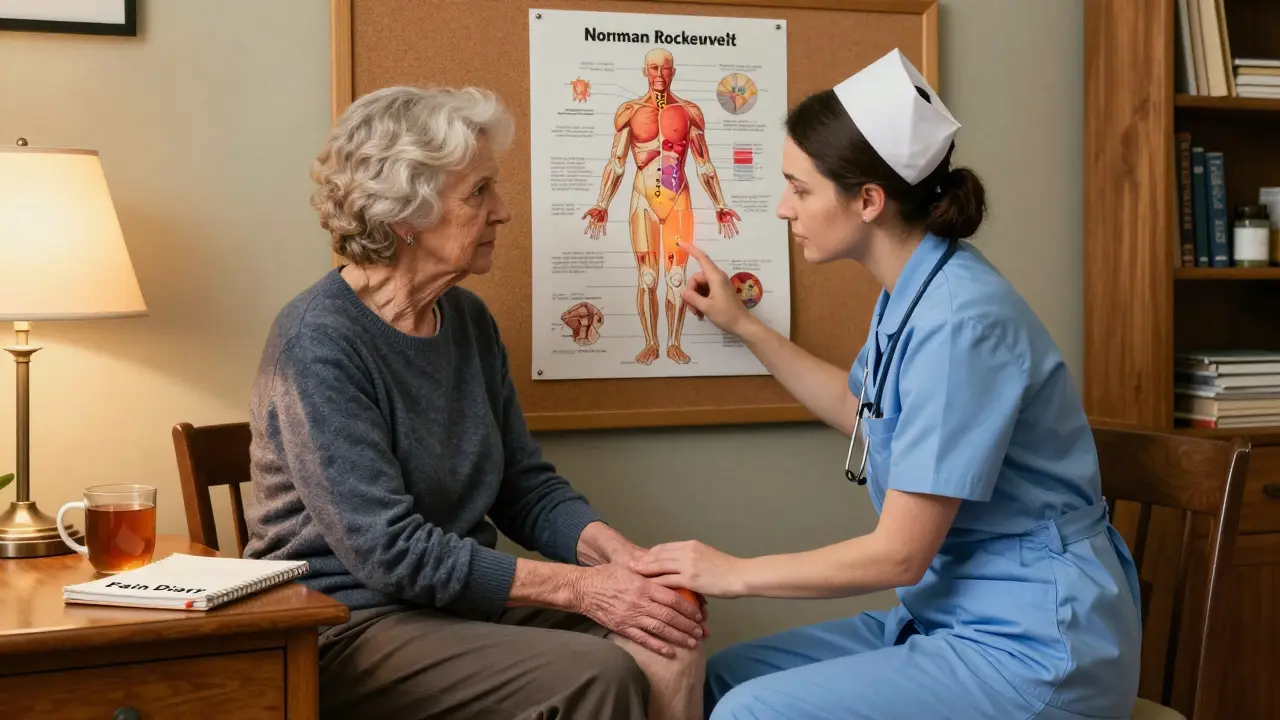
Sometimes, opioids alone aren't enough, especially if the pain stems from nerve damage or bone metastases. This is where adjuvant medications and targeted therapies come into play. Your care team might add anticonvulsants like gabapentin (100-1,200 mg three times daily) for neuropathic pain, which feels like burning or shooting electricity. Antidepressants such as duloxetine (30-60 mg daily) can also help modulate pain signals.
For bone metastases, the strategy shifts. The WHO guidelines recommend combining bisphosphonates, like zoledronic acid (4 mg IV every 3-4 weeks), with localized radiotherapy. A single fraction of 8 Gy or multiple fractions totaling 20-30 Gy can significantly reduce bone pain and prevent fractures. Corticosteroids like dexamethasone (4-16 mg daily) are also powerful allies for reducing inflammation around tumors pressing on nerves.
If you experience unacceptable side effects from opioids, such as extreme sedation or confusion, don't just push through it. The American Pain Society suggests "opioid rotation." This means switching to a different opioid, like fentanyl or methadone, using equianalgesic tables to calculate the new dose. Because our bodies don't fully tolerate all opioids equally, the new dose is typically started at 50-75% of the calculated equivalent to ensure safety.
Addressing the Barriers: Fear, Knowledge, and Access
Even with perfect guidelines, barriers persist. One major hurdle is the fear of addiction. Surveys by the National Cancer Institute show that 65% of patients worry about becoming addicted to opioids. While addiction is a risk in chronic non-cancer pain, the context of cancer pain is different. The goal is comfort and function. Under-treating pain causes physiological stress, worsens depression, and reduces the ability to fight the disease. Open conversations with your doctor about these fears are essential.
Another barrier is provider knowledge. A 2017 study by Cancer Care Ontario found that 40% of oncology nurses lacked current pain management certification. This doesn't mean your nurse doesn't care; it means systemic training gaps exist. You can advocate for yourself by asking, "Has my care team reviewed the latest NCCN or ASCO pain guidelines?" Additionally, cultural factors play a role. Studies indicate that 28% of Asian and Hispanic patients underreport pain due to cultural stoicism. Remember, reporting pain accurately is not weakness; it is data that allows your team to help you.
Emerging Trends: Technology and Personalized Care
The field is evolving rapidly. The 2022 ASCO guideline update strengthened the recommendation for early palliative integration, citing a 2.5-month median survival benefit in metastatic patients who received early support alongside standard treatment. This is a game-changer. It proves that comfort care contributes to longevity.
Technology is also stepping in. Smartphone applications for real-time pain tracking have been validated in a 2021 Journal of Clinical Oncology study, showing a 22% improvement in documentation accuracy. Instead of relying on memory during a short clinic visit, you can log pain levels, triggers, and medication responses throughout the day. This data gives your doctor a clearer picture of your baseline.
Looking ahead, genetic testing for CYP450 enzyme variants is becoming more common. These genes affect how your body metabolizes opioids. Some people are "rapid metabolizers," breaking down drugs too quickly for them to work, while others are "poor metabolizers," risking toxicity at standard doses. Tailoring medication based on your genetics moves us closer to truly personalized pain management. Furthermore, AI is being explored to predict individual pain trajectories, allowing for proactive rather than reactive care.
Practical Next Steps for Patients and Families
So, what should you do today? First, normalize the conversation about pain. Bring a pain diary to your next appointment. Record the time, intensity (0-10), location, and what helped or made it worse. Second, ask for a palliative care consultation early. Do not wait until treatments fail. Third, educate yourself on the side effects of your medications. Constipation, for example, is almost guaranteed with opioids and requires preventive laxatives, not just reaction after the fact.
If you are a caregiver, watch for signs of distress beyond physical pain. The NCCN uses a "distress thermometer" to screen for psychological suffering. A score of 4 or higher triggers a referral for psychosocial support. Your mental health is part of your physical recovery. Finally, stay informed about clinical trials. As of late 2023, there were 12 novel non-opioid analgesic agents in Phase II/III trials targeting specific cancer pain mechanisms. New options are always on the horizon.
When should I ask for a palliative care referral?
You should ask for a palliative care referral as soon as you receive a cancer diagnosis, especially if you have advanced stage disease or significant symptoms like pain, fatigue, or nausea. Early integration, within 8 weeks of diagnosis, has been shown to improve quality of life and potentially extend survival. It is not reserved for end-of-life care.
Will taking opioids for cancer pain make me addicted?
While addiction is a concern in chronic non-cancer pain management, the risk is different in cancer care. Physical dependence (needing the drug to avoid withdrawal) is expected with long-term use, but psychological addiction is less common when pain is the primary driver. The goal is adequate pain control to maintain function and quality of life. Doctors monitor closely to balance relief with safety.
What is the difference between palliative care and hospice?
Palliative care can be provided at any stage of illness and alongside curative treatments like chemotherapy or surgery. Hospice is a specific type of palliative care for patients who are no longer seeking curative treatment and have a prognosis of six months or less to live. Palliative care focuses on symptom management and quality of life throughout the cancer journey.
How do I manage breakthrough pain?
Breakthrough pain is a sudden flare-up of pain that occurs despite taking regular medication. Your doctor should prescribe a "rescue dose" of fast-acting medication, typically 10-15% of your total daily opioid dose. Keep this medication accessible and take it at the first sign of breakthrough pain. If you need rescue doses frequently, your baseline medication may need adjustment.
Can non-drug therapies help with cancer pain?
Yes, non-pharmacological interventions are crucial components of comprehensive pain management. Techniques include cognitive behavioral therapy, mindfulness meditation, acupuncture, massage, and physical therapy. Radiotherapy is also highly effective for bone metastases. These methods work alongside medications to reduce overall suffering and improve coping mechanisms.
