
When your tendon hurts-not just a quick twinge, but a persistent, dull ache that won’t go away no matter how much you rest-you’re not just dealing with inflammation. You’re dealing with tendinopathy. It’s not a sprain. It’s not a tear. It’s a breakdown. And it’s more common than you think. Around 30% of all sports medicine visits involve this condition, whether you’re a runner, a volleyball player, or someone who just started walking more and now your Achilles feels like it’s been pulled taut overnight.
What Actually Happens in Tendinopathy?
Tendons connect muscle to bone. They’re tough, but not indestructible. Over time, repeated stress without enough recovery causes tiny tears in the tendon’s collagen fibers. Instead of healing properly, the tissue gets messy-thicker, less organized, and full of abnormal blood vessels and nerves. That’s why it hurts. Not because of inflammation, as doctors once thought, but because the structure itself has changed. This is why rest alone doesn’t fix it. You need to rebuild the tendon from the inside out.Eccentric Training: The Gold Standard That Actually Works
For decades, the go-to fix was corticosteroid shots. Quick relief, then back to the same pain in a few months. Then, in 1998, a Swedish researcher named Hakan Alfredson did something radical. He told patients with chronic Achilles tendinopathy to do heel drops-slowly lowering their heels off a step-every day, even when it hurt. The results? Most patients improved. Not just felt better, but their tendons actually got stronger and more organized on ultrasound scans. Today, eccentric training is the first-line treatment for most tendinopathies. Here’s how it works: you lengthen the muscle under load. For your Achilles, that’s standing on your toes and slowly lowering your heel. For your patellar tendon (knee), it’s single-leg decline squats on a 25-degree slope. The key isn’t speed-it’s control. Lowering over 3 to 5 seconds. Three sets of 15 reps. Twice a day. For 12 weeks. Studies show this isn’t just a placebo. In one trial, people with patellar tendinopathy improved their VISA-P score (a pain and function measure) from 42 to 83 after 12 weeks of eccentric training. That’s a 98% improvement. For Achilles, the VISA-A score jumped from 45 to 75. And the changes weren’t just in how they felt-they showed up on imaging. Tendon stiffness increased by 15-20%. Collagen fibers realigned. The tendon got stronger.But It Hurts. A Lot.
Let’s be real. The first two weeks are brutal. About 68% of people say the pain during eccentric training feels unbearable at first. That’s normal. The goal isn’t to eliminate pain-it’s to work within it. The sweet spot? A pain level of 2 to 5 out of 10 during the exercise. If it hits 7 or higher, or if the pain lasts more than 24 hours, you’re overdoing it. Most people quit because they expect instant results. But tendons don’t heal fast. They need time. Twelve weeks is the minimum. Anything less? You’re just wasting your effort.Heavy Slow Resistance: The Quiet Alternative
Not everyone can handle the pain of eccentric training. That’s where heavy slow resistance (HSR) comes in. Instead of doing 15 reps twice a day, you lift heavier weights-about 70% of your one-rep max-doing three sets of 15 reps, three times a week. The movement is slow: three seconds up, three seconds down. It’s less frequent, but more intense. A 2015 study compared HSR to traditional eccentric training for Achilles tendinopathy. Both groups improved by 60-65%. But HSR had better adherence-87% stuck with it, compared to 72% for eccentric training. Why? Less daily pain. Less time commitment. For someone with a busy job or kids, HSR might be the only way to stick with treatment. And it works for other tendons too. Shoulder, elbow, even the patellar tendon. The principle is the same: load the tendon slowly and deliberately. Your body responds to tension, not just movement.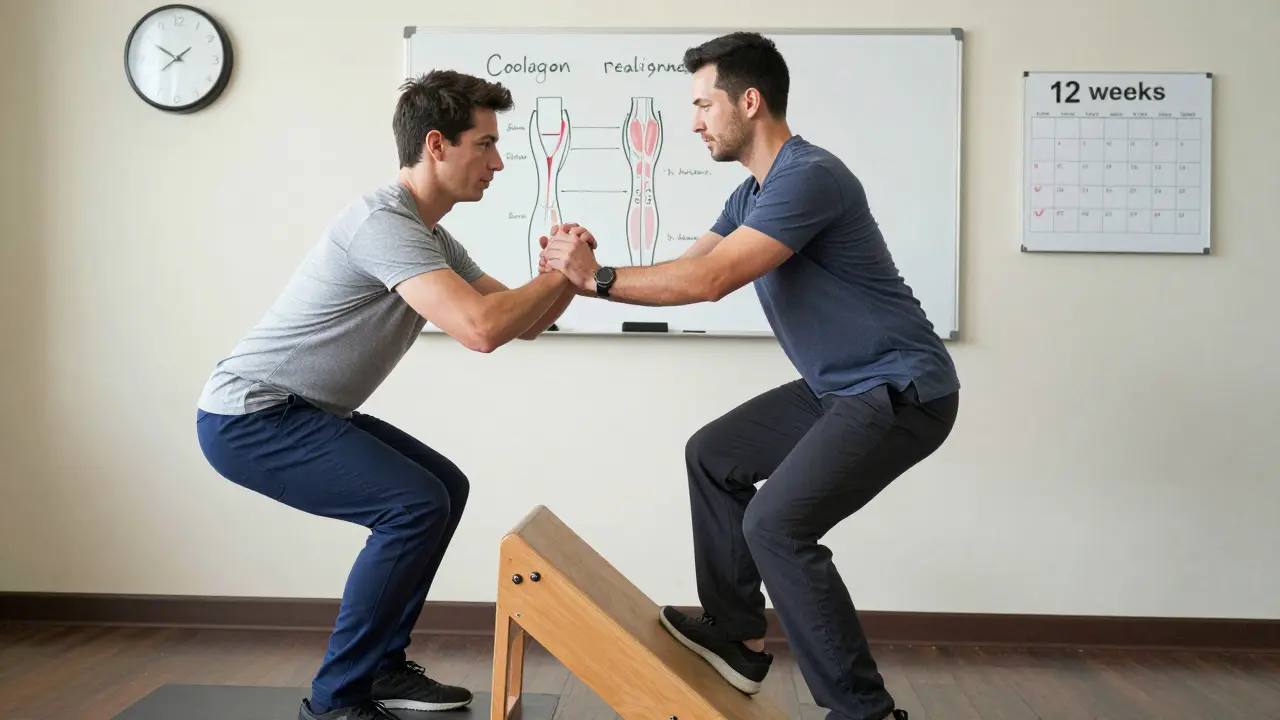
Isometrics: The Instant Pain Killer
If you need to get through a workout, a game, or just walk to the store without agony, isometrics are your secret weapon. These are static holds-pushing against something that won’t move. For your Achilles, that’s standing on your toes and holding the position for 45 seconds. For your knee, it’s a wall sit with a towel under your back. Rio et al. found that isometric holds reduced pain by 50% within 45 minutes. Eccentric exercises? Only 20%. That’s why many physical therapists now start sessions with isometrics. It’s not a cure-but it’s a bridge. Use it before activity to get moving. Then follow up with eccentric or HSR later in the day.Injection Options: What Actually Helps?
Corticosteroid injections used to be the default. Inject the pain, walk away, feel fine for a few weeks. But here’s the catch: 65% of people who got steroid shots needed another treatment within six months. Why? The injection kills pain signals, but it doesn’t fix the tendon. Worse, it can weaken the tissue over time. A 2013 BMJ study showed that people who did eccentric training were far less likely to need repeat treatment. Platelet-rich plasma (PRP) sounds fancy. You take your own blood, spin it to concentrate the platelets, and inject it into the tendon. The theory? Growth factors will heal the damage. But a 2020 review found PRP only beat placebo by 15-20% at six months. Not enough to justify the cost-often $500 to $1,000 out of pocket. Dry needling and shockwave therapy? Some people report relief, but the evidence is shaky. No large, high-quality study proves they’re better than exercise alone. Bottom line: injections might give you a temporary reprieve, but they don’t rebuild your tendon. Exercise does.Why Some People Don’t Get Better
About 30% of people don’t respond to eccentric training-even when they do it perfectly. Why? Because tendinopathy isn’t just a tendon problem. It’s a whole-body issue. If your hip muscles are weak, your knee takes extra strain. If your calf is tight, your Achilles gets overworked. If you’re stressed, your body doesn’t heal as well. Dr. Jill Cook, a leading expert, says you need to look at the “tendon continuum.” Is your tendon in the reactive phase (swollen, painful, recent)? Or the degenerative phase (thickened, scarred, long-term)? The treatment changes based on where you are. Also, technique matters. A 2023 study found that 92% of people who worked with a physical therapist to perfect their form improved. Only 68% of those who did it alone did. If you’re doing decline squats wrong, you’re not loading the tendon properly. You’re just hurting your knees.
How to Make It Stick
The biggest reason people fail? They don’t stick with it. Here’s how to win:- Start with isometrics to reduce pain before you begin eccentric work.
- Use an app like Tendon Rehab. It gives you video demos, timers, and progress tracking. People who used it had 85% adherence vs. 65% with paper logs.
- Track your pain. Use a scale of 1 to 10. Write it down after each session. Look for trends, not daily highs.
- Don’t stop when you feel better. Keep going for the full 12 weeks-even if you’re pain-free at week 8.
- Combine it with strength training for your whole leg or shoulder. Weak glutes? Fix them. Poor ankle mobility? Stretch and mobilize.
What’s Next for Tendinopathy Treatment?
The future isn’t just about more exercise. It’s about smarter exercise. Researchers are now testing load tolerance tests-measuring exactly how much weight your tendon can handle before it flares up. Then, they tailor the program to your body, not a textbook. Trials are also underway for new drugs that target tendon cells directly. One peptide, TAP-421, is set to enter phase II trials in early 2024. But these are years away from clinics. For now, the best treatment is still movement-controlled, consistent, and patient. No magic shot. No quick fix. Just you, your tendon, and the discipline to do the work.Real Talk: What People Actually Say
On Reddit, one runner wrote: “I did heel drops for 12 weeks. Week 1-3: thought I’d never walk again. Week 6: felt like I could jog. Week 12: ran a 10K. No pain. No injections. Just dumb patience.” Another said: “I tried PRP. Paid $800. Felt fine for two months. Then back to the same ache. I wish I’d just done the squats.” The data backs them up. In a 2021 survey of 452 runners with Achilles tendinopathy, 82% who completed eccentric training returned to their previous running level. Only 58% of those who got steroid shots did.Final Takeaway
Tendinopathy isn’t a death sentence. It’s not even a life sentence. But it does demand effort. You can’t out-inject your way out of it. You can’t rest your way out of it. You have to rebuild it. Eccentric training is the most proven, most cost-effective, most durable solution we have. HSR is a great alternative if the pain is too much. Isometrics help you get through the day. Injections? They’re a band-aid. If you’ve been struggling with tendon pain for months, the answer isn’t more scans, more shots, or more rest. It’s more load. The right kind. The right amount. And the patience to let your body heal.Is eccentric training the only effective treatment for tendinopathy?
No, but it’s the most consistently effective. Heavy slow resistance (HSR) training produces similar results for many people, especially those who can’t tolerate the pain of eccentric exercises. Isometric holds offer fast pain relief but don’t rebuild the tendon long-term. Injections like corticosteroids or PRP may reduce symptoms temporarily, but they don’t fix the underlying tissue damage. Exercise remains the only treatment proven to restore tendon structure and prevent recurrence.
How long does it take to see results from eccentric training?
You might feel less pain after 4 to 6 weeks, but real structural changes take longer. Ultrasound studies show tendon thickening and collagen realignment after 8 to 12 weeks. Most people need the full 12 weeks to see lasting improvement. Stopping early-like at week 6 or 8-means you’re likely to relapse. Patience is part of the protocol.
Can I do eccentric training at home without a physical therapist?
Yes, but it’s harder. A 2023 study found that people who worked with a physical therapist had a 92% success rate. Those who did it alone had only a 68% success rate. Why? Technique matters. Doing a decline squat with your knee caving in or your heel not dropping fully means you’re not loading the tendon correctly. Use video apps like Tendon Rehab or YouTube tutorials from certified physiotherapists. Record yourself and compare.
Does icing or anti-inflammatories help with tendinopathy?
Not really-and they might even slow healing. Tendinopathy isn’t caused by inflammation, so NSAIDs like ibuprofen don’t fix the root problem. Icing can reduce pain temporarily, but it doesn’t improve tendon structure. Some experts now advise against regular use of ice or NSAIDs during rehab because they may interfere with the healing response triggered by exercise. Use them only if pain is unbearable, and keep it short-term.
Can tendinopathy come back after treatment?
Yes, if you go back to the same habits. If you suddenly increase your running mileage, stop strength training, or ignore poor movement patterns, the tendon can flare again. The good news? People who complete a full 12-week program and maintain basic strength and mobility have a 67% lower chance of recurrence over two years. Think of it like brushing your teeth-you don’t stop once the cavity’s gone.
What’s the difference between Achilles and patellar tendinopathy treatment?
The principle is the same: load the tendon slowly and progressively. For Achilles, it’s heel drops with straight and bent knee. For patellar, it’s single-leg decline squats. The number of reps and sets are similar, but the movement patterns differ. Also, insertional Achilles tendinopathy (where the tendon attaches to the heel) responds less predictably to eccentric training than midportion Achilles. Some people with insertional issues need modified protocols or more focus on calf flexibility. Always tailor the exercise to your specific pain location.

Monte Pareek
December 19, 2025 AT 04:51Eccentric training isn't just the gold standard it's the only thing that actually rebuilds the tendon structure
Everything else is temporary masking
Corticosteroids? They're like putting duct tape on a cracked engine block
PRP? A fancy placebo with a $800 price tag
Isometrics help you get through the day but they don't fix the root problem
You want results? You do the work
12 weeks minimum
No shortcuts
No magic shots
Just slow controlled movement until your tendon forgets it ever got damaged
holly Sinclair
December 19, 2025 AT 12:10It's fascinating how we've spent decades treating tendinopathy as if it were an inflammatory condition when the real issue is structural degeneration
Our medical paradigm has been stuck in the 20th century while the science moved on
It's not about reducing pain-it's about restoring biological integrity
The tendon isn't broken, it's just forgotten how to be strong
And yet we still reach for injections before we ask the body to heal itself
There's something deeply cultural about this
We want a pill, a shot, a quick fix
But tendons don't care about our impatience
They respond to consistent, deliberate load
It's humbling really
Our bodies are ancient, intelligent systems
And we keep trying to outsmart them with technology instead of listening
Maybe the real treatment isn't the exercise-it's the humility to do it slowly, quietly, without fanfare
Kelly Mulder
December 20, 2025 AT 09:24Let me be perfectly clear: if you’re doing eccentric training without a certified physiotherapist supervising your form, you’re not rehabbing-you’re self-sabotaging
And if you think YouTube tutorials are sufficient, you’re delusional
There’s a reason 92% succeed with professional guidance and only 68% without
It’s not about motivation
It’s about biomechanical precision
One millimeter of knee valgus during a decline squat and you’re loading the patella, not the tendon
Do you know what that does to your cartilage over time?
Do you even understand the difference between midportion and insertional tendinopathy?
If not, stop pretending you’re doing the work
And for the love of science, stop calling PRP a miracle
It’s not
It’s a marketing scheme wrapped in plasma
Lynsey Tyson
December 20, 2025 AT 11:54I’ve been dealing with patellar tendinopathy for two years
Started with isometrics before every run-game changer
Then moved to HSR three times a week
Didn’t do it perfectly
Missed a few sessions
Had bad weeks
But I kept showing up
At week 10 I ran a 5K without pain
Not because I was strong
But because I didn’t quit
It’s not glamorous
It’s not quick
But it works
And if you’re reading this and you’re scared of the pain
Just start with 45 seconds of a wall sit
That’s all you need to begin
Edington Renwick
December 22, 2025 AT 03:16People don’t get better because they’re lazy
Not because they don’t understand the science
They get better when they’re forced to
My cousin did eccentric training for 14 weeks
She cried through week 3
Her husband made her do it
She’s running marathons now
He didn’t care about the studies
He just didn’t let her quit
That’s the real treatment
Not the exercises
Not the apps
Someone who won’t let you give up
And if you’re reading this and you’re still not doing it
Who’s holding you back?
Not your tendon
Not your schedule
Not your pain
It’s you
anthony funes gomez
December 22, 2025 AT 06:28Biomechanical loading induces mechanotransduction via integrin-mediated signaling cascades, which upregulates collagen type I synthesis and downregulates MMP-13 expression, thereby promoting tendon matrix remodeling
Isometric contractions activate Aδ and C-fiber nociceptors, triggering descending inhibitory pathways that modulate central sensitization
PRP’s efficacy is confounded by heterogeneity in platelet concentration, leukocyte content, and activation protocols
Yet, despite robust evidence for eccentric and HSR protocols, clinical adoption remains suboptimal due to cognitive dissonance between patient expectations and evidence-based timelines
And let’s not ignore the socioeconomic barrier: time, access to equipment, and lack of insurance coverage for physical therapy
It’s not a failure of compliance
It’s a failure of systemic support
Gloria Parraz
December 23, 2025 AT 11:29I used to think I was too busy for this
Work, kids, life
Then I hurt my Achilles and couldn’t walk to the mailbox
So I started with 45-second wall sits
Just five minutes a day
Then I added heel drops
Two sets
Even on days I felt like crap
Week 6: I walked to the park without wincing
Week 10: I played with my kids without fear
Week 12: I went for a run
It wasn’t perfect
But I didn’t quit
And if you’re thinking you don’t have time
Five minutes a day is still five minutes
And five minutes a day for 12 weeks changes everything
Kathryn Featherstone
December 24, 2025 AT 14:16One thing no one talks about is how lonely this feels
People don’t understand why you’re not just resting
Or why you’re not getting a shot
Or why you’re doing these weird slow movements
It’s not like a sprained ankle
There’s no cast, no crutches, no visible injury
So you look lazy
Or obsessed
Or both
But you know
You’re doing the quiet work
The kind no one sees
And that’s okay
It doesn’t need applause
It just needs to be done
Mark Able
December 25, 2025 AT 12:10Wait so you’re telling me I can’t just take ibuprofen and call it a day?
But I’ve been doing that for years
And I’m fine
So why change now?
Also I tried heel drops once and it felt like my leg was being ripped off
So I stopped
Is there a supplement for this?
Like collagen powder or something?
Or can I just do it once a week and still get results?
Because I’m busy
And I don’t have time to be a lab rat
Dorine Anthony
December 26, 2025 AT 17:10My PT told me to do eccentric training
I did it for 8 weeks
Then stopped because I felt fine
Two months later it came back
Worse
So I started again
This time I didn’t stop until week 12
Even when I didn’t feel pain
Now I do it once a week just to keep it in check
It’s not a cure
It’s maintenance
Like brushing your teeth
Only your tendon is the one that needs it
William Storrs
December 28, 2025 AT 08:32You’ve got this
It’s not easy
But you’re not alone
Every single person who’s recovered from tendinopathy started exactly where you are
Scared
Confused
Worried it won’t work
But they showed up
They did the reps
They didn’t quit
And so can you
One slow descent at a time
One day at a time
You’re not failing
You’re building
James Stearns
December 29, 2025 AT 15:37The notion that exercise alone can reverse structural tendon degeneration is a dangerous oversimplification
It ignores the role of systemic inflammation, metabolic dysfunction, and neurogenic sensitization
Furthermore, the assumption that all tendinopathies respond identically to eccentric protocols is biologically unsound
There is no one-size-fits-all solution
And yet, this misinformation is propagated by non-specialists with limited understanding of connective tissue biology
Until the medical community acknowledges the complexity of tendon pathology, patients will continue to be misled
And worse-harmed
Nina Stacey
December 30, 2025 AT 10:24i started doing heel drops because i was tired of being in pain
week one was rough
week three i cried
week six i thought about giving up
but i kept going
not because i believed in it
but because i had nothing else to lose
now i can run again
not fast
not far
but without pain
and thats enough
also i misspelled a lot of words here
im tired
and this is my first time typing this much
but i needed to say it