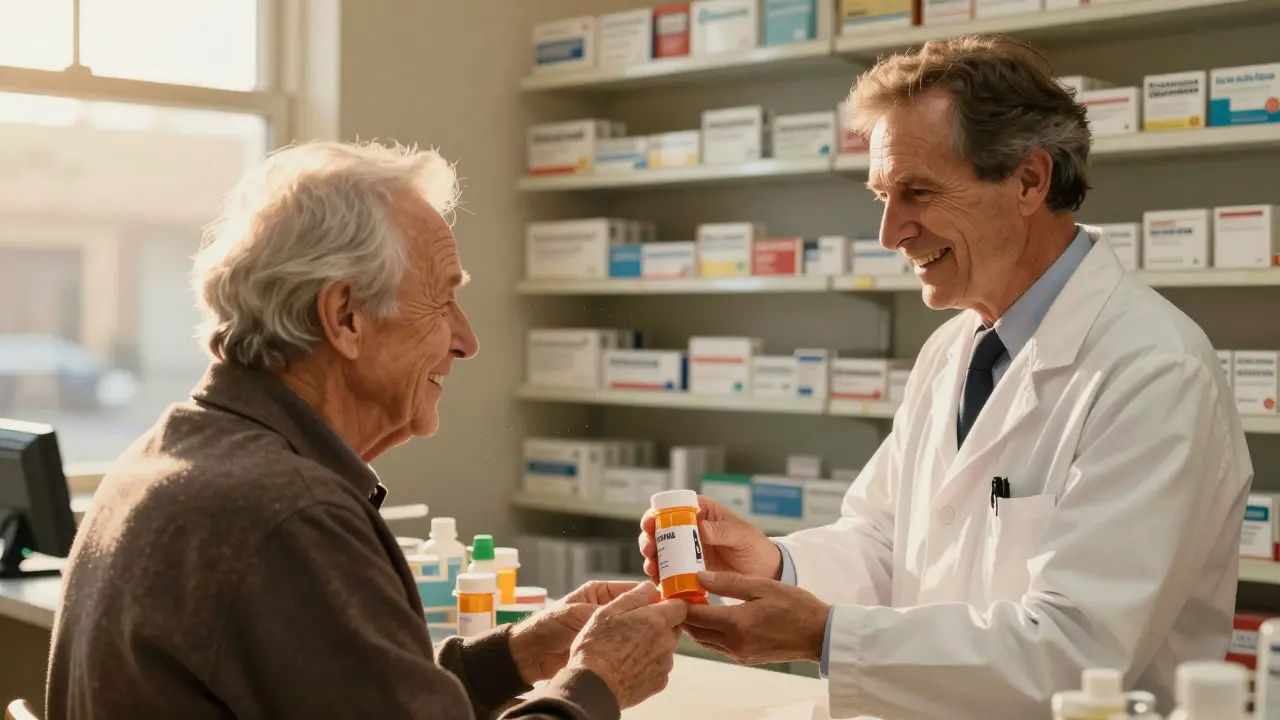
When you pick up a prescription at the pharmacy, you might not realize that the pill in your hand wasn’t the one your doctor wrote on the paper. More than 90% of prescriptions in the U.S. are filled with generic drugs. But not all generics are treated the same. The FDA uses a hidden code system - called therapeutic equivalence (TE) codes - to tell pharmacists exactly which generics can be swapped in without changing how the medicine works for you.
What Are Therapeutic Equivalence Codes?
Therapeutic equivalence codes are the FDA’s way of rating whether a generic drug can safely replace a brand-name drug. These codes appear in the Orange Book, officially titled Approved Drug Products with Therapeutic Equivalence Evaluations. The system started in 1980 and has been updated ever since to keep up with new drugs and better science. The code is usually one or two letters. The first letter tells you everything you need to know:- A means the generic is considered therapeutically equivalent to the brand-name drug. You can swap it without worry.
- B means the FDA hasn’t confirmed it’s equivalent. It might work fine - but there’s not enough proof yet.
What Makes a Generic an ‘A’?
For a generic to get an ‘A’ rating, it must pass three tests:- Pharmaceutical equivalence - same active ingredient, same strength, same dosage form (like tablet or capsule), and same route (taken by mouth, injected, etc.).
- Bioequivalence - the generic must deliver the same amount of medicine into your bloodstream at the same speed as the brand. This is tested in healthy volunteers using blood samples.
- Same clinical effect and safety - the FDA looks at the labeling, side effects, and how the drug behaves in real use.
- AB1, AB2, AB3, AB4 - used when there’s more than one brand-name drug as a reference. Each number points to a different original product. You can’t swap between AB1 and AB2 unless they’re proven interchangeable.
What Does a ‘B’ Code Really Mean?
A ‘B’ code doesn’t mean the generic is bad. It means the FDA doesn’t have enough data to say it’s equivalent. This often happens with complex drugs:- BC - extended-release tablets or capsules
- BT - topical creams or ointments
- BD - drugs with known bioequivalence issues
- BX - not enough data to judge
Why Does This System Exist?
The whole point of TE codes is to make generic substitution safe and simple. Before this system, pharmacists had no clear rules. Some substituted freely. Others never did. Patients got mixed results. The FDA created the Orange Book to bring order to the chaos. Today, 90% of generic drugs in the U.S. have an ‘A’ rating. That’s why 49 states allow pharmacists to swap generics automatically - no doctor approval needed. This saves the healthcare system about $1.2 billion every year. The system works best for simple pills taken by mouth - like antibiotics, blood pressure meds, or antidepressants. For these, bioequivalence is easy to prove. But for complex products - like inhalers, injectables, or creams - the science is harder. That’s why the FDA is working on new ways to evaluate them.How Pharmacists Use TE Codes
Every time a prescription comes in, pharmacists check the Orange Book - either online or through their pharmacy software. They look for the TE code. If it’s ‘A’, they can substitute without asking. If it’s ‘B’, they usually check with the prescriber. On average, pharmacists spend 2.7 minutes per prescription verifying the TE code. That adds up. But it’s worth it. In 2023, the FDA’s Orange Book website had 1.7 million unique visitors - mostly pharmacists, doctors, and pharmacy students. Pharmacy schools now teach TE codes as part of the core curriculum. Students spend 4 to 6 hours learning how to read them. That’s because mistakes can be costly. Substituting a ‘B’-rated drug without knowing the risks could lead to underdosing, overdosing, or side effects.
How It Compares to Other Countries
The U.S. system is unique. The European Medicines Agency (EMA) doesn’t use codes like this. Instead, they publish long scientific reviews for each generic. It’s thorough - but not practical for a busy pharmacist trying to fill 50 prescriptions in an hour. The FDA’s code system is built for speed and clarity. It’s designed to be used at the counter, not in a lab. That’s why it’s so effective in the U.S. - where generics make up 90% of prescriptions but only 23% of drug spending. Other countries don’t have a direct equivalent. Canada uses a similar system but with fewer categories. The UK relies on clinical judgment and local guidelines. The U.S. stands out because it’s standardized, public, and legally enforced.What’s Changing in 2026?
The FDA knows the system has limits. Between 2018 and 2022, applications for ‘B’-rated complex generics jumped 22%. These include things like inhalers for asthma, injectables for diabetes, and topical treatments for eczema. In 2022, the FDA released a draft guidance proposing new ways to evaluate these products - using real-world data, better testing methods, and even computer modeling. They’re aiming to reduce ‘B’ ratings for complex drugs by 30% by 2027. They’ve also expanded their Product-Specific Guidances (PSGs) to over 1,850 documents. These are detailed instructions for companies on how to prove bioequivalence for specific drugs. More guidance means fewer ‘B’ codes in the future. The goal isn’t to eliminate ‘B’ codes. It’s to make them more accurate. If a drug is truly equivalent, it should get an ‘A’. If it’s not - we need to know why.What You Should Know as a Patient
You don’t need to memorize codes. But you should know this:- If your pharmacist gives you a different pill than what your doctor prescribed, it’s probably a generic with an ‘A’ rating - and it’s safe.
- If you’re switched to a ‘B’-rated drug, ask why. It might be because the brand is out of stock, or because your insurance requires it. But you have the right to ask for the original.
- Don’t assume a ‘B’ means it’s unsafe. It just means the science is still catching up.
What does an AB code mean on a generic drug?
An AB code means the generic drug is considered therapeutically equivalent to the brand-name drug. It has the same active ingredient, strength, dosage form, and route of administration, and has passed FDA bioequivalence testing. You can safely substitute it without expecting any difference in how it works.
Can a B-rated generic be just as effective as a brand-name drug?
Yes, a B-rated generic may be just as effective - but the FDA doesn’t have enough data to confirm it yet. This often happens with complex products like inhalers, creams, or extended-release pills, where standard bioequivalence tests don’t fully capture how the drug behaves in the body. It’s not unsafe, but it needs more study before being labeled equivalent.
Why do some generics have AB1, AB2, or AB3 codes?
These codes appear when multiple brand-name drugs (called Reference Listed Drugs) exist for the same active ingredient. Each number (AB1, AB2, etc.) links the generic to a specific original product. You can only substitute between generics with the same number - swapping AB1 for AB2 isn’t allowed unless proven equivalent.
Are over-the-counter (OTC) drugs given therapeutic equivalence codes?
No. The FDA only assigns therapeutic equivalence codes to prescription drugs listed in the Orange Book. OTC medications are not evaluated using this system, even if they have generic versions.
How often is the Orange Book updated?
The FDA updates the Orange Book monthly. New drugs are added, TE codes are changed, and outdated entries are removed. Pharmacists and prescribers rely on these updates to make sure they’re using the most current substitution information.

Alex Danner
January 6, 2026 AT 20:17Just had a pharmacist swap my blood pressure med for a generic with an AB2 code. I didn’t even know there were sub-codes until I read this. Turned out the brand was out of stock, but the generic was fine. No side effects, same results. The Orange Book saved my sanity.
Pharmacists are the real MVPs here. They’re checking this stuff while juggling 50 scripts an hour. We don’t see it, but it’s why we don’t get poisoned by mix-ups.
Aparna karwande
January 8, 2026 AT 11:21India has better generic standards than this bureaucratic mess. We don’t need a 12-page code system to tell us if a pill works. If it’s made in a GMP-certified lab, it’s good. The FDA is overcomplicating things because of corporate lobbying. Why do we need AB1, AB2, AB3? Just test the damn thing and move on.
Also, ‘B’ ratings? That’s just American fear-mongering. In Delhi, we take generics daily and live longer than you.
PS: Your ‘Orange Book’ sounds like a 1980s fax machine manual. Time to upgrade.
Jessie Ann Lambrecht
January 9, 2026 AT 12:47Y’all need to stop treating ‘B’ like a death sentence. I’m a pharmacist in rural Ohio, and I’ve seen patients on B-rated topical creams for years-no issues. The science isn’t perfect yet, but real-world use often proves what labs can’t.
The FDA’s trying to fix this with real-world data and modeling? YES. Please. More of that. Less red tape, more innovation. We’re not in the 1980s anymore.
Also-thank you for explaining AB1/AB2. I’ve had patients ask me this for years. Now I can point them to this post. 🙌
Ayodeji Williams
January 11, 2026 AT 10:28bro i just took a generic for my anxiety and it made me feel like a zombie 😵💫
is this a B code thing? did i just get screwed by the system? 😭
also why do i have to be the guinea pig for your science experiments??
my doctor didn’t even tell me it was generic. now i’m mad. and tired. and kinda scared to take anything ever again.
Kamlesh Chauhan
January 11, 2026 AT 16:05why do we even need codes at all just give me the pill and shut up
all this talk about bioequivalence is just corporate jargon to make people pay more
generic is generic end of story
and who even reads the orange book nobody has time for this nonsense
Elen Pihlap
January 11, 2026 AT 22:55so if i get a B-rated cream and my skin breaks out… is it the drug or my body?? i just want to know who to blame 😔
Sai Ganesh
January 13, 2026 AT 01:13This system is actually quite brilliant when you think about it. In India, we often assume all generics are equal, but that’s not always true. The FDA’s approach-transparent, standardized, publicly accessible-is a model for developing nations.
What’s missing is public education. Most patients don’t know what AB1 means. Maybe the FDA should partner with pharmacies to print simple infographics on prescription labels.
Also, kudos for mentioning the 2.7 minutes per script. That’s 10+ hours a week per pharmacist. That’s labor, not bureaucracy.
Paul Mason
January 13, 2026 AT 18:39Oh for heaven’s sake, this is basic pharmacology. If you can’t tell the difference between a brand and a generic, you shouldn’t be taking pills.
And yes, the FDA’s system is the gold standard. The EMA’s 50-page reports? Useless. Who has time to read that between seeing patients?
Also, OTC drugs don’t need codes because they’re not regulated like prescriptions. Duh.
Stop making everything so complicated. It’s medicine, not a Netflix documentary.
Andrew N
January 15, 2026 AT 03:2290% of generics are rated A? That’s statistically suspicious. The FDA has a vested interest in promoting generics to reduce costs. There’s no way that many drugs pass bioequivalence so cleanly. Especially with complex formulations.
Also, ‘B’ ratings are being underreported. Many are quietly reclassified without public notice. The Orange Book isn’t as transparent as it claims.
And why are we still using letters? Why not a 1–10 scale? Or machine-learning risk scores? This system is archaic.
LALITA KUDIYA
January 15, 2026 AT 04:33thank you for this 😊 i never knew about AB codes but now i feel less scared to take generics
also the orange book update every month? that’s actually really cool 🌱
Poppy Newman
January 16, 2026 AT 18:15Wait-so if I get a B-rated inhaler for asthma, and it works fine for me, can I keep using it? Or do I have to switch back to the brand? 🤔