INR Safety Calculator
This calculator helps determine if turmeric supplements with black pepper may dangerously interact with your blood thinning medication. Based on clinical data showing how turmeric and piperine affect INR levels.
If you’re taking a blood thinner like warfarin, apixaban, or clopidogrel, and you’ve started taking turmeric with black pepper supplements, you might be putting yourself at serious risk. This isn’t just a theoretical concern-it’s a documented danger that has sent people to the hospital. Turmeric, the bright yellow spice, sounds harmless. Black pepper is just a seasoning, right? But when you combine them in supplement form, especially at high doses, you’re creating a chemical storm inside your body that can interfere with how your blood clots-and that can be life-threatening.
Why Turmeric and Blood Thinners Don’t Mix
Turmeric contains curcumin, a compound with real biological effects. It doesn’t just give food color-it also reduces platelet aggregation, meaning it makes your blood less likely to clot. That sounds great if you’re trying to prevent clots, but if you’re already on a prescription blood thinner, you’re doubling down on that effect. The result? Your blood becomes too thin.
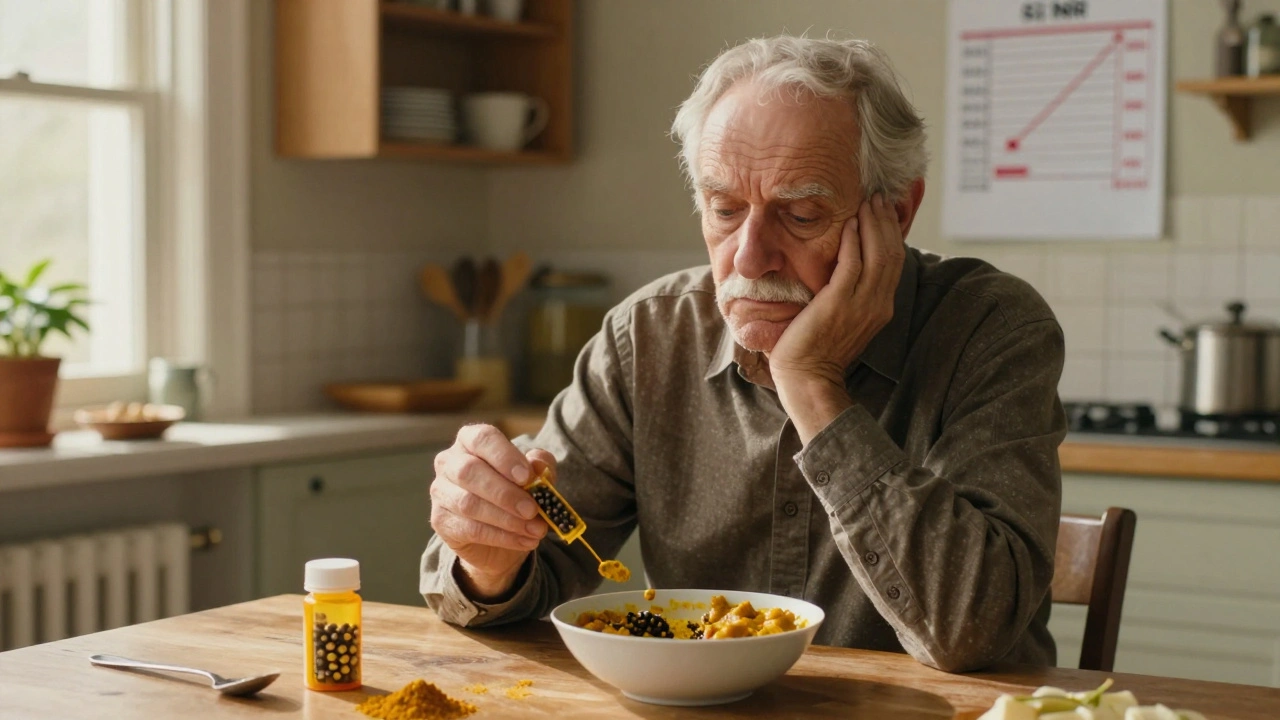
Doctors monitor this with a test called INR (International Normalized Ratio). For someone on warfarin, a stable INR is usually between 2.0 and 3.0. Go above 4.0, and your risk of internal bleeding spikes. A case study from the Welsh Medicines Advice Service described a patient whose INR jumped from 2.5 to 6.8 after starting a turmeric supplement. That’s not a small change-it’s a medical emergency. This patient had no prior bleeding issues, no other medication changes. Just turmeric.
It’s not just warfarin. Turmeric interacts with nearly every common blood thinner: heparin, enoxaparin, aspirin, clopidogrel, dabigatran, rivaroxaban. Even over-the-counter NSAIDs like ibuprofen and naproxen can become riskier when mixed with turmeric. The combination increases bruising, nosebleeds, gum bleeding, and worse-gastrointestinal bleeding that can require emergency surgery.
Black Pepper Makes It Worse-A Lot Worse
Here’s where things get dangerous. Most turmeric supplements on the market today include black pepper extract-piperine. Why? Because piperine boosts curcumin absorption by up to 2,000%. That sounds like a win for effectiveness. But in reality, it’s a trap.
When you take turmeric alone, your body absorbs maybe 1% of the curcumin. With piperine, that jumps to 20% or more. That means if you take a 500mg turmeric capsule with piperine, you’re effectively flooding your system with 10 times more curcumin than you’d get from the same dose without it.
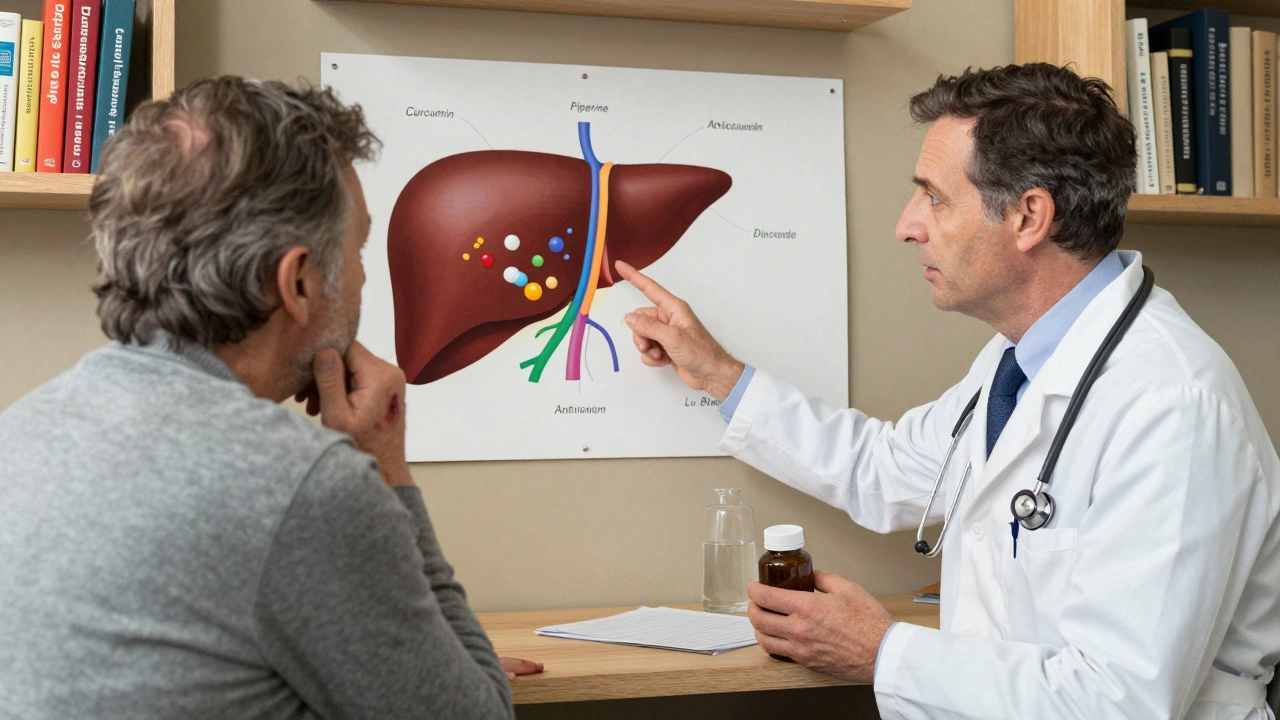
And piperine doesn’t stop there. It blocks liver enzymes-CYP3A4 and P-glycoprotein-that are responsible for breaking down not just curcumin, but also many blood thinners. This means your medication stays in your bloodstream longer than it should. Your body can’t clear it fast enough. That’s why INR levels can rise unpredictably, even if you’ve been stable for months.
One study showed that high-dose curcumin increased clopidogrel levels in the blood. Another found that curcumin made sulfasalazine concentrations jump 3.2 times higher. These aren’t lab fantasies-they’re real drug interactions with documented outcomes. And piperine is the hidden trigger.
Dietary Turmeric Is Fine. Supplements Are Not.
Let’s be clear: eating turmeric in food is not the same as taking a supplement. A teaspoon of turmeric in your curry, soup, or golden milk won’t raise your INR. The amount of curcumin you get from food is too low to have a significant effect on blood clotting.
But supplements? They’re concentrated. One capsule can contain 500mg of curcumin. A typical daily dose of turmeric supplement is 1,000-2,000mg. That’s the equivalent of eating over a cup of turmeric powder a day-something no one would ever do naturally.
Patients on Reddit and HealthUnlocked often say they’ve been taking turmeric for years without issues. But those who report problems are the ones who started supplements, not who added spice to their meals. One user on r/bloodthinners described going to the ER after three weeks of taking one teaspoon of turmeric powder daily. He was on apixaban. He had internal bleeding. He didn’t realize the difference between cooking spice and supplement powder.
What About Liver Damage?
It’s not just bleeding. Turmeric supplements, especially with black pepper, can hurt your liver. Symptoms include dark urine, yellow skin or eyes, nausea, loss of appetite, and extreme fatigue. These signs can show up within 2 to 12 weeks of starting the supplement.
MDVIP reported multiple cases of liver injury linked to turmeric-black pepper combos. The liver gets overwhelmed trying to process the flood of curcumin and the enzyme-blocking effects of piperine. This isn’t rare. It’s underreported because people don’t connect their symptoms to a supplement they think is “natural.”
And it’s not just about interactions. A 2022 ConsumerLab analysis found that 30% of turmeric supplements tested contained lead levels above California’s safety limits. So even if you avoid drug interactions, you might be poisoning yourself with heavy metals.
What Should You Do?
If you’re on a blood thinner, here’s what you need to do right now:
- Stop taking turmeric supplements with black pepper. This includes capsules, powders, gummies, and extracts labeled as “bioavailable” or “enhanced absorption.”
- Don’t assume “natural” means safe. Supplements aren’t regulated like drugs. Labels often omit warnings, even though the law requires them.
- Talk to your doctor or pharmacist. Tell them exactly what supplements you’re taking-even if you think they’re harmless. A 2022 JAMA study found that 42% of patients never mention supplements to their providers.
- Stick to food. A teaspoon of turmeric in your cooking is fine. You’d need to eat over 100 teaspoons a day to reach the dose in a single supplement.
- Watch for signs of bleeding or liver trouble. Unusual bruising, bleeding gums, blood in stool, dark urine, or jaundice? Seek help immediately.
Doctors at the Cleveland Clinic and British Heart Foundation agree: if you’re on a blood thinner, avoid turmeric supplements entirely. The risk isn’t worth it. Even if you feel fine now, the damage can build silently.

What’s Changing in 2025?
Regulators are catching up. The American College of Cardiology updated its guidelines in March 2024 to specifically warn against turmeric-black pepper combinations in patients on warfarin and other anticoagulants. The Welsh Medicines Advice Service now lists this interaction as “high risk” in their official alerts.
Research is also looking for safer alternatives. A 2023 study is testing lecithin-based curcumin delivery systems that might offer anti-inflammatory benefits without the absorption spike caused by piperine. But those aren’t available yet.
For now, the safest choice is simple: skip the supplement. If you want the benefits of turmeric, use it in your food. If you’re on blood thinners, your body doesn’t need extra help-it needs protection.
Final Reality Check
Turmeric supplements sold $1.14 billion worth of product in the U.S. in 2022. Nearly 1 in 5 American adults take them. Meanwhile, over 8 million Americans are on blood thinners. That’s a massive overlap. And yet, only 41% of turmeric supplement labels mention the risk of bleeding.
Companies market these products as “natural anti-inflammatories” or “superfoods.” But they don’t tell you that piperine turns a mild spice into a potent drug interaction. They don’t warn you about liver damage. They don’t mention lead contamination.
It’s not about fear. It’s about facts. Your blood thinner works because it’s carefully dosed. Turmeric with black pepper throws that balance off. And once you bleed internally, there’s no undo button.
If you’re taking a blood thinner, the answer isn’t “maybe.” It’s “no.” Skip the supplement. Enjoy your curry. Stay safe.


Olivia Hand
December 7, 2025 AT 22:50I’ve been taking turmeric for my arthritis for years-just the spice in food. But last month I switched to a ‘bioavailable’ capsule because my yoga instructor swore by it. Two weeks later I woke up with a bruise the size of a grapefruit on my thigh. Didn’t think twice until I read this. Holy crap. I threw out every bottle. Thanks for the wake-up call.
Turns out ‘natural’ doesn’t mean ‘safe.’ I feel dumb for not checking interactions. Lesson learned the hard way.
Sangram Lavte
December 8, 2025 AT 00:34In India, we use turmeric in everything-milk, curry, even on wounds. But we never take it as a pill. The dose in food is nothing. My uncle on blood thinners? He eats curry daily, no problem. But when he tried a supplement from Amazon? His INR went wild. Doctors told him to stop. It’s not the spice, it’s the concentration. Don’t confuse tradition with pharmacology.
Stacy here
December 10, 2025 AT 00:19Let’s be real-this isn’t about turmeric. It’s about the pharmaceutical industry’s fear of natural alternatives. They’ve spent decades convincing people that pills are the only way. But now they’re scared because a $5 spice with black pepper could replace their billion-dollar blood thinners.
They call it ‘dangerous’ because they don’t control it. The FDA doesn’t regulate supplements? That’s not a bug, that’s a feature. They want you dependent. Turmeric doesn’t need a patent. It grows in dirt. And that’s why they’re panicking.
They’ll ban it next. Mark my words. They already tried with CBD. Same playbook. Wake up. They’re not protecting you-they’re protecting profits.
And don’t even get me started on the lead contamination. Of course there’s lead. They’re not testing it. Why? Because they don’t want to know. This is a cover-up. I’ve seen it before.
They’ll say ‘consult your doctor.’ But your doctor gets paid by Big Pharma. Who’s really looking out for you?
Read the fine print. Read the studies. Read between the lines. The truth is buried under marketing jargon and ‘bioavailable’ nonsense.
They want you to believe you need their pills. But your body already knows how to heal. You just have to stop trusting the system.
Stay vigilant. Stay skeptical. And for god’s sake, don’t trust labels. The truth is in the soil, not the capsule.
Kyle Flores
December 11, 2025 AT 21:38My mom’s on warfarin and took turmeric supplements for ‘inflammation’ for 8 months. She never told anyone. One day she passed out from a GI bleed. Turned out her INR was 8.2. She spent a week in the hospital. We found the bottle in her nightstand.
She didn’t even know it had black pepper in it. The label just said ‘turmeric extract.’ No warning. No asterisk. Just ‘supports joint health.’
I’m not mad at her. I’m mad at the companies selling this stuff like it’s harmless. She’s 72. She trusts labels. We all do. But no one’s checking. No one’s enforcing. And people are getting hurt.
Please, if you’re on blood thinners-just don’t. Even if you think you’re fine. It’s not worth the gamble.
And if you’re a doctor? Ask about supplements. Don’t wait for patients to bring it up. Most won’t. I promise.
Louis Llaine
December 12, 2025 AT 03:33So let me get this straight. Eating curry is fine, but swallowing a pill with the same ingredients is a death sentence? Wow. What a conspiracy. Next you’ll tell me water is safe to drink unless you pour it into a Gatorade bottle.
Also, I just took a turmeric supplement with piperine. Should I start writing my will? Or just wait for the FDA to send me a certified letter saying I’m a walking time bomb?
Also also: my dog ate a capsule. Is he gonna bleed out? Should I call the vet or just start praying?
Someone please tell me this isn’t a marketing ploy to sell more blood thinners. Because if it is, I’m switching to turmeric and calling it a day.
Jane Quitain
December 13, 2025 AT 05:54I just found out my best friend went to the ER because of this. She’s 34, healthy, on apixaban after a blood clot. Took turmeric because she thought it was ‘anti-inflammatory magic.’ Now she’s scared to even eat a yellow curry. I’m so glad this post exists. You’re saving lives. Seriously. Keep speaking up!! 💪💛
Ernie Blevins
December 14, 2025 AT 04:47People are dumb. You take a supplement because you think it’s ‘good for you.’ Then you get sick. Surprise. You didn’t read the label. You didn’t ask your doctor. You just bought it because it had a picture of a sun on the box.
Now you’re mad at the system? Nah. You’re mad because you were lazy. Stop blaming the companies. Start blaming yourself.
Also, ‘natural’ doesn’t mean ‘good.’ Poison ivy is natural. Snake venom is natural. You wanna eat those too?
Just stop. Read. Ask. Think. Or keep being a walking lawsuit.
Nancy Carlsen
December 15, 2025 AT 09:21Thank you for this. 🙏 I’ve been telling my mom for months to stop her turmeric capsules. She said ‘but it’s natural!’ I showed her this article. She cried. Then she threw them out. We’re having curry tonight instead. 🌶️💛
Love that you’re sharing real science, not fear. You’re helping people make smart choices. Keep going! You’re a light in this noisy world. 💕
Ashley Farmer
December 15, 2025 AT 12:16I’m a nurse who works in anticoagulation clinic. We see this every single month. Someone comes in with a sky-high INR, says they ‘just started turmeric.’ Always with black pepper. Always didn’t think it mattered.
We’ve had patients bleed into their brains. Not exaggerating. One guy had a stroke because his INR hit 9. He was 52. Healthy. Just took turmeric ‘for his joints.’
It’s not about scaring people. It’s about saving them. Please, if you’re on blood thinners-don’t take the supplement. Ever. Even if you feel great. The damage doesn’t announce itself.
And if you’re a doctor-ask about supplements. Don’t wait. They won’t tell you unless you ask.
Sadie Nastor
December 16, 2025 AT 17:26Just wanted to say I’m so glad I found this before I started taking turmeric. I’m on rivaroxaban after my DVT. I thought it was ‘safe’ because it’s a spice. But now I know the difference between food and pills. I’m gonna keep using it in my soups and rice-just no capsules. Thank you for being so clear. This could’ve been me. 😔❤️