
When you get a vaccine, you’re not just protecting yourself-you’re helping protect everyone around you. But for a tiny number of people, something unexpected happens: an allergic reaction. It’s scary to think about, especially when headlines shout about rare cases. The truth? You’re far more likely to be struck by lightning than to have a serious allergic reaction to a vaccine. Still, it’s important to know what to watch for, how the system catches these rare events, and what it really means for your health.
How Rare Are Allergic Reactions to Vaccines?
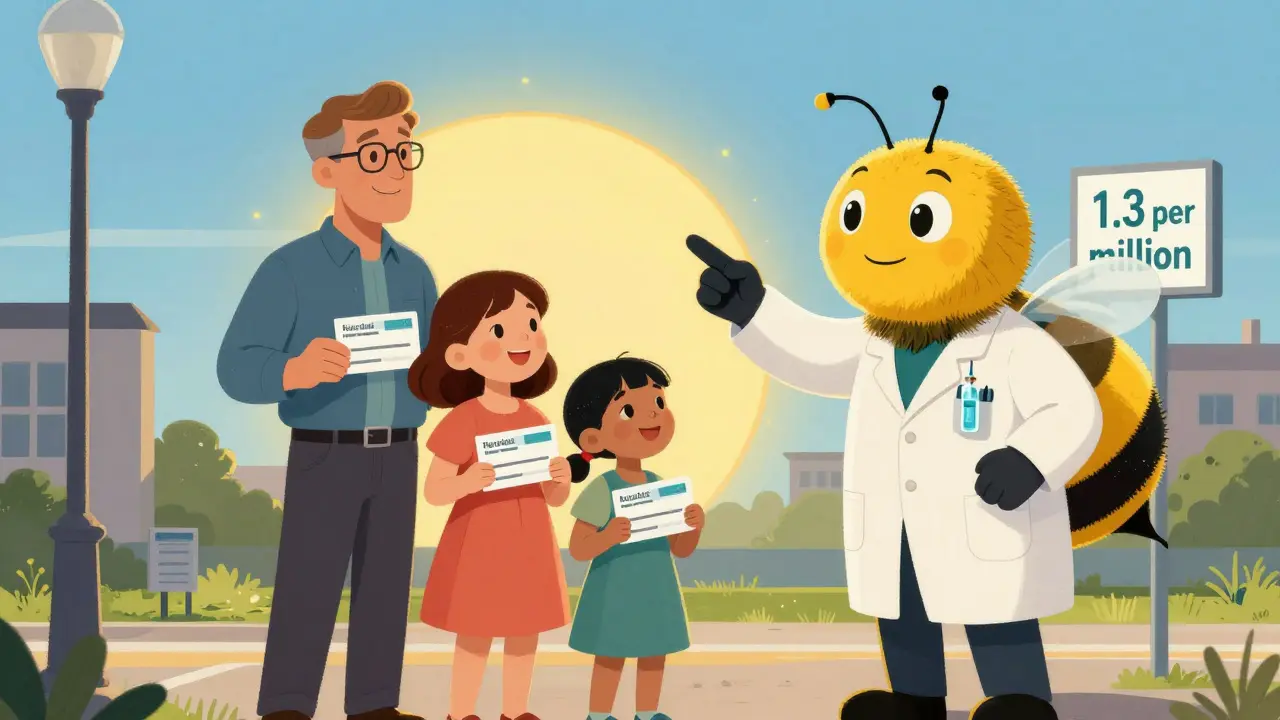
Let’s start with the numbers. Across all vaccines given in the U.S., anaphylaxis-a severe, life-threatening allergic reaction-happens in about 1.3 cases per million doses. That’s like flipping a coin 1 million times and getting heads exactly once. For the mRNA COVID-19 vaccines, the rate was higher at around 5 to 11 cases per million doses. Still, that’s less than the chance of being hit by a falling coconut.
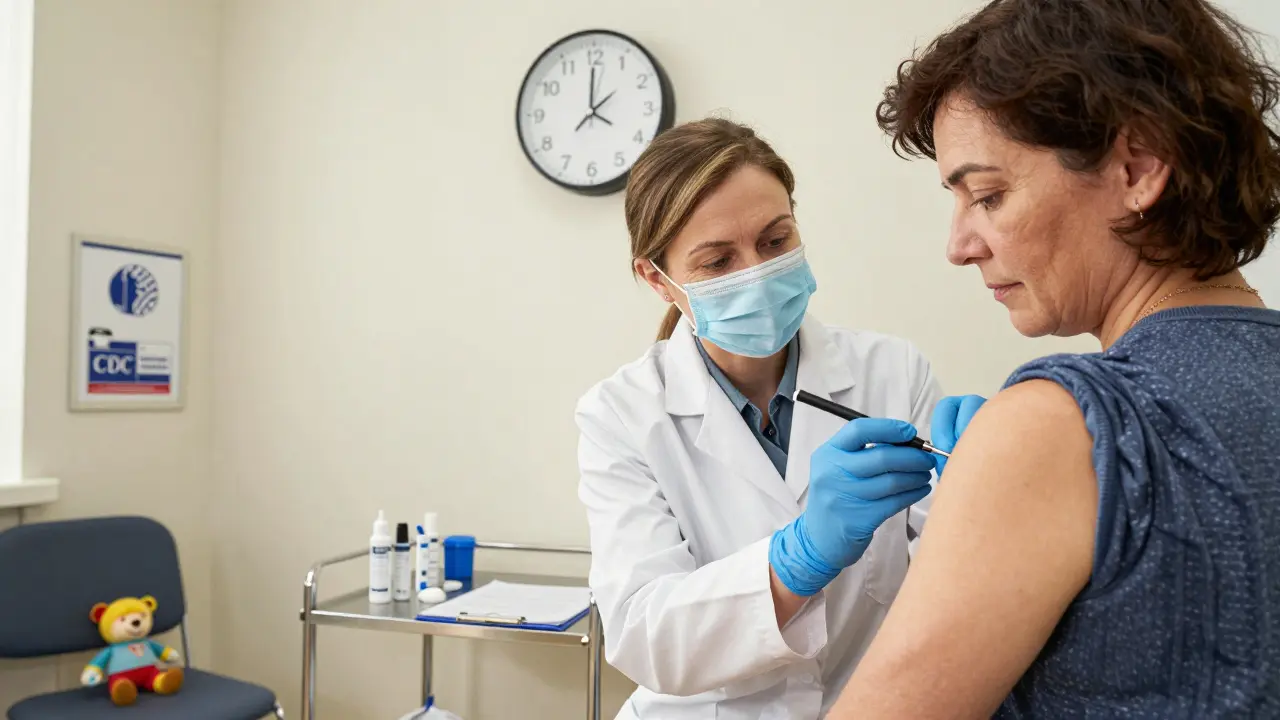
Most reactions happen fast. About 86% of cases show symptoms within 30 minutes. And more than 70% of those happen within the first 15 minutes. That’s why vaccination sites ask you to wait after your shot. It’s not bureaucracy-it’s a safety net.
Women make up about 81% of reported allergic reactions, and the average age is around 40. But reactions have been seen in kids as young as 3 months and adults over 80. Age and gender don’t predict who’ll react-they just show patterns in who’s being monitored.
What Actually Causes These Reactions?
People often blame the virus piece in the vaccine. But it’s rarely the active ingredient. Most allergic reactions are triggered by tiny, non-viral components:
- Polyethylene glycol (PEG): Found in mRNA vaccines like Pfizer and Moderna. It’s also in some laxatives and cosmetics. If you’ve had a known severe reaction to PEG before, talk to your doctor.
- Polysorbate 80: Used in some vaccines as a stabilizer. It’s chemically similar to PEG, so people allergic to one might react to the other.
- Egg protein: This used to be a big worry for flu shots. But today, even people with life-threatening egg allergies can safely get the flu vaccine. Studies have tracked over 4,300 egg-allergic individuals receiving flu shots-none had serious reactions, including 656 with past anaphylaxis to eggs.
- Yeast protein: Used to grow hepatitis B and HPV vaccines. Only 15 possible cases have ever been flagged in 180,000 allergy reports. Most weren’t confirmed as true allergies.
- Aluminum salts: These help boost the immune response. They don’t cause anaphylaxis. Instead, they sometimes cause a hard, painless lump at the injection site that lasts weeks. It’s not dangerous, just annoying.
And here’s the key point: if you’ve had a reaction to a vaccine before, you’re more likely to react again. But if you’ve never had one, your risk is astronomically low.
How Do We Know When Something Goes Wrong?
The U.S. doesn’t rely on luck or guesswork. It has one of the most advanced vaccine safety systems in the world: VAERS-the Vaccine Adverse Event Reporting System. Run jointly by the CDC and FDA since 1990, VAERS collects reports from doctors, patients, and vaccine makers. In 2023, it received over 40,000 reports. But here’s the catch: not every report means the vaccine caused the problem.
VAERS is a warning system, not a proof machine. It picks up signals. For example, if 10 people report anaphylaxis after a new vaccine in one week, that’s a red flag. Then scientists dig deeper-checking medical records, comparing rates to background levels, ruling out other causes.
Other countries have similar systems. The European Medicines Agency’s EudraVigilance gets over 1.5 million reports a year. The WHO coordinates global efforts, and 137 countries now have functional safety monitoring.
After the 1976 swine flu vaccine was linked to Guillain-Barré syndrome, the U.S. built this system to catch problems early. Today, it’s not just reactive-it’s predictive. Tools like v-safe, a smartphone app launched during the pandemic, let people self-report symptoms daily. Over 3.6 million people used it, giving real-time data that helped confirm safety.
What Happens If You Have a Reaction?
If you feel dizzy, break out in hives, have trouble breathing, or your throat swells within minutes of getting a shot-tell the provider immediately. They’re trained for this. Every vaccination site must have epinephrine on hand. It’s the only treatment that stops anaphylaxis in its tracks.
Epinephrine works fast. It tightens blood vessels, opens airways, and reverses swelling. Most people recover fully with prompt treatment. No deaths from vaccine-related anaphylaxis have been confirmed in the U.S. since VAERS began tracking.
Afterward, the provider must report the reaction to VAERS within 24 hours-even if they’re not sure it was caused by the vaccine. That’s how the system learns.
For people with a history of severe allergic reactions, the CDC recommends a 30-minute observation period after vaccination. For everyone else, 15 minutes is enough.
What About Egg Allergies? Should You Still Get the Flu Shot?
This is one of the biggest myths still floating around. In the past, flu vaccines were made using chicken eggs. So if you were allergic to eggs, you were told to avoid them.
That changed in 2017. After reviewing data from 28 studies involving more than 4,300 egg-allergic people-including 656 with past anaphylaxis-the CDC and AAP updated their guidelines. You don’t need to be monitored. You don’t need to skip the shot. You don’t even need to go to an allergist first.
The amount of egg protein in today’s flu vaccines is so low it’s practically negligible. The same goes for the MMR vaccine, which also used to raise concerns. Multiple studies now confirm: egg allergy is not a reason to avoid these vaccines.
What Should You Do Before Getting Vaccinated?
If you’ve never had a reaction to any vaccine or injectable medication, you don’t need to do anything special. Just show up. Tell the provider if you’ve ever had a serious allergic reaction to anything-food, medicine, insect stings, or previous shots.
If you’ve had a confirmed anaphylaxis reaction to a vaccine before, or to a component like PEG or polysorbate, talk to an allergist. They can help determine if it’s safe to get another dose, possibly using a graded dose approach or skin testing.
Don’t avoid vaccines because you’re scared of an allergic reaction. The risk of getting sick from measles, flu, or COVID-19 is thousands of times higher than the risk of anaphylaxis.
What’s Next for Vaccine Safety?
Scientists are working on better ways to predict who might react. A 2023 study in Nature Immunology found possible biomarkers in mast cells-immune cells that trigger allergic reactions-that could one day lead to a simple blood test before vaccination.
Right now, there’s a clinical trial (NCT04976276) testing skin tests for mRNA vaccine components. If it works, it could help identify people at risk without having to avoid vaccines entirely.
The CDC’s 2023-2027 plan includes $28 million to improve data analysis for rare events. That means faster detection, better alerts, and more confidence for the public.
The system isn’t perfect. Passive reporting can miss cases. But it’s the best we have-and it’s working. Since 1990, it’s caught issues with rotavirus, flu, and HPV vaccines before they became widespread problems.
Every vaccine you get is a vote of confidence in this system. And every report-even if it turns out to be unrelated-is part of keeping it strong.

Nilesh Khedekar
January 16, 2026 AT 10:16So let me get this right-you’re telling me I’m more likely to be hit by a falling coconut than to have a reaction to a vaccine?? I’ve seen coconuts fall in Goa, and let me tell you, they don’t just drop-they CRASH like a Bollywood stunt. Still, I’ll take my chances with the shot over the flu any day. 🇮🇳
Jami Reynolds
January 18, 2026 AT 05:36Let’s be clear: VAERS is a garbage-in-garbage-out system. Anyone can report anything. A woman reported her cat died after her neighbor got vaccinated. The CDC didn’t investigate? That’s not safety-that’s mass hysteria disguised as science. They’re hiding the truth. The numbers don’t add up. The real deaths are buried.
Nat Young
January 19, 2026 AT 01:26Wait-you said anaphylaxis is 1.3 per million? That’s not rare. That’s a statistical inevitability when you’re injecting 300 million people. You’re not reducing risk-you’re redistributing it. And PEG? That’s in your toothpaste. You think people haven’t been getting exposed for decades? This isn’t a surprise-it’s a delayed reaction to corporate chemistry. The system isn’t catching problems-it’s just delaying the fallout.
Niki Van den Bossche
January 20, 2026 AT 07:51Ah, the sacred ritual of the hypodermic sacrament-where we anoint ourselves with polyethylene glycol and polysorbate 80, those shimmering elixirs of modernity, as if we’re partaking in some post-industrial Eucharist. We’ve traded ancient wisdom for molecular orthodoxy, and now we worship at the altar of peer-reviewed journals while our bodies become unwitting testaments to pharmaceutical alchemy. Is this healing-or are we just the latest batch of biopolitical subjects?
ellen adamina
January 21, 2026 AT 19:07I had a reaction to the flu shot last year-just a rash and some dizziness. Didn’t think much of it until I read this. Thanks for explaining why it happened. I’ll still get the next one. Just gonna wait the full 30 minutes now.
Tom Doan
January 23, 2026 AT 09:20So you’re telling me the system works… but only if you’re white, middle-class, and have access to a clinic? What about the guy in rural Alabama who passed out after his shot and no one reported it? Or the undocumented worker who got a fever and assumed it was COVID? This system isn’t perfect-it’s privileged.
Annie Choi
January 24, 2026 AT 14:28Love this breakdown. Real talk-vaccine safety isn’t about fear, it’s about infrastructure. VAERS, v-safe, global surveillance-this is the closest we’ve ever come to real-time immunological telemetry. We’re not just getting shots, we’re feeding data that saves lives. Keep reporting, keep showing up. The system needs you.
Ayush Pareek
January 25, 2026 AT 23:42As someone from India where vaccine hesitancy is still common, I’ve seen people avoid shots because of rumors. This post is a gift. I’m sharing it with my family. We’ve lost too many to preventable diseases. Don’t let fear of a one-in-a-million chance stop you from protecting your kids.
Nicholas Urmaza
January 26, 2026 AT 21:31Stop sugarcoating. The fact that you need to wait 15 minutes proves the risk isn’t theoretical. They don’t make you wait because it’s nice-they wait because it’s dangerous. And don’t act like PEG is harmless just because it’s in shampoo. That’s like saying asbestos is fine because it was in insulation
Sarah Mailloux
January 28, 2026 AT 11:44My mom was terrified of the flu shot because of egg allergies-until she got it last year and didn’t even feel a thing. Now she’s the one pushing everyone else to get theirs. This myth needs to die. Seriously, stop scaring people with 2005 guidelines.
Jan Hess
January 29, 2026 AT 12:09Great summary. I’m a nurse and I see people freak out over the 15-minute wait like it’s a prison sentence. Just sit. Breathe. Watch TikTok. You’re fine. And if you’re not? We’ve got epinephrine. It’s not a trap-it’s a safety net.
Iona Jane
January 30, 2026 AT 19:30They say 1.3 per million but what about the 10,000 people who died after the shot and were buried under ‘cardiac arrest’? What about the babies with autism? What about the women who lost their periods? The system is a lie. They’re covering it up. I’ve seen the documents. They know.
Jaspreet Kaur Chana
January 31, 2026 AT 06:05Back in Delhi, we used to say ‘jab lagao, dawa na khao’-get the shot, don’t take medicine. My uncle got his first vaccine at 72 and now he’s dancing at weddings again. People here still whisper about side effects but when you show them the numbers-1.3 per million-they shut up. We don’t need fear. We need facts. And we need to stop letting Hollywood scare us with fake stories.
Haley Graves
February 1, 2026 AT 18:05For anyone still scared-this isn’t about blind faith. It’s about risk comparison. You drive to the clinic. That’s risk. You skip the shot and get the flu. That’s risk. The math is clear. Don’t let anxiety override logic. Get the shot. Then go live your life.