
Warfarin & NSAID Bleeding Risk Calculator
Assess Your Bleeding Risk
Your Bleeding Risk Assessment
Select your medications and click 'Calculate Risk' to see your personalized assessment
When you're on warfarin, even a simple painkiller like ibuprofen can turn dangerous. It's not just a warning on the label-it's a real, measurable risk backed by decades of research. People taking warfarin for atrial fibrillation, deep vein thrombosis, or mechanical heart valves are already balancing a fine line between clotting and bleeding. Adding an NSAID? That line gets much thinner.
How Warfarin Works
Warfarin doesn't thin your blood like water. It stops your liver from making key clotting factors-II, VII, IX, and X-by blocking vitamin K. Without those factors, your blood takes longer to clot. That’s why doctors track your INR (International Normalized Ratio). A normal INR is around 1.0. For most people on warfarin, the target is between 2.0 and 3.0. Go above 4.0, and your risk of serious bleeding jumps sharply.
Warfarin’s effect builds slowly. It can take days to reach full strength, and small changes in diet, illness, or other drugs can throw your INR off balance. That’s why regular blood tests are non-negotiable.
How NSAIDs Interfere
NSAIDs-like ibuprofen, naproxen, diclofenac, and even aspirin-work by blocking enzymes called COX-1 and COX-2. COX-2 is linked to pain and inflammation, which is why NSAIDs help with arthritis or headaches. But COX-1? That’s the enzyme your platelets need to stick together and form clots. When NSAIDs block COX-1, platelets can’t do their job properly.
That’s bad enough on its own. But when you combine that with warfarin’s suppression of clotting factors, you get a one-two punch. Your blood can’t clot effectively from two different angles: fewer clotting proteins and impaired platelet function.
The Numbers Don’t Lie
A 2019 analysis from the European Society of Cardiology found that people taking both warfarin and an NSAID had more than double the risk of bleeding compared to those taking warfarin alone. That’s a 2.09-fold increase. But the risk isn’t the same for every NSAID:
- Naproxen: 4.1 times higher bleeding risk
- Diclofenac: 3.3 times higher
- Ibuprofen: 1.79 times higher
Naproxen carries the highest risk-not because it’s stronger, but because it stays in your system longer. Longer exposure means more prolonged platelet suppression.
And it’s not just your stomach. Bleeding can happen anywhere:
- Gut: 2.24 times higher risk
- Brain: 3.22 times higher risk (intracranial hemorrhage)
- Urinary tract: 1.57 times higher
- Lungs: 1.36 times higher
One study showed that nearly 40% of warfarin users who started an NSAID saw their INR spike by 15% or more. That’s not a minor fluctuation-it’s a red flag that requires immediate action.
Why Your Stomach Is Ground Zero
NSAIDs don’t just mess with platelets. They also damage the protective lining of your stomach and intestines. They reduce prostaglandins, which normally help maintain blood flow to the gut lining and repair minor damage. Without them, your stomach becomes vulnerable to ulcers and bleeding.
Warfarin doesn’t cause ulcers. But if you already have one-and NSAIDs made it worse-warfarin turns a slow leak into a hemorrhage. A 2024 meta-analysis confirmed that combining warfarin with NSAIDs doubles the risk of gastrointestinal bleeding compared to warfarin alone.
Even “safer” NSAIDs like celecoxib (a COX-2 inhibitor) carry the same risk. The old idea that selective NSAIDs are safer for people on blood thinners? That’s been debunked.
Who’s at Highest Risk?
Not everyone on warfarin who takes an NSAID will bleed. But certain people are far more vulnerable:
- Those on high-dose warfarin (more than 40 mg per week): Their bodies are already stretched thin. A small change can tip them over.
- People taking other interacting drugs: Antibiotics, antifungals, even some herbal supplements like garlic or ginkgo can amplify the effect.
- Those with low baseline INR: If your INR is near 2.0, you have less room to spare. A small rise can push you into danger.
- Patients using meloxicam: One study flagged this NSAID as an independent risk factor for dangerous INR spikes.
Age matters too. Older adults are more likely to be on warfarin, more likely to have arthritis, and more likely to have fragile blood vessels and thinner stomach linings. It’s a perfect storm.
What About Newer Blood Thinners?
Many people switch from warfarin to DOACs like apixaban, rivaroxaban, or dabigatran thinking they’re safer. But NSAIDs still pose a risk.
A 2018 study found that while dabigatran didn’t interact with NSAIDs in the same way as warfarin (no INR to spike), people taking both still had higher rates of major bleeding-especially in the gut. In fact, 40% of major bleeds in NSAID users on DOACs were gastrointestinal. So even if you’re not on warfarin, NSAIDs aren’t risk-free.
What Should You Do Instead?
If you’re on warfarin and need pain relief, here’s what works:
- Acetaminophen (paracetamol): Up to 3,000 mg per day is generally safe. It doesn’t affect platelets or the stomach lining. It’s the first-line recommendation from the American College of Chest Physicians.
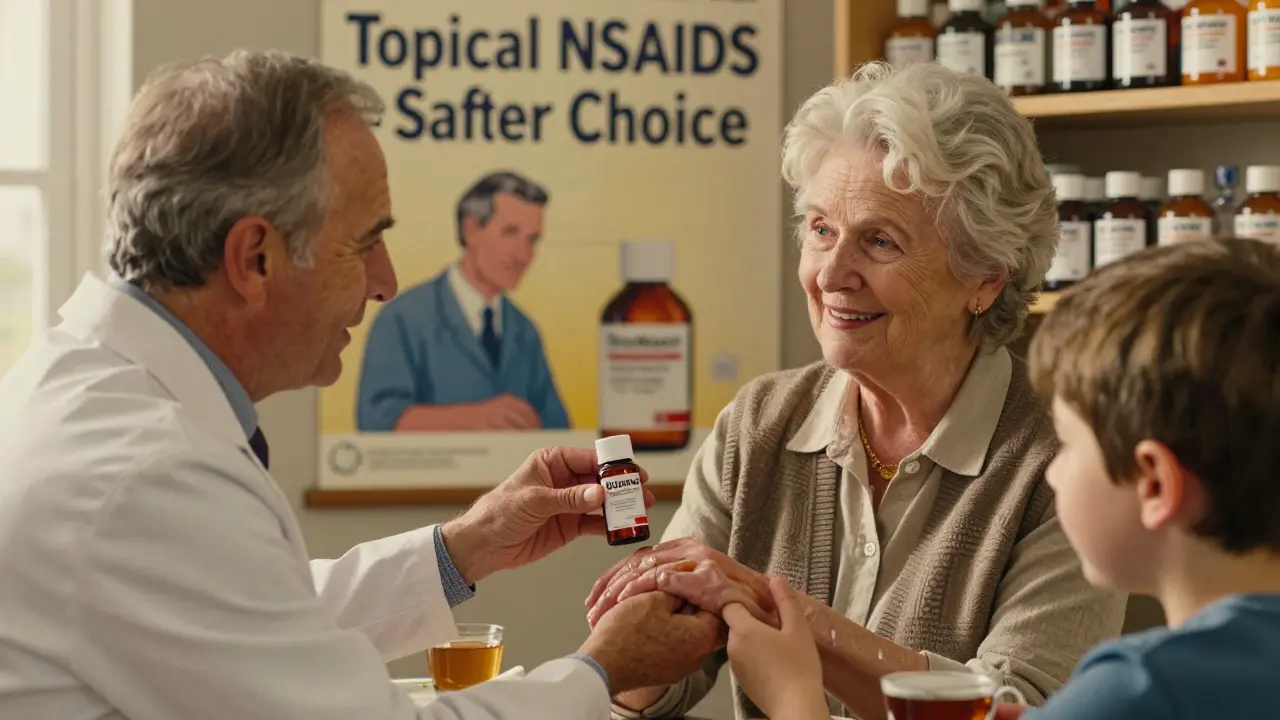
- Topical NSAIDs: Gels or patches like diclofenac gel applied to your knee or shoulder deliver the drug locally, with far less systemic absorption. Much lower risk.
- Physical therapy: For chronic joint pain, strengthening muscles and improving mobility reduces reliance on meds.
- Heat/cold therapy: Simple, effective, and free.
If you absolutely must take an oral NSAID-say, for a flare-up of severe arthritis-your doctor should:
- Use the lowest effective dose for the shortest time possible
- Prescribe a proton pump inhibitor (PPI) like pantoprazole 40 mg daily to protect your stomach
- Check your INR within 3-5 days of starting the NSAID
- Monitor weekly while both drugs are taken
And never start an NSAID without telling your anticoagulation clinic or pharmacist. Even over-the-counter ones.

Why Do Doctors Still Prescribe This Combo?
Despite clear guidelines, a 2022 study found that nearly 3 out of 10 warfarin users got an NSAID prescription within a year. That’s not just a mistake-it’s a systemic failure.
Doctors are busy. Patients ask for pain relief. NSAIDs are cheap, familiar, and available without a prescription. But the data is overwhelming: this combo kills. A single bleed can mean hospitalization, blood transfusions, or death.
It’s preventable. But only if everyone-patients, pharmacists, and doctors-understands the stakes.
What to Watch For
If you’re on warfarin and take an NSAID-even once-know the signs of bleeding:
- Bright red or black, tarry stools
- Unusual bruising, especially large or unexplained
- Bleeding gums when brushing teeth
- Persistent nosebleeds
- Severe headache, dizziness, confusion (possible brain bleed)
- Dark urine or blood in urine
- Unexplained weakness or fatigue (sign of anemia from slow bleeding)
If any of these happen, stop the NSAID and get medical help immediately. Don’t wait.
The Bottom Line
Warfarin and NSAIDs don’t just mix poorly-they multiply danger. The risk isn’t theoretical. It’s quantified, documented, and deadly. For most people, acetaminophen and non-drug therapies are safer, effective alternatives. If an NSAID is unavoidable, it must be used with extreme caution, protective meds, and close monitoring.
This isn’t about avoiding pain. It’s about surviving it.
Can I take ibuprofen if I’m on warfarin?
It’s not recommended. Ibuprofen increases your bleeding risk by nearly 80% when taken with warfarin. If you must use it, do so only for a few days, at the lowest dose, with a stomach-protecting drug like pantoprazole, and get your INR checked within 3-5 days. Acetaminophen is a safer choice for pain relief.
Does naproxen have a higher risk than other NSAIDs?
Yes. Naproxen carries the highest bleeding risk among common NSAIDs when taken with warfarin-4.1 times higher than warfarin alone. That’s because it lasts longer in your body, meaning prolonged suppression of platelet function. Avoid it if you can.
Is aspirin safe with warfarin?
No. Even low-dose aspirin (81 mg) increases bleeding risk. It blocks platelets and can also reduce clotting factor production. Unless you’re on it for heart protection (and your doctor specifically approved it), avoid combining it with warfarin.
How often should INR be checked when starting an NSAID?
Check your INR within 3 to 5 days after starting the NSAID. Then check weekly while both drugs are taken. If your INR rises above 4.0, your doctor may pause the NSAID or adjust your warfarin dose.
Can I use topical NSAIDs like diclofenac gel?
Yes. Topical NSAIDs are much safer because very little of the drug enters your bloodstream. For joint pain in the knee or elbow, diclofenac gel is a good option. Still, tell your doctor you’re using it.
What if I accidentally took ibuprofen while on warfarin?
Stop taking it immediately. Watch for signs of bleeding-bruising, dark stools, dizziness. Call your doctor or anticoagulation clinic. They’ll likely want to check your INR within 24-48 hours. One dose isn’t usually catastrophic, but it’s a warning sign to be more careful next time.
Are there any NSAIDs that are safe with warfarin?
No NSAID is truly safe with warfarin. All carry some increased risk. The goal isn’t to find the “safest” NSAID-it’s to avoid oral NSAIDs entirely. Use acetaminophen, physical therapy, or topical options instead.
Why does meloxicam have a higher risk with warfarin?
Studies show meloxicam is independently linked to significant INR spikes in warfarin users, even more than expected based on its NSAID class. The exact reason isn’t fully understood, but it may involve how it affects liver enzymes that process warfarin. It’s best avoided.

Nisha Marwaha
December 30, 2025 AT 16:47The pharmacokinetic interplay between warfarin and NSAIDs is a classic example of dual-pathway anticoagulant synergy-COX-1-mediated platelet dysfunction compounded by vitamin K antagonism. This isn't just a contraindication; it's a pharmacodynamic cascade with clinically significant hemorrhagic potential. The 2.09-fold increase in bleeding events is not statistical noise-it's a red flag for systemic risk stratification failures in primary care.
Furthermore, the differential risk profile among NSAIDs (naproxen > diclofenac > ibuprofen) correlates directly with half-life and platelet recovery kinetics. Naproxen’s 12–14 hour half-life sustains irreversible COX-1 inhibition, whereas ibuprofen’s shorter duration permits partial platelet recovery. This nuance is routinely overlooked in clinical decision-making.
Topical NSAIDs are underutilized in this population. The transdermal bioavailability of diclofenac gel is <5% of oral, rendering systemic anticoagulant interaction negligible. Yet, most guidelines still lump all NSAIDs into a single ‘avoid’ category, which is overly simplistic and potentially harmful to patients with chronic musculoskeletal pain.
Also, meloxicam’s disproportionate effect on INR may stem from CYP2C9 inhibition, a key enzyme in S-warfarin metabolism. This isn't just an NSAID issue-it's a cytochrome P450 interaction masked as a class effect. More pharmacogenomic screening is needed in anticoagulated patients.
Finally, the assumption that DOACs eliminate NSAID risk is misleading. While they lack INR variability, their renal clearance and protein binding profiles still create synergistic bleeding pathways with NSAIDs, particularly in the GI tract. The 40% GI bleed rate in DOAC+NSAID users is alarming and underreported.
This requires a paradigm shift: NSAIDs aren’t just ‘risky’-they’re pharmacologically incompatible with chronic anticoagulation. Period.
Paige Shipe
January 1, 2026 AT 12:11Actually, I think this article is way overblown. I’ve been on warfarin for seven years and I take ibuprofen for my arthritis every other day. My INR has never gone above 3.2. The doctors just scare people to sell more blood tests. I don’t need to be told to avoid ibuprofen-I’ve been doing it my way for years and I’m fine. If your INR is stable, why panic over a few pills? The real problem is the healthcare system making everything into an emergency.
Also, acetaminophen isn’t perfect-it can wreck your liver if you take too much. So maybe we should stop pretending one drug is the holy grail and start trusting patients to make their own choices. I’ve never had a bleed. Ever. So I think this fear-mongering needs to stop.
Duncan Careless
January 2, 2026 AT 23:28I appreciate the depth of this post. As a pharmacist who’s counseled dozens of elderly patients on anticoagulants, I can tell you the most dangerous moment is when someone picks up an OTC NSAID at the pharmacy without telling anyone.
One woman I worked with-82, on warfarin for AFib-took naproxen for a bad back for three days. She didn’t think it mattered because it was ‘just a painkiller.’ She ended up with a GI bleed and needed two units of blood. She didn’t even know her INR had spiked to 6.8.
Topical diclofenac? Yes. Acetaminophen? Absolutely. But even ‘safe’ options need disclosure. We need better pharmacy alerts. And we need patients to understand: if it’s not on your anticoagulation list, don’t assume it’s safe. Ask. Always ask.
Also, the meloxicam point is critical. I’ve seen it spike INR more than any other NSAID in my practice. It’s not on most interaction checkers. That’s a gap.
Jim Rice
January 4, 2026 AT 19:41Wow, another fear-based medical article. Let me guess-next you’ll say coffee increases bleeding risk because it’s a ‘vasoconstrictor’? Or that breathing oxygen is dangerous because it oxidizes blood cells?
This is why people distrust doctors. You take one study, cherry-pick the worst-case numbers, ignore individual variability, and turn a manageable interaction into a death sentence. I’ve seen people die from being too scared to take pain meds. That’s not medicine-it’s medical tyranny.
And why is acetaminophen the ‘golden child’? It’s hepatotoxic. It kills more people annually than warfarin bleeds. But no one writes articles about how dangerous Tylenol is. Hypocrisy.
Also, ‘don’t use NSAIDs’? That’s lazy. What if someone has severe rheumatoid arthritis and acetaminophen doesn’t touch their pain? Do they just suffer? Do they become addicted to opioids because you’re too scared to prescribe a ‘risky’ NSAID with a PPI?
Stop infantilizing patients. Give them data. Let them decide. Don’t scare them into compliance.
Henriette Barrows
January 6, 2026 AT 16:35I just want to say thank you for writing this. My dad is on warfarin for his AFib, and he was taking ibuprofen every day for his knee pain. I didn’t know it was this dangerous until I read this. We switched him to Tylenol and started using a heating pad-he says his pain is still manageable. He’s also been checking his INR every week now.
I just wish more people knew this. My aunt’s husband died from a brain bleed after taking naproxen for a week. No one told him it was risky. He thought it was just like aspirin.
Please keep sharing stuff like this. It saves lives.
Louis Paré
January 7, 2026 AT 05:04Let’s be honest-this entire post is a glorified marketing pamphlet for acetaminophen and PPIs. The real issue? The medical-industrial complex profits from INR tests, PPI prescriptions, and anticoagulation clinics. NSAIDs are cheap. Acetaminophen? Also cheap. But PPIs? Those are billion-dollar drugs.
And let’s not pretend the bleeding risk is evenly distributed. Most people on warfarin are elderly, frail, and already on 12 other meds. Of course they bleed. It’s not the NSAID. It’s polypharmacy. Blame the system, not the drug.
Also, the ‘40% of patients spike INR’ stat? That’s from a small retrospective cohort. Where’s the RCT? Where’s the control group? This isn’t science-it’s alarmist correlation dressed up as causation.
And why is meloxicam singled out? Because someone got a weird lab result once? That’s not evidence. That’s anecdotal noise.
Stop weaponizing fear. Patients are not children. They deserve nuance, not dogma.
Marie-Pierre Gonzalez
January 7, 2026 AT 16:47Thank you for this meticulously researched and profoundly important summary. As a nurse working in geriatric anticoagulation, I witness the consequences of this interaction daily. The emotional toll on patients who experience unexplained bleeding is devastating-fear, guilt, loss of autonomy.
I especially appreciate the emphasis on topical NSAIDs. We’ve had remarkable success with diclofenac gel for osteoarthritis patients. One 86-year-old man, previously reliant on oral NSAIDs, now manages his hip pain with gel and physical therapy. His INR has been stable for 14 months.
Let us not forget: the goal is not to eliminate pain, but to preserve life while managing it. This article is a lifeline. Please share it with every primary care provider you know.
With deepest respect,
Marie-Pierre
Janette Martens
January 8, 2026 AT 07:48This is why Canada is falling behind. We let American doctors scare people with numbers and forget about real solutions. In Quebec, we use NSAIDs all the time with warfarin. We just monitor better. We don’t need to switch to Tylenol-everyone knows it’s weak. We need more doctors who know how to manage risk, not just avoid it.
Also, why is everyone so scared of ibuprofen? My uncle takes it with warfarin and he’s 80 and still hikes. Your article is too American. We need less fear, more common sense.
Manan Pandya
January 8, 2026 AT 22:12As a clinical pharmacist in India, I’ve seen this play out repeatedly. Many patients here self-medicate with NSAIDs because they’re cheap and available without prescription. I once had a patient on warfarin for DVT who took diclofenac for back pain for two weeks. He presented with melena and an INR of 7.4. He survived, but barely.
What’s missing in Western literature is the cultural context: in many low-resource settings, acetaminophen is less accessible, and patients don’t have regular INR access. So the advice to ‘use acetaminophen’ sounds privileged.
Our solution? We prioritize topical NSAIDs and educate patients using pictorial guides. We also use lower-dose warfarin when possible. We don’t just say ‘avoid’-we say ‘here’s how to do it safely if you must.’
Also, meloxicam is rarely used here, but when it is, we check INR within 48 hours. It’s a silent killer.
Aliza Efraimov
January 10, 2026 AT 09:40I’ve been a nurse for 22 years, and I’ve seen too many patients bleed out because someone thought ‘it’s just one pill.’ This isn’t theoretical. I held a woman’s hand as she coded from a GI bleed after taking naproxen for a headache. She was 69. She had a pacemaker. She didn’t know the risks.
And yes-DOACs aren’t magic. I had a patient on rivaroxaban who took ibuprofen for three days and ended up with a retroperitoneal hematoma. He needed surgery. He’s lucky he’s alive.
Acetaminophen isn’t perfect, but it’s the *safest* option. Not because it’s trendy, but because it doesn’t touch platelets or the stomach lining. It’s science, not opinion.
If you’re on warfarin and you’re reading this: please, for the love of God, don’t reach for the ibuprofen. Call your clinic. Ask. Wait. Use heat. Use ice. Use Tylenol. Your life is worth more than a few hours of pain.
I’m not a doctor. But I’ve seen what happens when people don’t listen. Don’t be the next story.