
Most people don’t think about their kidneys until something goes wrong. But by the time symptoms like swelling, fatigue, or foamy urine show up, up to half your kidney function may already be gone. That’s why creatinine, GFR, and urinalysis aren’t just lab results-they’re early warning signs that can change your health trajectory. These three tests are the foundation of kidney health checks in the UK and around the world, and knowing what they mean can help you catch problems before they become serious.
What Creatinine Tells You About Your Kidneys
Creatinine is a waste product your muscles make every day as they break down creatine for energy. Healthy kidneys filter creatinine out of your blood and send it out in your urine. When your kidneys start to slow down, creatinine builds up in your bloodstream. That’s why doctors measure it in blood tests.
But here’s the catch: creatinine doesn’t rise until your kidneys have lost about 50% of their function. That makes it a late signal, not an early one. A 70-year-old with low muscle mass might have a "normal" creatinine level even if their kidneys are struggling. Meanwhile, a young, muscular person might have a higher creatinine level simply because they have more muscle-not because their kidneys are failing.
That’s why creatinine alone isn’t enough. It’s a starting point, not the full story. In the UK, every blood test from your GP includes creatinine. If it’s high, your doctor won’t panic-they’ll look at your age, sex, and weight before deciding what it means.
Understanding GFR: The Real Measure of Kidney Performance
Glomerular Filtration Rate, or GFR, is the gold standard for measuring how well your kidneys filter blood. It’s not directly measured in most clinics. Instead, it’s estimated using your creatinine level, age, sex, and sometimes ethnicity. This estimated number-called eGFR-is what shows up on your lab report next to creatinine.
The formula most UK labs use today is the CKD-EPI equation. It replaced the older MDRD formula because it’s more accurate, especially for people with near-normal kidney function. The result is given in mL/min/1.73 m²-a way to compare kidney performance across different body sizes.
Here’s what your eGFR means:
- 90 or above: Normal kidney function, even if there’s mild damage
- 60-89: Mildly reduced function-may need monitoring
- 45-59: Mild to moderate reduction
- 30-44: Moderate to severe reduction
- 15-29: Severe reduction-preparation for dialysis may begin
- Below 15: Kidney failure-dialysis or transplant likely needed
But eGFR has limits. It’s not reliable for people under 18, pregnant women, or those who are extremely muscular or severely overweight. In those cases, doctors may use cystatin C-a different blood marker that’s less affected by muscle mass. It’s not routine yet, but it’s becoming more common in specialist clinics.
Why Urinalysis Is Just as Important as Blood Tests
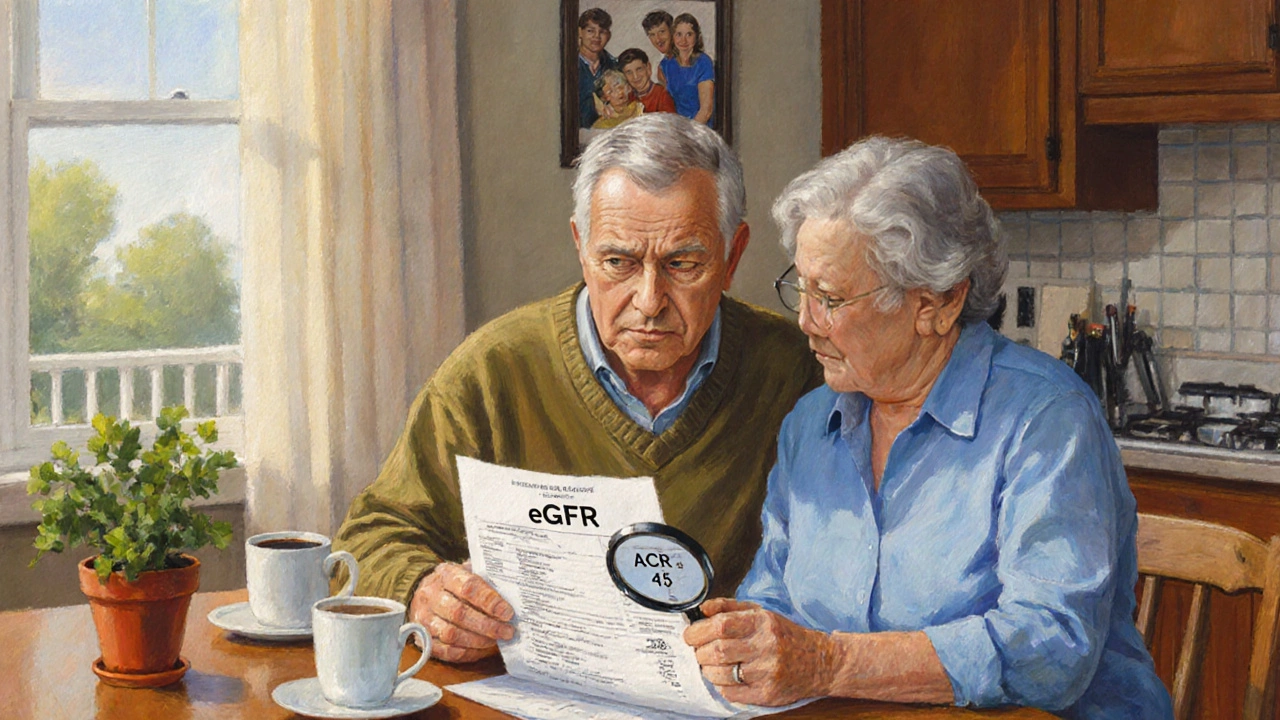
Even if your creatinine and eGFR look fine, protein in your urine can be the first sign of kidney trouble. That’s where urinalysis comes in. Not the old dipstick test you might remember from school-it’s now a precise lab test called the Albumin-to-Creatinine Ratio (ACR).
Albumin is a protein your kidneys normally keep in your blood. When the filters in your kidneys get damaged-often from diabetes or high blood pressure-they start leaking albumin into your urine. That’s proteinuria. And it can happen long before creatinine rises.
The UK Kidney Association recommends ACR as the first-line test for anyone at risk. Here’s what the numbers mean:
- Less than 3 mg/mmol: Normal
- 3 to 70 mg/mmol: Microalbuminuria-early kidney damage
- Over 70 mg/mmol: Macroalbuminuria-significant damage
If your ACR is in the 3-70 range, your GP will ask you to repeat the test on an early morning urine sample. One high result could be from dehydration, infection, or exercise. Two or three high results over weeks confirm a problem.
Even if you feel fine, if you have diabetes, high blood pressure, heart disease, or a family history of kidney failure, you should have both an eGFR and an ACR test at least once a year. That’s the standard of care in the NHS.
Who Needs These Tests-and How Often?
You don’t need to wait for symptoms. If you fall into any of these groups, you should be tested regularly:
- People with type 1 or type 2 diabetes
- Those with high blood pressure (especially if it’s hard to control)
- Anyone who’s had a previous episode of acute kidney injury
- People with cardiovascular disease
- Those with a family history of kidney failure
- People over 60
The NHS doesn’t screen everyone yearly, but if you’re in one of these groups, your GP should be ordering both an eGFR and an ACR at least once a year. If your results are borderline, you might be tested every 3-6 months.
Even if you’re not in a high-risk group, it’s smart to ask for a basic metabolic panel-including creatinine-during your annual check-up. Many GPs offer it, especially if you’re over 50 or have other chronic conditions.
What Happens If Your Results Are Abnormal?
Abnormal doesn’t mean you’re headed for dialysis. Most early kidney damage can be slowed-or even reversed-if caught in time.
If your eGFR is low or your ACR is high, your doctor will likely:
- Check your blood pressure and adjust medication if needed
- Review your diabetes control (HbA1c if you have it)
- Ask you to cut back on salt and processed foods
- Recommend stopping NSAIDs like ibuprofen if you take them regularly
- Prescribe ACE inhibitors or ARBs-medications that protect kidneys even if your blood pressure is normal
- Refer you to a nephrologist if damage is moderate to severe
Lifestyle changes matter. Losing 5-10% of your body weight, quitting smoking, and controlling blood sugar can dramatically slow kidney decline. A study from the University of Bristol in 2024 showed that people with early kidney damage who followed a low-salt, plant-focused diet saw a 20% improvement in ACR over 12 months.

What About 24-Hour Urine Tests?
You might hear about collecting urine for 24 hours. That’s used less often now. It’s messy-you have to save every drop for a full day. It’s also less accurate than ACR because it’s easy to miss a sample or over-collect.
Doctors still use it in rare cases: if you’re losing a lot of protein (over 3g per day), if you have unusual symptoms, or if they suspect a rare kidney disease. But for routine screening, ACR is faster, cheaper, and just as good-if not better.
What You Can Do Today
You don’t need a medical degree to protect your kidneys. Here’s what works:
- Ask your GP for an eGFR and ACR test if you’re over 50 or have risk factors
- Keep your blood pressure under 130/80 if you have kidney issues
- Don’t take ibuprofen or naproxen daily without checking with your doctor
- Drink water when you’re thirsty-no need to force 2 litres a day
- Get your HbA1c checked yearly if you have diabetes
- Don’t ignore foamy urine, swollen ankles, or unexplained fatigue
Most kidney damage is silent. But with just two simple tests-creatinine for eGFR and urine ACR-you can see what’s happening before it’s too late. Don’t wait for symptoms. Ask for your numbers. Know your numbers. Your kidneys will thank you.
Can I check my kidney function at home?
No reliable home tests exist for eGFR or urine albumin. Some smart toilets or urine strips claim to detect protein, but they’re not accurate enough for medical use. Only a lab test with proper equipment can give you reliable results. If you’re concerned, ask your GP for a blood and urine test-it’s quick, free on the NHS, and far more accurate.
Why is my eGFR different from my friend’s even if we’re the same age?
eGFR calculations adjust for sex and body size. Men usually have higher muscle mass, so their creatinine levels are naturally higher, which can lead to a slightly lower eGFR-even if their kidneys are healthy. Women, older adults, and people with less muscle mass often have lower creatinine, which can make eGFR appear higher. That’s why the formula includes these factors. It’s not a mistake-it’s designed to be more accurate.
Does drinking lots of water improve my GFR?
Drinking extra water won’t boost your GFR if your kidneys are damaged. In fact, forcing fluids can strain your kidneys if you already have advanced disease. The best advice is to drink when you’re thirsty. For most people, that’s about 6-8 glasses a day. Don’t overdo it. Your kidneys regulate fluid balance naturally-unless they’re already struggling.
Can medication affect my creatinine or GFR results?
Yes. Common painkillers like ibuprofen, naproxen, and diclofenac can temporarily reduce kidney function and raise creatinine. Some antibiotics, blood pressure meds like ACE inhibitors, and even contrast dyes used in scans can affect results. Always tell your doctor what you’re taking before a blood test. If you’re on long-term NSAIDs, ask if you can switch to paracetamol instead.
If my ACR is high but my eGFR is normal, am I at risk?
Yes. A high ACR means your kidney filters are leaking protein, which is often the earliest sign of damage-even if your overall filtration rate (eGFR) is still normal. This is especially common in people with diabetes or high blood pressure. Left unchecked, this can lead to progressive kidney decline. Your doctor should treat this as a warning sign and start protective measures, like blood pressure control and lifestyle changes, even if your eGFR looks fine.

Matthew Higgins
November 30, 2025 AT 02:49Man, I never realized how much my kidneys were just chillin’ in the background until I read this. Like, I thought if I wasn’t peeing blood or swollen like a balloon, I was fine. Turns out I’ve been ignoring the quiet alarms for years. Thanks for breaking it down without making me feel dumb.
stephen idiado
December 1, 2025 AT 13:30ACR is overrated. eGFR is the only metric that matters. Everything else is noise peddled by lab corporations. You don’t need a urine test-you need a GFR trend. Stop overtesting.
gerardo beaudoin
December 2, 2025 AT 21:42I’ve got type 2 diabetes and my doc ordered the ACR last year-turned out I was in the microalbuminuria range. Changed my diet, cut the salt, started walking daily. A year later, it’s back to normal. This isn’t just info-it’s a lifeline if you’re paying attention.
Richard Thomas
December 4, 2025 AT 19:13While the article presents a comprehensive overview of renal biomarkers, it regrettably fails to adequately address the confounding influence of sarcopenia in elderly populations, particularly as it pertains to the CKD-EPI equation’s reliance on creatinine as a proxy for muscle mass. Furthermore, the omission of cystatin C as a first-line biomarker in primary care settings represents a significant methodological gap, especially given its superior sensitivity in detecting early glomerular dysfunction independent of lean body mass. The recommendation to rely solely on eGFR and ACR without acknowledging the emerging clinical utility of combined biomarker panels is, in my professional estimation, premature and potentially misleading.
Sohini Majumder
December 5, 2025 AT 17:23Okay but like… why is everyone so obsessed with kidneys?? I mean, I drink water, I don’t take ibuprofen like candy, and I still got a weird foamy pee once after a workout-so now I’m terrified?? Like, I just wanna nap, not get a nephrologist referral 😭😭😭
Jennifer Wang
December 5, 2025 AT 23:20As a clinical nephrologist with over two decades of experience in renal diagnostics, I must emphasize that the article accurately reflects current UK and international guidelines. The integration of eGFR and ACR remains the gold standard for early detection of chronic kidney disease. It is imperative that primary care providers consistently implement these screenings, particularly in high-risk populations. The data supporting the predictive value of microalbuminuria for progression to end-stage renal disease is robust and well-documented in the Journal of the American Society of Nephrology. Delayed screening remains the leading preventable cause of avoidable renal decline.
tushar makwana
December 7, 2025 AT 18:23my cousin in delhi had diabetes and never checked his kidneys till he got really tired all the time… now he’s on meds and doing better. this post is like a quiet friend telling you to check in on yourself. no drama, just truth. thank you.
Andrew Keh
December 9, 2025 AT 13:46Thanks for sharing this. I’ve been telling my dad to get his numbers checked for years-he’s 67, has high blood pressure, and always says ‘I feel fine.’ Now I’m sending him this. Simple, clear, and backed by real guidelines. That’s the kind of info we need more of.