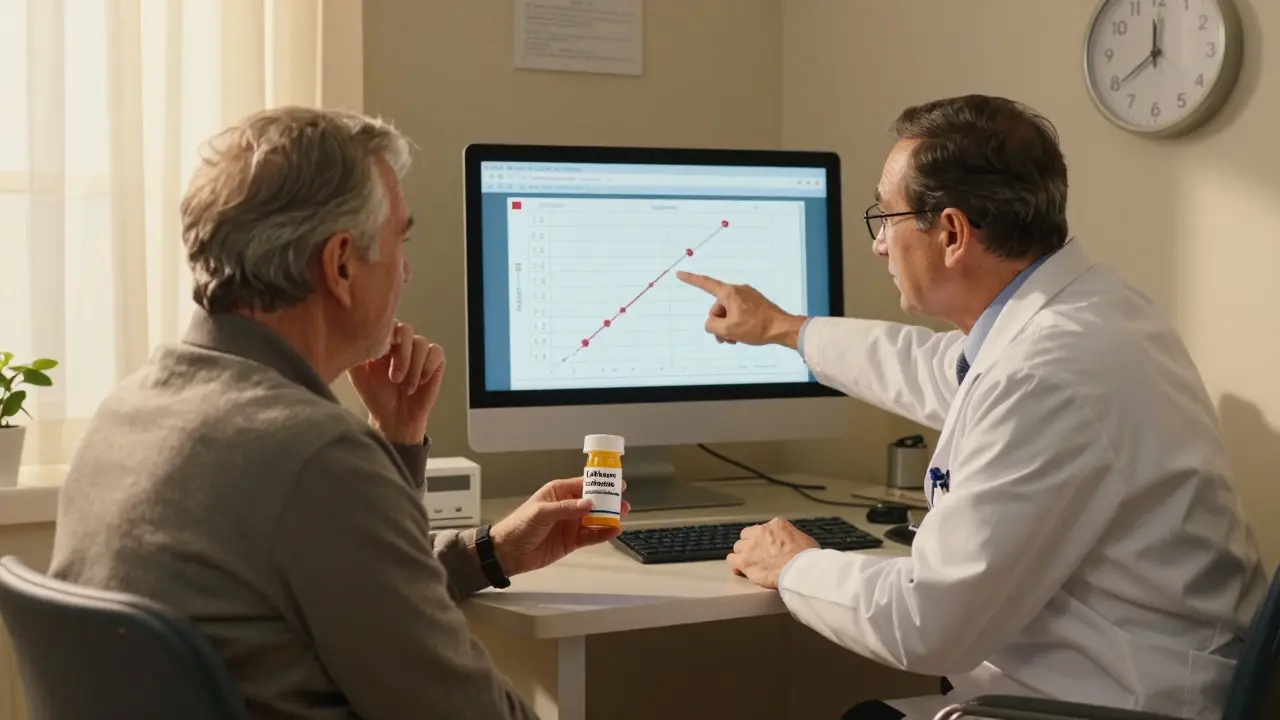
When you're managing bipolar disorder with lithium carbonate, the brand on the bottle can actually matter more than you think. Even though generic versions are supposed to be identical to the brand-name drug, small differences in how they release lithium into your bloodstream can shift your serum levels - and that can mean the difference between staying stable and ending up in the hospital.
Why Serum Levels Are Everything
Lithium works by stabilizing mood, but it doesn't take much to push it from helpful to dangerous. The safe range? Between 0.6 and 1.2 mmol/L. Go above 1.5, and you risk toxicity: tremors, confusion, even seizures. Drop below 0.6, and the drug stops working - relapse rates jump sharply. This narrow window is why lithium is called an NTI drug: narrow therapeutic index. There's no room for guesswork.That’s why doctors don’t just prescribe a pill and call it a day. They check your blood. Regularly. Every 3 to 6 months when you’re stable. More often when you start, switch brands, or change doses. The timing matters too. For immediate-release lithium, blood is drawn 12 hours after your last dose. For extended-release versions, it’s often 24 hours - because that’s when the drug levels even out in your body.
Generics Aren’t Always Interchangeable
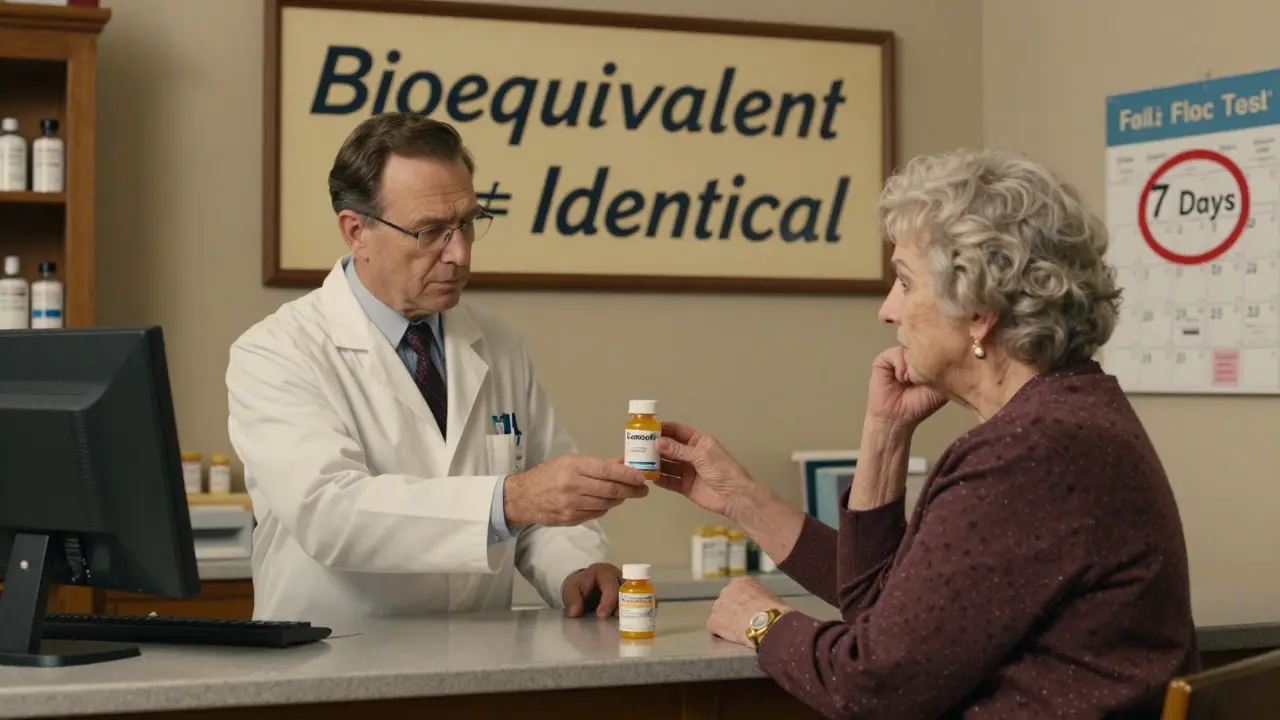
All generic lithium carbonate must meet FDA standards: their absorption must be within 80-125% of the brand-name version. Sounds fair, right? But here’s the catch: that’s a 45% range. Two generics can both be “bioequivalent” and still deliver very different amounts of lithium into your blood over time.A 2024 study in the Journal of Psychopharmacology found that patients switched from Camcolit to Priadel - both sustained-release generics - ended up with 11% higher average serum levels, even when the dose stayed the same. Four patients in that study crossed into toxic territory (above 1.3 mmol/L) after a simple brand switch. No dosage change. Just a different pill.
Why? Because the way the tablet breaks down in your gut varies. Priadel releases lithium over about 2 hours. Camcolit takes longer. One might peak higher and faster. Another spreads it out. Even small differences in dissolution rate can change your peak concentration - and your risk.
And it’s not just between brands. Even two different batches of the same generic can vary slightly. That’s why doctors who know lithium well will tell you: once you find a brand that works, stick with it. Don’t let the pharmacy switch it without telling you.
Formulation Matters More Than You Realize
There are two main types of lithium carbonate: immediate-release and extended-release. The difference isn’t just convenience - it’s safety.Immediate-release tablets (like those from Essential Pharma) hit peak levels in 1-2 hours. That means your blood spikes quickly, then drops. You need to take it 2-3 times a day to keep levels steady. It’s harder on your kidneys and more likely to cause side effects like nausea or hand tremors.
Extended-release versions (Camcolit, Priadel, Lithobid) release lithium slowly over 4-5 hours. That smooths out the peaks and valleys. You can often take it once or twice a day. Fewer side effects. Better compliance. But here’s the twist: because the drug is released slowly, your blood levels stay lower overall. So to get the same mood-stabilizing effect, you might need a higher daily dose - and your target serum level should be higher too.
Experts now agree: if you’re on extended-release lithium, aim for 0.8-1.0 mmol/L. If you’re on immediate-release, 0.6-0.8 mmol/L is often enough. Mixing them up? That’s how people end up with levels that are too low - or too high.
Who Needs Lower Levels - And Why
Not everyone should be on the same target. Age, sex, and kidney function change how your body handles lithium.People over 60 clear lithium slower. Their kidneys don’t filter as well. Many experts recommend reducing the target to 0.4-0.6 mmol/L for older adults. One study showed patients over 80 were getting, on average, 437 mg less lithium per day than those under 30 - not because they needed less, but because doctors were being cautious. That’s good. But if you’re on a generic and your doctor doesn’t know your formulation, you might get a dose that’s too high for your age.
Women, on average, need about 96 mg less lithium per day than men, even when adjusted for weight. Why? Hormones and body composition affect how lithium is distributed. And if you have thyroid issues - which happens in 5-15% of long-term users - your metabolism changes. Lithium can cause hypothyroidism. That means you might need to adjust your dose again.
What You Must Monitor - Beyond Serum Levels
Lithium doesn’t just affect your brain. It affects your kidneys, thyroid, and electrolytes. That’s why blood tests aren’t just about lithium.Every 6 months, you need:
- Serum creatinine and eGFR - to check kidney function
- Thyroid panel - TSH, free T4
- Sodium levels - low sodium can cause lithium to build up dangerously
Some clinics now use cystatin C instead of creatinine to estimate kidney function. It’s more accurate in older adults and people with muscle loss. If your clinic still uses creatinine alone, ask if they’ve considered switching.
Also, watch your salt and fluid intake. If you start a low-sodium diet, go on a marathon, or get sick with vomiting or diarrhea, your lithium levels can spike. That’s a red flag. Drink water, eat normally, and call your doctor if you feel off.

What to Do If You’re Switching Generics
If your pharmacy switches your lithium brand - even if it’s still labeled “lithium carbonate” - don’t assume it’s safe. Here’s what to do:- Ask your pharmacist - What brand are you getting? Is it the same as before?
- Call your prescriber - Tell them you were switched. Ask if you need a blood test.
- Get a serum level check - Within 7-14 days of the switch. Don’t wait for your next scheduled test.
- Track symptoms - Are you more tired? Shaky? Nauseous? Or feeling low again? These aren’t just “side effects.” They could be signs your level changed.
One patient switched from Priadel to a new generic and didn’t tell her doctor. Two weeks later, she had a seizure. Her lithium level was 1.88 mmol/L. She was fine after treatment - but she almost didn’t make it. It wasn’t the drug. It was the switch.
The Future: Personalized Dosing
Science is catching up. The International Consortium on Lithium Genetics (ConLiGen) has found over 30 gene variants linked to how people process lithium. Some people naturally need higher doses. Others clear it too fast. In the next 5 years, we’ll likely see blood tests that include genetic markers to predict your ideal dose.Some hospitals are already testing AI tools that pull data from your EHR - age, weight, kidney function, current dose, even your sodium levels - and suggest a target dose. It’s not perfect yet. But it’s better than guessing.
Until then, the best tool you have is your doctor and your own awareness. Lithium is one of the oldest and most effective treatments for bipolar disorder. But it’s also one of the most finicky. The right generic, the right dose, the right monitoring - that’s what keeps you stable for decades.
Don’t let a pharmacy switch cost you your stability. Know your brand. Know your level. And never stop asking questions.
Can I switch between lithium generics without checking my blood level?
No. Even though generics are required to be bioequivalent, small differences in how they release lithium can cause your serum level to rise or drop by 10-20%. That’s enough to trigger toxicity or relapse. Always get a blood test within 7-14 days after switching brands.
What’s the safest lithium serum level for someone over 65?
For patients over 65, most experts recommend a target range of 0.4-0.6 mmol/L. Older adults clear lithium more slowly due to reduced kidney function. Even a standard adult dose can become toxic. Lower targets reduce risk without losing effectiveness, especially when combined with more frequent monitoring.
Does lithium affect the thyroid, and how often should I get tested?
Yes. Lithium can cause hypothyroidism in 5-15% of users, especially women and those on long-term therapy. You should get a TSH and free T4 test every 6-12 months. If your TSH rises above 4.5 mIU/L, your doctor may need to adjust your dose or add thyroid medication.
Why do some people need higher doses of extended-release lithium?
Extended-release formulations release lithium slowly, so peak blood levels are lower than with immediate-release versions. To achieve the same mood-stabilizing effect, doctors often need to prescribe higher daily doses - and target higher serum levels (0.8-1.0 mmol/L) compared to 0.6-0.8 mmol/L for immediate-release. It’s not about strength - it’s about timing.
Can dehydration cause lithium toxicity?
Yes. Lithium is cleared by your kidneys, and it competes with sodium. If you’re dehydrated, your kidneys hold onto lithium instead of flushing it out. This can cause levels to spike quickly. Drink plenty of water, avoid extreme salt restriction, and contact your doctor if you have vomiting, diarrhea, or fever - even if you feel fine.
Are there any conditions that make lithium unsafe?
Yes. Lithium is contraindicated if you have severe kidney disease (eGFR under 30 mL/min), Brugada syndrome, or significant heart disease. It’s also risky if you’re taking certain diuretics, NSAIDs, or ACE inhibitors - all of which can raise lithium levels. Always tell your doctor about every medication you take.

Siobhan Goggin
January 5, 2026 AT 10:33Lithium is one of those drugs that feels like walking a tightrope blindfolded. I’ve been on it for 12 years, and the only thing that kept me stable was sticking to the same generic like it was sacred text. When my pharmacy switched me without telling me, I felt like my brain was full of static for two weeks. Got my levels checked-jumped from 0.78 to 1.12. No symptoms at first. That’s the scary part. Don’t wait until you’re shaking to act.
Always ask for the brand name on the script. If they say ‘it’s the same,’ ask them to show you the pill. Photos help. I keep a little notebook with pictures of my pills now. Weird? Maybe. But I’m alive.
Doctors don’t always know the difference between Priadel and Camcolit. Pharmacists? Even less. You have to be your own advocate. It’s exhausting, but worth it.
And yes, salt matters. I used to hate it, but now I eat pickles like they’re candy. My lithium level stays steady. Weird science, but it works.
Don’t let anyone tell you it’s ‘just a pill.’ It’s your stability. Treat it like it’s made of glass.
Thanks for writing this. Needed to hear it today.
Vikram Sujay
January 5, 2026 AT 11:08The philosophical underpinning of pharmaceutical regulation in the context of narrow therapeutic index drugs reveals a profound tension between economic efficiency and clinical safety. The FDA’s 80–125% bioequivalence threshold, while mathematically sound, is ethically indefensible when applied to lithium, a substance whose margin between therapeutic efficacy and irreversible neurological damage is narrower than the variance in human cognitive interpretation of ‘sameness.’
One might argue that the market-driven imperative for cost reduction has inadvertently transformed a life-sustaining intervention into a gamble governed by batch-to-batch variability. This is not merely a pharmacological issue-it is a failure of the social contract between the medical establishment and the vulnerable.
Further, the reliance on serum levels as the sole metric of safety neglects the phenomenological reality of the patient: the tremor in the hand, the fog in the mind, the silence in the voice. These are not side effects. They are signals.
Until regulatory frameworks account for individual pharmacokinetic variance-guided not by population averages but by lived experience-we are not treating illness. We are administering controlled risk.
One must wonder: if a drug’s safety depends on the patient’s vigilance, has medicine surrendered its duty to guarantee safety?
Jay Tejada
January 5, 2026 AT 12:43Bro, I switched generics once. Thought I was cool. Didn’t tell my doc. Two weeks later, I woke up feeling like my brain was being stirred with a rusty spoon. Couldn’t focus. Hands shook like I’d chugged three Red Bulls. Thought I was just tired.
Turns out my level was 1.3. Toxic. Had to go to the ER. Got pumped full of fluids like a soda machine. Felt like death for three days.
Now I have a sticker on my pill bottle that says ‘DO NOT SWITCH.’ I show it to the pharmacist. They roll their eyes. I don’t care. I’m alive.
Also, lithium and low-sodium diets? Don’t. Just don’t. I tried it for ‘health.’ Almost got a seizure. My body didn’t thank me.
TL;DR: Stick to your brand. Drink water. Eat salt. Don’t be a hero.
josh plum
January 6, 2026 AT 12:49Let me tell you something the pharmaceutical industry doesn’t want you to know. These ‘generics’? They’re not just different-they’re designed to fail. Big Pharma knows if you stay on their brand, you’ll be loyal. So they let the generics in, make them ‘close enough,’ then sit back while people get sick. It’s not incompetence. It’s profit.
And don’t get me started on the FDA. They’re in bed with these companies. That 80–125% range? That’s not science. That’s a loophole. A legal way to kill people slowly and call it ‘cost-saving.’
I’ve seen it. My cousin went from stable to ICU because her pharmacy switched her to some no-name pill. The doctor? ‘Oh, it’s the same.’ Same? Same as what? Same as poison? No. It’s corporate malpractice.
And now they want to use AI to ‘optimize’ dosing? Please. AI doesn’t know what it’s like to wake up with your tongue swollen and your thoughts stuck in molasses.
Stop trusting the system. Fight back. Demand your brand. Document everything. And if your doctor doesn’t care? Find a new one. This isn’t healthcare. It’s a rigged game.
Brendan F. Cochran
January 7, 2026 AT 06:29ok so i was on lithium for 8 years and never had a prob until my pharmacy switched me to some random generic called ‘lithi-something’ and i thought ‘eh its the same’
WRONG. i started forgetting my own name. like, literally. called my mom ‘daddy’ once. she cried. i cried. we both cried.
got my levels checked-1.42. toxic. they said ‘oh you’re lucky you didn’t have a seizure’
lucky? i lost 3 weeks of my life. i missed my sister’s wedding. i had to relearn how to make coffee.
now i only take camcolit. if the pharmacy tries to switch me, i go in with a printed copy of this post and a lawyer’s number. they get scared. good.
also i eat salt like a salt shaker on a rollercoaster. i dont care if its ‘unhealthy’-i need to live.
ps: if your doctor says ‘it’s fine’ they dont know jack. ask for the pill picture. take a selfie with it. keep it. forever.
jigisha Patel
January 8, 2026 AT 22:43The assertion that generic lithium formulations are non-interchangeable lacks sufficient empirical validation across the broader population. While individual case reports are compelling, they do not constitute population-level evidence. The FDA’s bioequivalence standards are statistically rigorous and validated through thousands of clinical trials.
Moreover, the 11% increase observed in the 2024 study was within the margin of assay variability and may reflect confounding factors such as hydration status, dietary sodium fluctuations, or non-adherence.
Furthermore, the notion that patients must remain on a single brand perpetuates pharmaceutical monopolies and inflates healthcare costs unnecessarily. Generic substitution is a cornerstone of sustainable medicine.
Perhaps the issue lies not with the generics, but with inadequate monitoring protocols. If serum levels are checked at appropriate intervals-every 3–6 months-then brand switching becomes a non-issue.
Patients should not be encouraged to fear pharmacists. They are trained professionals. The real problem? Patient non-compliance with monitoring. That’s the true epidemic.
Jason Stafford
January 10, 2026 AT 12:48They’re watching you. Every time you switch generics, they log it. Every blood test? Uploaded to a database. Your lithium levels? Sold to insurers. They’re using this to predict who’s ‘stable’ and who’s ‘risky’-so they can deny you coverage later.
I know someone who got flagged because her levels dropped after a switch. Three months later, her insurance dropped her mental health coverage. ‘High-risk patient.’
And now they’re pushing AI dosing? That’s not medicine. That’s surveillance. They don’t care if you live. They care if you’re ‘predictable.’
They’re coming for your meds next. Then your therapy. Then your right to even ask for the brand.
Don’t be fooled. This isn’t about safety. It’s about control.
And if you think I’m crazy? Look up the ‘Lithium Data Initiative’-it’s real. They’ve got your name already.
Cassie Tynan
January 10, 2026 AT 17:46Let’s be real-lithium is the OG mood stabilizer. It’s been around since the 1940s. We’re still using a drug discovered by a guy who thought sea water might cure mania. And yet, we’re still fumbling with it like it’s a magic potion.
The fact that we still don’t have personalized dosing? That’s embarrassing. We have DNA tests for dog breeds, but not for how your body handles lithium? Pathetic.
And yet-here we are. People are dying because someone at CVS thought ‘it’s just a pill.’
So yeah, stick to your brand. Track your salt. Drink water. And if your doctor acts like this is all common sense? Laugh in their face. It’s not. It’s a miracle we’re still alive.
Also, I once took lithium with a glass of sparkling water. Felt like my brain was fizzing. Don’t do that. Just… don’t.
Rory Corrigan
January 11, 2026 AT 06:20just wanted to say… lithium saved my life. but it almost took it too.
i used to think ‘i’m fine’ until i wasn’t.
now i have a little ritual: every time i get my script, i take a pic of the pill. same time every month, i check my levels. i even have a spreadsheet. it’s weird. i know.
but when you’ve seen the other side… you don’t take chances.
also, if you’re on extended-release, don’t crush the pill. i did. almost died. it’s not candy.
weird? yeah. alive? yes.
thank you for this post. i needed to read it.
💛
Connor Hale
January 11, 2026 AT 12:21I’ve been on lithium for 18 years. I’ve been on five different generics. I’ve had two hospitalizations. Both were after switches.
Here’s what I’ve learned: it’s not about the pill. It’s about the system. The system doesn’t care if you live or die. It cares about cost, speed, and compliance.
So you become the system’s counterweight. You become the human in the machine.
I don’t trust pharmacies. I don’t trust insurance. I don’t even trust my doctor’s memory.
I trust my blood test results. I trust my journal. I trust the way my hands feel in the morning.
It’s exhausting. It’s lonely. But it’s the only thing keeping me here.
So thank you for writing this. Not because it’s new. But because someone else out there might read it and not make the same mistake.
Stay steady. Stay aware. Stay alive.
Oluwapelumi Yakubu
January 13, 2026 AT 07:05Man, this post hit me right in the soul. I’ve been on lithium since I was 21. Now I’m 42. I’ve watched friends vanish because they didn’t know the difference between a pill and a prison sentence.
Here’s the truth no one says: lithium doesn’t make you normal. It makes you *you* again. Without it, I was a storm with no center. With it? I’m a calm lake. Even when the wind blows.
But that lake? It’s thin ice. One wrong switch, one low-sodium diet, one missed blood test-and it cracks.
I don’t just take my pills. I honor them. I say thanks every morning. I keep my salt shaker next to my coffee mug like a shrine.
And I tell everyone I know: if you’re on lithium, you’re not just a patient. You’re a warrior. You’re fighting a silent war with a drug that’s older than your dad.
So don’t let anyone take your peace. Not even the pharmacy.
Stay grounded. Stay loud. Stay alive.
Siobhan Goggin
January 14, 2026 AT 13:21One more thing-don’t let anyone tell you your fear is ‘overreacting.’ If you feel off after a switch, you’re not paranoid. You’re informed.
I once told my doctor I felt ‘dull’ after a generic switch. He said, ‘That’s just aging.’ I left. Found a new one who checked my levels the next day. It was 1.25. I was on the edge.
Trust your body. It knows more than any algorithm.
And if you’re reading this and you’re stable? Hold onto it. Guard it. It’s not luck. It’s vigilance.