
INR Level Checker & Risk Analyzer
Valve Range: 2.5 - 3.5
Select Your Condition:
Enter a value to begin
Please input your INR number above and select your condition to see the analysis.
Imagine getting a call from the lab saying your blood test results are "off." For most people, this is just an inconvenience. For someone taking warfarin, a common blood thinner medication used to prevent dangerous clots, it could mean the difference between staying safe or facing a serious health emergency. This anxiety stems from the need to keep your blood's clotting ability in a very narrow "therapeutic window." That is where the International Normalized Ratio (INR) comes in. It is the standardized number that tells you and your doctor if your dose is right.
If you have been prescribed warfarin, you likely hear the term INR constantly. But do you really understand what those numbers mean for your daily life? Are you testing often enough? Should you consider doing it at home? Getting these details right isn't just about following orders; it is about protecting yourself from strokes and bleeding risks. Let’s break down exactly how INR works, what your target should be, and how modern technology is changing the way we manage this critical treatment.
What Is INR and Why Does It Matter?
To understand INR, you first need to look at the older test it replaced: the Prothrombin Time (PT) test. In the past, labs measured how many seconds it took for your blood to clot. The problem was that different laboratories used different chemicals (thromboplastin reagents) to trigger the clotting process. One lab might report a PT of 15 seconds, while another reported 18 seconds for the exact same level of anticoagulation. This inconsistency led to medication errors and confusion.
In 1983, the World Health Organization (WHO) introduced the INR system to fix this mess. The INR is a calculated value that standardizes PT results globally. It uses a formula: INR = (Patient PT ÷ Mean Normal PT)^ISI. The ISI (International Sensitivity Index) accounts for the specific sensitivity of the lab's reagent. Because of this math, an INR of 2.0 means the same thing whether you are tested in Bristol, London, or New York. This standardization reduced medication errors by approximately 35%, according to the American Society of Hematology.
| INR Value | What It Means | Action Required |
|---|---|---|
| 1.0 | Normal clotting time (no blood thinners) | No action needed |
| < 1.5 | Blood clots too fast; high risk of stroke/clot | Contact doctor immediately |
| 2.0 - 3.0 | Standard therapeutic range for most conditions | Maintain current dose |
| 2.5 - 3.5 | Higher therapeutic range for mechanical heart valves | Maintain current dose |
| > 4.9 | Blood clots too slow; high risk of bleeding | Hold dose and seek medical advice |
Knowing Your Personal Target Range
One of the biggest misconceptions patients have is that there is one single "correct" INR for everyone. There isn’t. Your target depends entirely on why you are taking blood thinners. If your INR is too low, your blood can clot, leading to deep vein thrombosis (DVT), pulmonary embolism, or stroke. If it is too high, your blood won't clot when you get cut, leading to dangerous internal or external bleeding.
For most people with atrial fibrillation (AFib) or a history of venous thromboembolism, the sweet spot is an INR between 2.0 and 3.0. However, if you have a mechanical mitral valve, your target is higher, typically between 2.5 and 3.5, because mechanical valves are more prone to clot formation. Patients with mechanical aortic valves usually stay in the 2.0-3.0 range, though this can vary based on additional risk factors like age or hypertension.
The stakes are high. According to the American Heart Association, keeping your INR within this narrow window reduces the risk of major bleeding complications by 28% and stroke by 42% in AFib patients. Dr. Jack Ansell, a leading expert in hematology, notes that maintaining your INR within 10% of your target range can reduce stroke risk by up to 60%. Precision is not just a preference; it is a survival strategy.
Warfarin vs. DOACs: Do You Still Need INR Testing?
You might wonder why you have to bother with frequent testing when newer drugs exist. You are right to ask. Direct Oral Anticoagulants (DOACs) like apixaban, rivaroxaban, and dabigatran have changed the landscape. These drugs work directly on specific clotting factors and do not require routine INR monitoring. They offer convenience and a wider therapeutic window, meaning they are safer even if you miss a dose or eat something unexpected.
However, warfarin is far from dead. It remains the only approved option for certain high-risk groups, particularly those with mechanical heart valves or severe renal impairment. As of recent data, warfarin still accounts for about 30% of anticoagulant prescriptions in the United States. More importantly, cost plays a huge role. Warfarin costs roughly $4.00 per month, whereas DOACs can run between $550 and $650 monthly. For many patients, especially those without comprehensive insurance coverage, warfarin is the only financially viable choice.
If you are on warfarin, you cannot switch to DOACs without a thorough discussion with your cardiologist. But if you are eligible for DOACs, the elimination of INR monitoring is a massive quality-of-life improvement. For those who must stay on warfarin, understanding how to manage the monitoring process is key.
Home INR Monitoring: Convenience vs. Reality
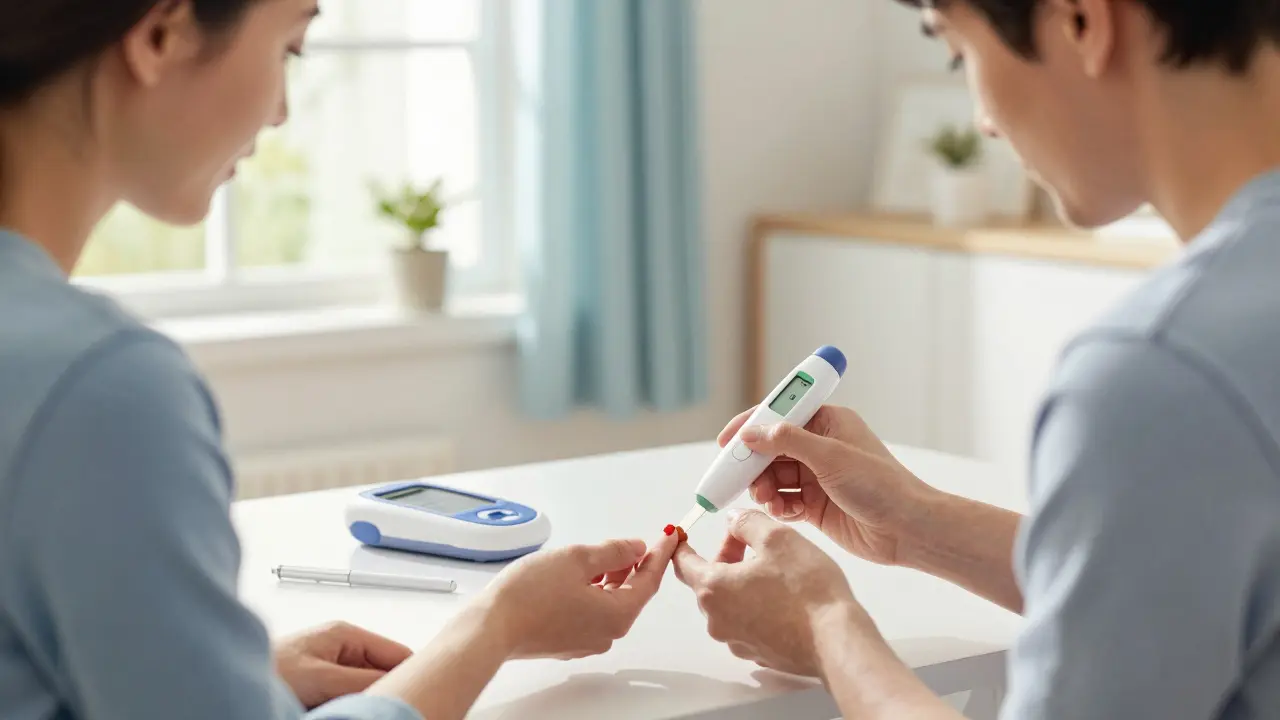
Going to the clinic every week or month is tedious. It takes time off work, involves travel, and often means waiting hours for a simple finger prick. This is why home INR monitoring has become increasingly popular. Devices like the Abbott Cardiovascular Acelis Connected Health system and Roche CoaguChek allow you to test yourself at home using just 10-15 microliters of blood from a finger prick. Results appear in 30-60 seconds, compared to the 24-48 hours it often takes to get lab results.
The benefits are real. Clinical trials show that patients who monitor at home achieve their therapeutic range (Time in Therapeutic Range or TTR) 72% of the time, compared to only 58% for those relying solely on clinic visits. This better control translates to a 34% reduction in thromboembolic events and a 21% drop in major bleeding incidents.
But it is not perfect for everyone. About 25-30% of patients struggle with home testing due to visual impairments, dexterity issues, or cognitive limitations. Some users find the finger-prick technique difficult, wasting test strips if they don't fill the capillary tube correctly. Additionally, while Medicare Part B covers 100% of home INR testing for eligible patients, commercial insurers may require co-pays or prior authorization. Always check your coverage before buying a device.

How to Test Correctly and Interpret Results
If you decide to test at home or go to the lab, consistency is your best friend. The American Heart Association recommends testing at the same time of day, ideally between 8 AM and 12 PM, after fasting for 4-6 hours. Eating large meals, especially those high in Vitamin K (like spinach or kale), can temporarily alter your INR. While you shouldn't avoid these foods entirely, keeping your intake consistent helps stabilize your levels.
When you get your result, interpret it carefully:
- INR < 1.5: Your blood is clotting too quickly. Contact your provider immediately as you are at risk for clots.
- INR 2.0 - 3.0 (or your specific target): You are in the safe zone. Continue your current dose.
- INR > 4.9: Your blood is too thin. Hold your next warfarin dose and contact your healthcare provider within 24 hours. Watch for signs of bleeding like unusual bruising, nosebleeds, or red urine.
Training is essential. Most programs require 2-4 supervised sessions (totaling 120-180 minutes) to teach you proper finger-prick technique, device operation, and how to report results. Don't skip this step. Proper technique ensures accuracy, which is vital since some home devices can show variance from lab results at critical high-INR levels.
Future Trends and AI in Monitoring
Technology is evolving rapidly. In early 2023, the FDA approved smartphone-connected monitors like the Bayer CoaguChek ProConnect, which automatically send results to your doctor with 98.7% accuracy. This eliminates human error in recording numbers. Furthermore, AI-assisted algorithms, such as the INR Advisor platform, are being tested to predict required warfarin dose changes with 83% accuracy. These tools aim to make dosing less of a guessing game and more of a precise science.
Despite the rise of DOACs, the global INR monitoring market is projected to grow to $2.14 billion by 2028. This growth is driven by an aging population and increasing rates of atrial fibrillation. For now, if you are on warfarin, mastering your INR management is non-negotiable. Whether you test at home or in a clinic, staying informed and proactive is the best way to protect your health.
How often should I test my INR?
Frequency depends on your stability. When starting warfarin or changing doses, you may need testing twice weekly. Once stable, guidelines recommend at least once monthly. However, some providers prefer bi-weekly checks. Never stop testing without explicit instruction from your doctor.
Can food affect my INR levels?
Yes, significantly. Vitamin K helps blood clot, so eating large amounts of green leafy vegetables (spinach, kale, broccoli) can lower your INR. Conversely, alcohol and cranberry juice can raise it. The key is consistency-keep your diet steady rather than avoiding healthy foods entirely.
Is home INR testing covered by insurance?
Medicare Part B covers 100% of home INR testing for eligible patients with no deductible. Commercial insurance varies; many plans cover it but may require a physician's order and prior authorization. Some patients face initial claim denials, so always verify coverage with your insurer before purchasing a device.
What should I do if my INR is too high?
If your INR is above 4.9, hold your next warfarin dose and contact your healthcare provider immediately. Watch for signs of bleeding such as unusual bruising, bleeding gums, or dark stools. Do not take extra Vitamin K unless instructed by a doctor, as this can cause your INr to swing too low.
Why is warfarin still used if DOACs are easier?
Warfarin is the only approved blood thinner for patients with mechanical heart valves and those with severe kidney disease. Additionally, it is significantly cheaper ($4/month vs. $550+/month for DOACs), making it accessible for many patients who cannot afford newer alternatives.


Ben Murphy
June 27, 2026 AT 04:52It is frankly disheartening to see the medical community still clinging to warfarin with such fervor when superior alternatives exist. The reliance on this archaic monitoring system speaks volumes about the systemic inertia that plagues modern healthcare. One must question the ethical implications of prescribing a drug that demands such rigorous, invasive compliance from patients who are already managing chronic conditions. It is not merely an inconvenience; it is a form of medical gaslighting where the patient's autonomy is sacrificed at the altar of outdated protocols. The so-called 'therapeutic window' is less a scientific marvel and more a bureaucratic trap designed to keep patients tethered to clinic visits. We should be demanding better, not accepting this substandard care as the norm.
Fred Stone
June 27, 2026 AT 20:28hey man i get what you mean but honestly for some folks like those with mechanical valves there really isnt another option yet. its tough i know but at least we got home testing now which helps a lot. my dad uses the coagu chek and he says its way easier than driving to the lab every week. just gotta be careful with the finger prick though dont wanna waste strips lol