
QT Prolongation Risk Assessment Tool
Understand Your Risk
This tool helps you understand how medications, health conditions, and other factors may impact your QT interval risk. Based on clinical guidelines and research, it provides a personalized risk assessment.
Every year, hundreds of people in the UK and across the world die suddenly from a heart rhythm they never knew they had - all because of a common medication they were prescribed. It’s not a rare accident. It’s a predictable, preventable risk tied to something called QT prolongation.
What QT Prolongation Really Means
Your heart doesn’t just beat randomly. It follows a precise electrical pattern. On an ECG, the QT interval shows how long it takes the lower chambers of your heart (the ventricles) to recharge after each beat. When that interval gets too long - longer than 450 milliseconds in men or 470 in women - it creates a dangerous window where the heart can slip into a chaotic rhythm called Torsades de Pointes. That rhythm can turn into sudden cardiac death in seconds. This isn’t theoretical. In the late 1990s, two popular antihistamines - terfenadine and astemizole - were pulled off shelves after they were linked to dozens of sudden deaths. Since then, over 100 medications have been flagged for the same risk. And it’s not just the old ones. New prescriptions, even for common conditions like depression or infections, can still trigger it.Medications That Carry the Highest Risk
Not all QT-prolonging drugs are equal. Some are far more dangerous than others. Class III antiarrhythmics like dofetilide and sotalol are the most risky. Dofetilide alone causes Torsades in about 3.3% of patients, even when used exactly as directed. Antibiotics like moxifloxacin can push the QT interval up by 6-15 milliseconds - enough to tip someone over the edge if they’re already at risk. Meanwhile, ciprofloxacin barely moves the needle. The difference isn’t just in the drug - it’s in how the body handles it. Antidepressants are another major concern. Citalopram at 40mg daily increases QTc by an average of 8.5 milliseconds. Escitalopram, its close cousin, only adds 4.2. That’s why many doctors now avoid citalopram in older patients or those with heart conditions. Even over-the-counter drugs like certain antihistamines or anti-nausea meds (ondansetron) can be risky when combined with other medications. The real danger isn’t just one drug. It’s the mix. If you’re taking erythromycin - a common antibiotic - and also a drug that blocks the CYP3A4 enzyme (like fluconazole or grapefruit juice), your risk of sudden death jumps fivefold. That’s not a small bump. That’s a red flag.Who’s Most at Risk?
It’s not just about the drug. It’s about the person taking it. Women are more vulnerable than men. Older adults - especially those over 65 - are at higher risk because they often take seven or more medications at once. People with heart disease, especially heart failure or prior heart attacks, face 10 to 100 times greater risk than those with healthy hearts. Low potassium or magnesium levels? That’s another trigger. Bradycardia - a slow heart rate - makes things worse because some drugs prolong the QT more when the heart is already beating slowly. Genetics play a role too. Some people carry hidden mutations that make their hearts more sensitive to QT-prolonging drugs. That’s why two people on the same medication can have wildly different outcomes. One feels fine. The other collapses. And here’s the hard truth: most people who die from drug-induced QT prolongation don’t have a history of heart problems. They’re not on heart meds. They’re not even seeing a cardiologist. They’re just someone who got a prescription for an infection, a migraine, or depression - and didn’t know the hidden cost.
What Clinicians Are Doing About It
Hospitals in the UK and US are starting to wake up. Mayo Clinic introduced an automated ECG alert system in 2015. When a patient’s QTc hits 500ms or more, the system flags it before a high-risk drug is given. Result? A 37% drop in dangerous prescriptions. The MHRA in the UK recommends a simple three-step check before prescribing:- Check the baseline QTc - is it already prolonged?
- Look for electrolyte imbalances - is potassium below 4.0 mEq/L?
- Review all other meds - are there any CYP3A4 inhibitors or other QT-prolonging drugs?
The False Alarm Problem
Not every long QT is dangerous. And not every alert is real. A 2022 study in JAMIA found that 78% of QTc alerts in one hospital were false positives - triggered by noise, poor ECG leads, or normal variations. Residents get so used to ignoring them that they start tuning out entirely. That’s alarm fatigue. And it’s deadly. Some doctors overreact. A 2021 survey of 347 patients on citalopram found that 22% stopped taking it because they were scared of QT prolongation - even though only 3% actually had a QTc over 500ms. That’s a problem too. Stopping an effective antidepressant can lead to relapse, hospitalization, or suicide. The key is balance. Don’t panic over every small change. But don’t ignore clear red flags.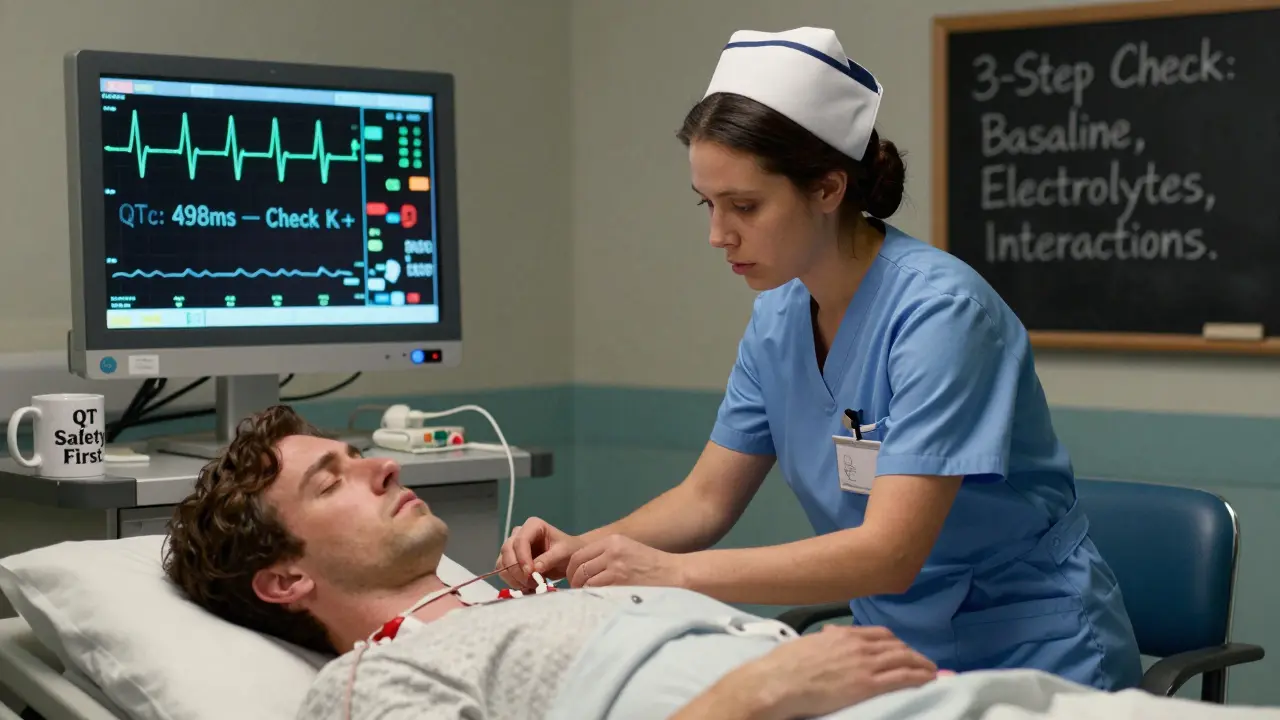
What’s Changing Now
The old way of testing for QT risk - just measuring the interval - is outdated. The FDA’s CiPA initiative, launched in 2013, uses computer models and cell-based tests to predict real-world risk better. It’s now the global standard. New rules from the International Council for Harmonisation (effective December 2023) require drug makers to look at T-wave shape, not just QT length. Why? Because the T-wave’s peak-to-end timing is a stronger predictor of sudden death than the total QT interval. Each 1-standard-deviation increase in that interval raises risk by 21%. Even AI is stepping in. Verily Life Sciences’ QTguard system uses machine learning to cut false alarms by 53%. It doesn’t just look at numbers - it reads the shape of the heartbeat. And in the future, we may be able to test for genetic risk. The NIH’s All of Us program is collecting DNA from a million people to find which gene variants make someone more likely to have a drug-induced arrhythmia. That could one day mean personalized prescriptions - no more guessing.What You Should Do
If you’re on any prescription - especially antidepressants, antibiotics, antifungals, or heart meds - ask these questions:- Is this drug known to affect the QT interval?
- Have I had an ECG recently? What was my QTc?
- Am I taking anything else that could interact with it - even over-the-counter or herbal meds?
- Have my potassium or magnesium levels been checked this year?
Why This Matters More Than You Think
QT prolongation isn’t just a cardiology issue. It’s a systemic problem in how we prescribe medicine. We focus so much on efficacy - does it work? - that we forget safety. Does it kill? The FDA has flagged 142 medications with QT warnings. That’s nearly 9% of all prescriptions. And the cost? Over $2.4 billion in avoidable hospitalizations in the US alone. In the UK, it’s likely similar. We’ve known about this for decades. We have tools to prevent it. But we still don’t use them consistently. The truth is, most of these deaths happen quietly. No warning. No fanfare. Just a person who went to bed fine and didn’t wake up. And it’s often because someone didn’t ask the right questions - or didn’t know to ask at all. You don’t need to be a doctor to protect yourself. Just be curious. Ask. Double-check. Push for a simple ECG if you’re on a new drug and have any risk factors. Because in medicine, the most dangerous thing isn’t the drug. It’s assuming it’s safe - without checking.What is a normal QTc interval?
A normal corrected QT interval (QTc) is under 450 milliseconds for men and under 470 milliseconds for women. Values above 500 ms or an increase of more than 60 ms from baseline are considered high risk for dangerous arrhythmias.
Can over-the-counter drugs cause QT prolongation?
Yes. Some antihistamines (like diphenhydramine), anti-nausea drugs (like ondansetron), and even certain herbal supplements can prolong the QT interval - especially when combined with other medications or in people with existing risk factors.
How do I know if my medication is risky?
Check the AZCERT.org database, which lists over 200 medications by risk level (Known, Possible, Conditional Risk). You can also ask your pharmacist or doctor. If your drug has a black box warning or mentions "QT prolongation" in the leaflet, it’s flagged.
Is QT prolongation reversible?
Yes. Stopping the offending drug and correcting electrolyte imbalances (especially potassium and magnesium) often reverses the prolongation within days. In severe cases, magnesium sulfate is given intravenously to stabilize the heart rhythm.
Should I get an ECG before taking a new medication?
If you’re over 65, have heart disease, take multiple medications, or have a history of fainting or irregular heartbeat, yes. A baseline ECG is a simple, non-invasive way to identify hidden risk before starting a new drug. It’s not always routine - but it should be.
Can stress or exercise trigger sudden death in someone with QT prolongation?
In most cases, no. Drug-induced QT prolongation is usually triggered by bradycardia (slow heart rate), not exercise. But sudden emotional stress or loud noises can sometimes trigger arrhythmias in people with inherited long QT syndrome - a different condition. For drug-induced cases, the biggest trigger is drug interactions or low potassium.



jeremy carroll
December 15, 2025 AT 07:16bro i took citalopram for 2 years and never knew it could do this. my grandma almost died last year from some antibiotic combo and no one told us. scary stuff.
Jocelyn Lachapelle
December 17, 2025 AT 02:19my mom’s on amiodarone and they never checked her QT. she’s 72, on 6 meds, and no one asked if she had low potassium. we got lucky. this should be standard.
Edward Stevens
December 18, 2025 AT 05:44so let me get this straight… we have AI systems that can predict heart death from a single ECG trace, but my primary care doc still prescribes ondansetron to a 78-year-old on fluconazole without blinking? 🤦♂️
Mike Nordby
December 18, 2025 AT 07:45The clinical implications here are profound. The current paradigm of relying solely on QTc interval thresholds is fundamentally inadequate. The CiPA initiative rightly shifts focus to T-wave morphology, which demonstrates superior predictive validity for arrhythmic risk. Furthermore, the prevalence of false-positive alerts-78% in one study-highlights systemic cognitive overload in clinical workflows. This isn’t a failure of technology, but of implementation. We must integrate dynamic risk stratification: genetic susceptibility screening, real-time electrolyte monitoring, and pharmacogenomic decision support. Without these, we’re merely rearranging deck chairs on the Titanic.
Jake Sinatra
December 19, 2025 AT 00:14If you're over 65 or on more than 3 meds, get an ECG before any new prescription. Period. This isn’t optional. It’s basic. The cost is $50. The alternative is a funeral. Stop waiting for a crisis to act. Your life isn’t a gamble.
RONALD Randolph
December 19, 2025 AT 04:08Christina Bischof
December 19, 2025 AT 05:08i just asked my pharmacist about my new antibiotic and she pulled up the azcert database on her phone. said it was possible risk but fine if my potassium’s good. it felt good to ask. small things matter.
John Samuel
December 19, 2025 AT 16:21As a clinician who has witnessed the quiet tragedy of drug-induced torsades, I am compelled to underscore the moral imperative embedded within this discourse. The disparity between available knowledge and clinical practice is not merely a technical gap-it is an ethical chasm. We have tools: automated ECG alerts, CiPA-compliant risk modeling, pharmacogenomic databases, and real-time electrolyte tracking. Yet, in community hospitals, these remain luxuries. The patient who collapses at home after a routine prescription for azithromycin and fluconazole is not a statistical anomaly-they are the consequence of systemic inertia. We must elevate vigilance from an afterthought to a cornerstone of prescribing. A baseline ECG is not a burden-it is a covenant. A potassium level is not a lab result-it is a lifeline. Let us cease to treat safety as an afterthought, and instead, reframe it as the very foundation of medical ethics. The heart does not wait. Neither should we.